Duty Decides the Gauge
On an Anguillian villa the same stone can appear on a pool surround, a shaded loggia, a service path and a driveway apron, and a specifier who orders one thickness for all four has made a structural decision without noticing. Gauge and format follow the load the surface carries, the bedding it sits on and the restraint at its edge. They do not follow the pattern the client liked in a photograph. Anguilla is a limestone island from shore to shore, so none of this is a claim about better rock; what is not produced locally is calibrated, dimension-sawn paving supplied in repeatable lots, gauges and finishes. Get that order of operations right and a stone terrace here will outlive several rounds of furniture.
Four Duties on One Plot
Nearly every villa job here breaks into the same categories, and they are worth marking on the drawing before anything is priced.
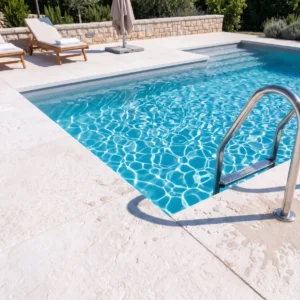
- Pedestrian terrace and pool surround: foot traffic, bare feet, furniture and the occasional service trolley.
- Interior to exterior thresholds: light traffic, but the tightest tolerance on gauge because the finished floor level is already fixed.
- Service and garden paths: light wheeled loads, carts, barrows and the odd narrow machine.
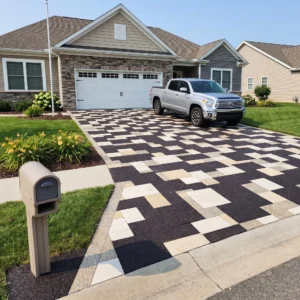
- Driveway, apron and turning ground: vehicle duty, including delivery trucks that will turn on the surface rather than reverse off it.
- Boundary conditions, where paving meets planting, wind-blown sand or unmade ground.
Format and Thickness Are One Decision
A thin unit in a very large format is a different product from a thin unit in a small format, even when the stone and the finish are identical. The wider the piece, the more completely it depends on continuous support beneath it, and the less it forgives a bedding layer that settles unevenly. Narrow the format and the same gauge becomes far more tolerant of imperfection. That is why the honest answer to “how thick?” always begins with “how big, and sitting on what?” Anyone who answers with a single number has not asked enough questions.
Where Large Formats Struggle
Large-format paving reads beautifully across a wide terrace and it is the right answer over a properly formed, fully supported base. It is the wrong answer where vehicles load a flexible bed, where falls change direction sharply, or where the surface is broken up by drains, steps and planters. Every cut into a large unit wastes more material than the same cut into a small one, so a busy plan quietly raises both the cost and the number of vulnerable slivers along the edges. On this island the specification that survives is usually the one built around paving units sized by use rather than around drawing convenience.
Small Units, Setts and Turning Loads
Where wheels turn, small units earn their place. They distribute load through more joints, follow falls without lipping and can be lifted and reset without disturbing a whole field.
- Turning circles and aprons, where steering loads try to shove a large slab sideways.
- Curved edges and radii, which a small unit follows and a large unit has to be cut to fake.
- Falls that change direction, such as a courtyard draining to more than one outlet.
- Zones over buried services, where future access is a certainty rather than a risk.
- Transitions between a vehicle surface and a pedestrian one, which want a change of scale as well as a change of gauge.
The Bedding Decides What the Stone Must Do
Thickness is a conversation about what sits underneath as much as what sits on top. The same unit is generous on one build-up and marginal on another.
- Bonded over a formed concrete base: the stone spans nothing, so gauge is about wear and handling more than strength.
- Laid on a flexible bed over compacted aggregate: the unit works harder, and small formats behave better under wheels.
- Pedestal or raised systems on a roof terrace: the unit is supported only at points, and gauge becomes a genuine structural number.
- Thresholds tied to a fixed floor level, where the build-up depth dictates the gauge you are allowed to want.
Edge Restraint Is Part of the Answer
Paving fails at its edges long before it fails in the field, and the thin, poor soils on this island give an unrestrained perimeter very little to push against. A vehicle surface needs a positive restraint at every free edge, formed as a haunched curb, a bedded edging course or a concrete upstand hidden by planting. Where a driveway meets sand-blown ground, that edge is also the line where wind-carried material begins to migrate into the joints, so it needs to be detailed as a boundary rather than assumed as one.
Agreeing the Specification Early
Because Anguilla’s freight route involves a hub leg and a channel crossing, changing your mind on gauge halfway through a build is expensive in weeks rather than dollars. Fixing the zoning early is the cheapest decision on the job, and comparing gauges within limestone paving in gauged thicknesses is a quick way to see how the options differ before the drawing is issued.
- Zone the plan by duty and mark the vehicle areas explicitly, including where trucks will turn.
- Fix the build-up at every threshold before choosing a gauge anywhere else.
- Order all duties in one consignment so gauges, lots and tones arrive together.
- Allow cutting waste honestly, higher on large formats and on plans full of drains and steps.
- Ask for the available gauge in the exact format and finish you want, rather than assuming it exists.
Specify by duty, order once, and the stone stops being the risky part of the program.