The test nobody runs before buying
Stand on the paving barefoot at two in the afternoon in July. That is the whole test. Everything else is theory. On this island a terrace that fails that test does not get used between eleven and four, which is a large slice of the day to design away, and no amount of furniture fixes it. Tone is the first lever you have, and it is the cheapest one, because you choose it before anything is ordered rather than after.
Why pale stone runs cooler
A pale surface sends more of the sun back and holds less of it. A dark surface takes more in and re-radiates it as heat you feel through your feet and against your shins as you sit. Sitting close to the tropic, the island takes the sun high overhead for much of the year, so horizontal surfaces catch the strongest angle available. The difference between a pale terrace and a dark one is not subtle at midday, and it is felt long after sunset, because a dense dark surface keeps giving heat back into the evening when you actually want to be outside.
Tone is not the only lever
Tone gets the attention, but three other choices matter almost as much, and they cost nothing if you make them early.
- Shade: a pergola, a deep eave or a mature tree beats any material choice ever made.
- Texture: a lightly textured surface breaks up direct glare and feels less harsh than a mirror-flat one.
- Layout: pale paving on the walking routes, planting or gravel on the areas nobody crosses barefoot.
- Wet zones: a splash edge or a rinse line near the pool drops surface temperature immediately.
Glare is the other half of comfort
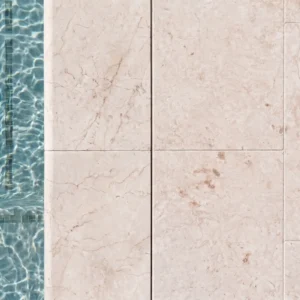
Pale stone can overshoot. On the dry southern coast around Ponce and Guanica, where cloud cover is thinner and light is harder, a large flat expanse of very light paving can be uncomfortable to look at even when it is pleasant to stand on. The fix is texture and break-up rather than a darker stone, because trading down in tone to solve glare buys you a hot floor. This is where light-toned limestone paving stock with a worked surface earns its keep: it scatters light instead of bouncing it in one sheet.
Where heat actually bites
Not every square foot needs the same answer. Spend the tone budget where feet are bare and shade is scarce.
- Pool copings and the first three feet of deck, which are crossed barefoot dozens of times a day.
- Roof terraces and amenity decks in the San Juan metro, fully exposed with nothing above them.
- Outdoor kitchen and dining zones used in the late afternoon, when a dark floor is still discharging heat.
- Entry paths and stairs to the beach at Rincon or Palmas del Mar, where nobody is wearing shoes.
- Pet routes and shaded runs, an easy thing to forget until August.
Finish changes how tone reads
The same stone can look and feel like three different materials depending on how the surface is worked. A brushed or honed surface reads softer and warmer to the eye; a bush-hammered or sandblasted surface reads paler in daylight because the broken microtexture scatters more light, and it grips better when wet. Choosing a finish is therefore a comfort decision, not only a look decision, and it is worth reviewing how each surface finish reads before you settle on tone. A wet sample photograph tells you more than a dry one, every time.
- Honed: smooth and even, warm to the eye, best kept for covered or shaded areas.
- Brushed: a softly worked face that holds tone close to honed while cutting the sheen.
- Sandblasted: an open matte surface that reads a shade lighter under strong daylight.
- Bush-hammered: the most broken of the four, palest in full sun and the least glaring.
What sits under the stone matters too
Heat is a system, not a material. A pale unit bonded tight to a black waterproof membrane on a fully exposed roof deck will still run warm, because the assembly beneath it stores energy through the day. Ventilated or pedestal-set assemblies change that picture, and they also change how the deck answers wind uplift, which is not a small consideration on an island that adopted the 2018 Puerto Rico Building Code and the Residential Code after Maria, with wind design running roughly in the 150 to 200 mph band depending on structure type and risk category.
- Membrane and slab: a dark waterproofing layer banks heat under any tone of stone above it.
- Air gap: pedestal or ventilated build-ups let that heat escape rather than storing it.
- Thickness: heavier units warm more slowly, then hold their warmth longer into the evening.
- Restraint and fixing: an engineer’s call on an exposed deck, and the hardest item to revisit.
Talk to your engineer about restraint and fixing before you talk to anyone about tone.
Try it in your own courtyard
Island light is specific, and no screen reproduces it. Put a small sample down in the exact spot, in the exact orientation, and leave it there for a fortnight. Check it barefoot at midday, look at it against your wall color at five, and hose it down to see how it reads wet. Samples are small pieces meant for exactly this, not full pallets. The terrace you will actually use is the one you tested with your own feet.