The Island Is Limestone
There is no polite way to sell limestone into Anguilla without acknowledging the obvious: the island itself is limestone. Reef limestone of Oligocene, Miocene and Pliocene age covers effectively the whole landmass, laid over the deeper volcanic rock of the island arc, with only two small outcrops of tilted tuffs and basalt breaking the pattern. The Anguilla Formation is a named geologic unit, and it carries fossils from a warm shallow sea that existed here roughly twelve to twenty million years ago.
So anyone writing that imported limestone is somehow unlike what Anguilla already has is simply wrong about the ground under their feet. The real question is a different one.
What the Rock Cap Actually Is
The limestone that makes up Anguilla is a reef cap under thin, poor soil. It is the reason the island is flat, dry and open, with no rivers and with Crocus Hill topping out at 240 feet. It is also the material behind generations of local walls and dressed openings, which is part of the island’s built character and deserves respect rather than comparison.
- Reef limestone, formed in place, variable in structure across short distances
- Overlying volcanic arc rock that surfaces only in two small outcrops
- Thin soils, which is why the island reads as low, open and bright
- A long local tradition of building with what the ground provided
What Is Not Produced Here
The gap is industrial, not geological. Anguilla has no commercial dimension-stone operation turning out sawn, gauged paving in graded and repeatable lots. That is a supply-chain fact about processing capacity, not a judgment about rock. Calibrated paving needs block extraction, sawing lines, calibration, sorting, grading and packing, and those are the pieces a project imports. It is also why gauged paving lots for villa work are ordered by thickness tolerance and finish rather than picked by eye.
- Consistent thickness so a large terrace lays flat without constant packing
- Graded color and vein sorting across several hundred square feet
- Repeatable formats that let a pattern be drawn before delivery
- Reorder capability when a second phase follows eighteen months later
- Documented absorption, density and finish for the actual lot supplied
None of those five things is a property of the rock. They are properties of a processing chain, and they are exactly what an architect needs when a terrace has to be drawn, priced and laid to a fixed date.
Designing the Two Together
The schemes that work best do not choose. They let rough local walling do what it has always done, and let sawn imported units handle flat work that has to be dead level, dimensionally predictable and comfortable underfoot.
- Local rough stone for boundary walls, planters and retaining faces
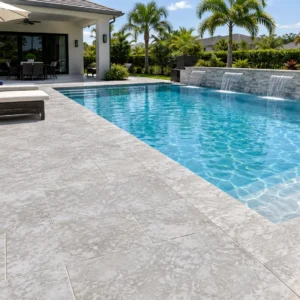
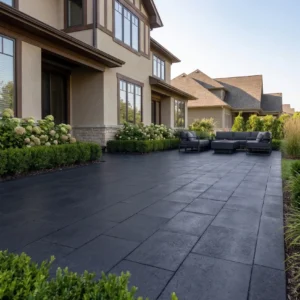
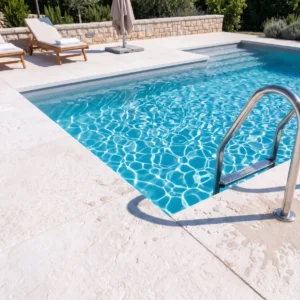
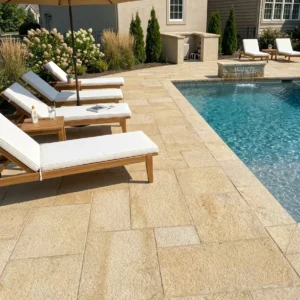
- Sawn imported units for terraces, pool surrounds and covered circulation
- A shared tonal family so the two read as one palette in the same light
- Deliberate junctions, where the change of texture is designed and not hidden
Supply Rhythm on a Small Island
Anguilla is an ultra-luxury villa and boutique resort market with a population near sixteen thousand, so quantities are modest and timing is everything. Named schemes such as Beach Enclave at Rendezvous Bay, the Salina Estate villas and the cliff-top villas of Ani Private Resorts above Little Bay are the scale of work in question: small, exacting and unforgiving of a wrong lot. Getting the right material in the right week is worth more than a discount, and our supply route to Anguilla is planned around that reality.
Landing the Consignment
Cargo generally reaches the island on a feeder leg into Road Bay at Sandy Ground after a hub call at Port St. Maarten, so crates are handled twice and packing quality shows up as breakage or the absence of it.
- Commercial consignments clear through Anguilla Customs on ASYCUDA World
- A registered broker normally prepares and submits the declaration
- Duty is charged ad valorem on CIF value under Anguilla’s own tariff
- Since 1 August 2025 a 9% Import Goods Tax applies to the CIF value of imports
- Confirm the current duty rate for your stone classification with your broker
Prices on this island are usually discussed in US dollars even though the Eastern Caribbean dollar is the official currency, so agree early which figure a budget line refers to and whether it is landed or ex-quay.
A Note on Local Sourcing
Sand and aggregate deserve care in any Anguillian conversation. The beaches are the island’s central asset and its livelihood, and nothing in a paving specification should read as an argument for drawing material from them. Bedding sand, jointing material and base aggregate are procurement questions for your contractor, and they belong inside the island’s land development regime and the guidance of the planning authorities rather than being settled by convenience.
A Complement, Not a Replacement
Imported paving earns its place here for one honest reason: processing and repeatability, delivered to a schedule. It does not out-perform the ground Anguilla is made of, and it should never be sold that way. Used well it sits quietly beside local walling and lets each material do the job it is genuinely good at. Owners here can tell the difference between a supplier who understands that and one reading from a script written for somewhere else, so the framing matters as much as the stone. The right frame is partnership between two limestones, not competition.