The Island Is Limestone
Start from the honest position. The Turks and Caicos Islands sit on a limestone platform, and that limestone is not a background detail. It is the ground under the road, the reef offshore, the sand on the beach and the rubble in the oldest walls standing on Providenciales. Any conversation about importing stone here has to begin by acknowledging that the islands already have their own, and that it does specific jobs extremely well.
What it does not do is serve as a finished wearing surface. That distinction is the whole story, and it is worth setting out plainly rather than glossing over it.
What the Ground Here Can and Cannot Do
Local material is worked and sold across the islands, and it has real uses on almost every site.
- Construction sand is readily available locally and sold by the cubic yard or by the dump-truck load.
- The locally sourced white sand has weaker properties than the imported black sand used in structural work.
- Local gravel exists as a by-product of limestone screening; it is soft and is not recommended for concrete.
- Screened topsoil is local and priced by the truck load, with availability driving the number.
- The island limestone is soft, so it is used as fill and screening rather than as a wearing surface.
Almost Everything Else Arrives by Boat
The second honest position is that this is already an import economy for building, and has been for a long time.
- Quality aggregates, including pea gravel and concrete gravel, are brought in rather than dug locally.
- Concrete blocks arrive predominantly from the Dominican Republic.
- Lumber, steel, windows, doors and every specialty product come across the water.
- South Dock on Providenciales is the primary cargo entry point and the distribution hub for the outer islands.
The Short Step From Block to Stone
Here is the argument that matters, and it is structural rather than promotional. In most markets, natural stone competes against a locally made concrete product with a short, cheap supply chain. In TCI the block, the good aggregate and the lumber are all imported anyway. That means the marginal step up from imported block and concrete to imported natural stone is smaller here than in almost any other market. You are not adding a freight leg; you are changing what sits on the pallet. Compare that against the cut limestone as the wearing surface and the arithmetic often surprises owners.
A Sensible Division of Work on Site
The two materials are not rivals. On a well-planned villa they do different jobs and never meet in the same layer.
- Local sand and screened material go into fill, sub-base shaping and landscape work.
- Imported aggregate and reinforcement go into the slab and the structural build-up.
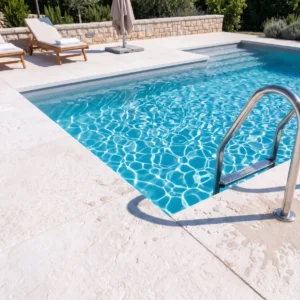
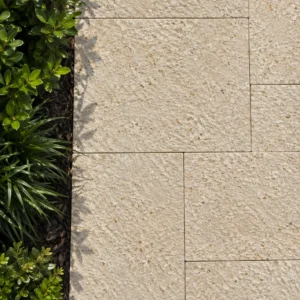
- Imported dimension stone goes on top as the surface people walk on and look at.
- Local rubble and boulders suit garden walls, planters and informal edges where wear is low.
Heritage Fabric Deserves Distance
Limestone rubble was the historic building material across these islands, and the surviving structures are not decorative scenery. Cheshire Hall Plantation on Providenciales stands as ruins of a late-eighteenth-century cotton plantation, with a great house, a cotton-press base, a kitchen, a cistern and a well. It is held and interpreted by the Turks and Caicos National Trust, along with the salt salinas of Grand Turk, Salt Cay and South Caicos.
These are sites with a difficult history and they are managed as heritage, not as a quarry or a design reference to be borrowed casually. The correct posture on a modern project is distance and respect: build new work in new material, and leave the historic fabric to the people charged with conserving it.
Duty, Brokers and Landed Cost
Because the case rests on landed cost, get the landed cost right rather than guessing at it. The islands are a British Overseas Territory using the United States dollar, but they are not United States customs territory, so nothing enters duty free on the strength of the currency. There is no general sales tax and no value added tax, which is genuinely unusual in this region, but duty is charged on the CIF value and it funds a large share of government revenue.
- Building materials attract a reduced duty rate with a Customs Processing Fee on top; confirm the rate and HS classification for your product using TCI Customs’ Tariff Finder.
- A licensed customs broker is not legally required but is officially recommended for declaration and clearance.
- Declarations run through ASYCUDA World using the SAD, with invoice, manifest and any permits attached.
- The islands are an associate member of CARICOM rather than a full member, so confirm the applicable tariff treatment with TCI Customs rather than assuming a regional rate table.
Full logistics detail sits on the sourcing help for Provo projects page, including outer-island barge legs.
Specifying the Two Together
Write the specification so the local and the imported material each have a defined role, a defined tolerance and a defined supplier. That single act prevents the common site argument in which soft screened gravel finds its way into a bedding layer it was never meant for, or an owner pays freight on material that could have been dug half a mile away. The island’s own limestone is the landscape and the heritage fabric, and imported dimension stone is simply the finished surface laid on top of it.