What the island’s quarries actually produce
Drive the northern karst belt, past the mogotes, and you are looking at limestone country. Operations here work it hard and work it well: crushed aggregate, sand, road base and cement feedstock, the materials that build a reinforced-concrete island. That output is not a lesser version of paving. It is a different product with a different job, made to a different set of tolerances, and every terrace on this island sits on top of it in one form or another. Any conversation about imported stone that starts by talking down local quarrying has already lost the plot.
The gap is calibration, not quality
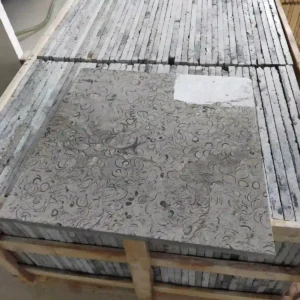
What no local operation runs is a dimension-stone line: blocks sawn into slabs, slabs cut into units of a repeatable size, thickness held to a tolerance across a whole order, and a surface finished to a named specification with test data behind it. That is a different factory, not a better rock. When an architect in Santurce specifies a 3 cm exterior unit at a stated finish and expects the tenth pallet to match the first, calibration is the requirement, and calibration is what arrives in a container rather than out of a crusher.
- Blocks sawn into slabs, then cut to a repeatable unit size across an entire order.
- Thickness held to a stated tolerance, so bedding depth does not change unit to unit.
- A named finish applied consistently, with a wet reference sample as well as a dry one.
- Absorption and density data tied to the exact material and finish being supplied.
The adoquin question
Somebody will raise Old San Juan. The famous blue adoquines are worth being accurate about: they were cast from iron-furnace slag carried as ship ballast from the sixteenth century onward and laid through the eighteen hundreds. They are not natural stone and they are not cobblestone, so they are not a precedent for either. What they genuinely are is the island’s paving memory, the reason a Puerto Rican client already has strong opinions about joint width, unit scale and how a paved surface should sound underfoot. Respect that instinct; do not misquote its geology.
One drawing, two supply chains
On a well-detailed project the local and imported materials appear in the same section, stacked in order.
- Subgrade and compacted base: local crushed aggregate, specified by grading, bought by the truck.
- Structural slab or screed: local cement, sand and aggregate, placed by the same crew that pours everything else on the island.
- Bedding: local sand or a mortar bed batched from local materials.
- Wearing surface: imported calibrated units, ordered by size, thickness and finish, delivered on marked pallets.
- Edge restraint and conten: whichever material the drawing calls for, provided the two meet cleanly at the joint.
Why that split saves money
The heaviest, cheapest, most volume-hungry part of a paved area is the part below the surface, and shipping mass across water is the expensive part of any import. Buying base and bedding locally and importing only the visible layer is not a compromise; it is the arrangement that keeps the budget sane. It is also why dimension limestone cut to size is ordered against a takeoff rather than by guesswork, because every extra square foot on the pallet is freight you paid for and IVU you declared.
- Base and bedding bought locally, by the truck, with no water crossing in the price.
- Only the visible layer imported, ordered against a measured takeoff rather than a guess.
- Thickness matched to actual use, since surplus mass is freight weight you pay for twice.
- Offcuts planned into steps, borders and thresholds instead of written off on site.
What the landed number includes
Because the island sits inside US customs territory, mainland stone arrives as a domestic shipment with no federal duty line. Jones Act carriage on US-flag, US-built and US-crewed vessels lifts the freight rate but delivers frequent scheduled sailings from Jacksonville and Port Everglades into San Juan. IVU sales and use tax then applies at 11.5 percent, being 10.5 percent state and 1 percent municipal, on total landed cost including freight and insurance, declared electronically through Hacienda and the SURI portal, with use tax due at filing unless a bond is in place. Confirm the current rate and your filing route with your accountant, and if the job is on Vieques or Culebra, add the barge leg from Ceiba to the schedule as well as the budget.
How to brief a local contractor
Crews here are excellent at concrete and comfortable with tile. Imported dimension stone sits between the two, so the briefing is short but specific.
- State the unit thickness and confirm the bedding method to suit it, rather than defaulting to a tile build-up.
- Agree joint width in writing before the first course goes down, because it drives the material takeoff.
- Ask for pallets to be opened and blended across the area so any natural variation reads as intention.
- Set a protection plan for the surface while other trades are still working overhead.
Getting the two halves quoted
Price the local half locally and the imported half against a takeoff, then compare the total against the life you expect from the surface. Guidance on sizes, thicknesses and finishes sits across our stone supply across Puerto Rico pages, and small samples travel ahead of any order so a client can hold the material before signing. Local quarries build the island and imported dimension stone finishes it, which is exactly how a good detail should read.