Two Products, One Pavement
There is a habit in imported-materials marketing of pretending the destination has nothing. It is a bad habit anywhere and a plainly false one in Antigua and Barbuda, where limestone, clay, barite, volcanic stone and a little salt are all quarried, and where the material under most roads and yards came out of the ground on the island. The accurate description of a stone terrace here is a two-supplier pavement: the structure below is local, the wearing surface above is imported, and each layer is doing the job it is genuinely best at.
What the Island Quarries Actually Make
Burma Quarry produces subbase and base materials. Bendals Quarry produces crushed stone for road finished surfaces. Both are aggregate and roadstone operations, which is exactly what a construction market needs in volume and exactly what should never be freighted across an ocean. The island of Antigua has real geological variety behind that output: a Basal Volcanic Suite in the mountainous southwest, the mixed Central Plain Group running from St John’s to the southeast, and the fossil-rich Antigua Formation limestone of the northeast that forms Devil’s Bridge. Barbuda is a low coral-limestone island of an entirely different character. None of that production is calibrated dimension paving, and none of it is trying to be.
The Base Course Comes From Here
Everything below the bedding layer should be sourced locally, and the reasons are commercial rather than sentimental.
- Aggregate is heavy and cheap, so freight would cost more than the material itself.
- Local base material is available in the volumes a driveway or terrace actually needs.
- Island contractors know how it compacts and how it drains after a heavy downpour.
- Short haul distances keep the job moving when a delivery slips by a day.
There is a second reason, less often stated. A base course has to behave the way the ground behaves, and locally won material has already proved itself against local soils, local rainfall patterns and the short intense downpours that define the wet season on a dry island.
The Wearing Surface Comes By Sea
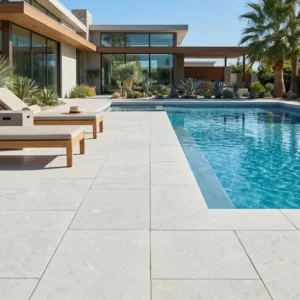
The top layer is a different product with different demands: consistent thickness so the laying gang is not shimming every unit, repeatable sizes so a pattern closes properly, a controlled finish for grip, and a pore structure tight enough to keep salt out. Those are dimension-stone disciplines, and they are why imported wearing courses in cut stone land here rather than being cut on the island. The freight side is genuinely convenient: Deep Water Harbour at St John’s takes direct sailings from the Port of Palm Beach, with no wait for a feeder from a hub elsewhere in the region.
Making the Two Layers Agree
Most failures at this interface come from treating the layers as two separate contracts rather than as one build-up with two suppliers. The paving takes the blame because it is the part you can see, but the fault is usually a few inches lower down.
- Match bedding depth to the actual paver thickness, not a default figure from a manual.
- Confirm the local aggregate grading suits the bedding method you have chosen.
- Check that the base drains, since standing water beneath a unit drives salt up into it.
- Set out levels for both layers together so falls toward a cistern inlet survive to the surface.
- Use non-ferrous fixings throughout on coastal work, whatever the layer beneath is made of.
The Cost Logic of a Split Supply
Splitting the supply is the cheapest honest way to build a good pavement on these islands.
- The heavy tonnage travels a few miles instead of a few thousand.
- Import charges fall only on the thin, high-value layer that has to be imported.
- Duty follows the CARICOM Common External Tariff, and stone from outside the region pays the full rate.
- Sales tax has stood at seventeen percent since 1 January 2024, on landed value plus duty and charges.
Run the arithmetic on the whole build-up rather than on a square-foot rate for the paving alone. A client comparing two quotations often finds the difference sits in the base, the bedding and the handling, not in the stone that gets photographed.
An Ordering Sequence That Avoids Storage
Storage is the hidden cost on a small island, so sequence the two supplies instead of stacking both on site. Order the paving early enough to suit the sailing and the clearance, then time the base and bedding delivery to the week the gang starts laying. Ask about supply and delivery into St John’s at the same time you price the aggregate.
- Confirm the sailing before you confirm the laying dates.
- Appoint the broker early, not in the week the container arrives.
- Keep a small overage of paving on site for cuts and for later repairs.
- For Barbuda, price the small-vessel leg to River Wharf as its own line item.
A Pavement With Two Passports
The finished terrace is a collaboration, and describing it that way is far more useful to a client than any claim of imported superiority. Local quarries supply the mass, the structure and the drainage, delivered in hours rather than weeks. Imported stone supplies the calibrated, graded, finished surface that people walk on and look at every day. Neither replaces the other, and a specifier who understands both layers writes a better drawing and a leaner budget. Get the layers right and the pavement will outlast every argument about where the stone came from.