One Island, Several Climates
Saint Lucia is small enough to drive across in a morning and varied enough that a single specification rarely fits a whole property. The Atlantic side takes driven rain and salt on the wind. The Caribbean side is calmer but holds damp in shaded corners. The interior is steep, wet and green, with runoff arriving from above. A villa at Cap Estate, a hillside terrace above Soufriere and a service yard at Vieux Fort are three different jobs, and the honest way to choose material is to divide the site into zones before naming any stone at all.
What Each Material Is Good At
Both are natural stone and both perform outdoors. They simply lean in different directions.
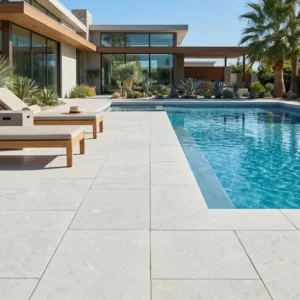
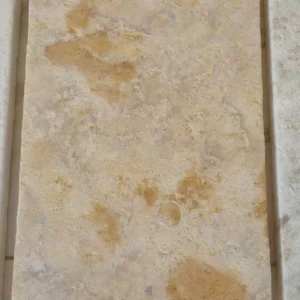
- Limestone reads pale and warm, runs cooler underfoot in strong sun and suits terraces, pool surrounds and interiors.
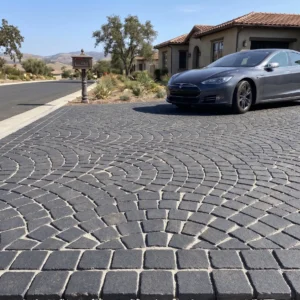
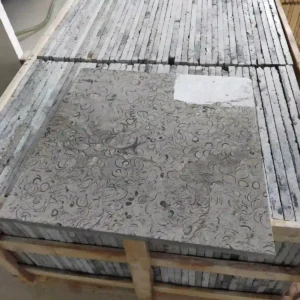
- Basalt reads dark and even, hides tire marks and general grime, and takes hard mechanical wear well.
- Limestone is generally easier to work and to cut on site for awkward junctions and curves.
- Basalt tends to be denser, which helps where vehicles turn, brake or stand loaded.
- Both accept textured finishes, so grip is a finish decision rather than a material decision.
Windward Frontage and Salt Air
On the Atlantic coast toward Dennery and Micoud, salt spray and wind-driven rain arrive together, and detailing counts as much as stone selection.
- Density and low porosity matter whichever material you choose, since a tight surface gives salt less room to work.
- Generous falls keep salt-laden water moving off the surface instead of sitting on it.
- Permeable joints and sound edge restraint stop water from working underneath the units.
- A fresh water washdown routine belongs in the handover notes, not in an optional appendix.
Leeward Shade and Standing Damp
Around Castries, Gros Islet, Rodney Bay and Marigot Bay, the sea is gentler and the issue becomes hours of dampness rather than salt load. Shaded terraces and paths under planting grow a biological film that darkens a surface and quietly costs grip. Pale limestone shows the greening earlier, which is arguably an advantage since it prompts a wash before the surface gets slick. Darker basalt hides it longer, so put the cleaning schedule in writing rather than relying on the surface to tell you when it needs attention.
Layout helps as much as material in these positions. Opening a shaded route to air movement, keeping planting trimmed back from the paving edge and making sure water clears rather than sitting will all extend the life of a finish. Where a path genuinely cannot be opened up, choose a textured face with depth to spare, because that surface will be doing its work with a film on it for part of every year.
Slope, Runoff and Water Volume
The Saint Lucian design driver is water, not wind, and Hurricane Tomas on 30 October 2010 is why every experienced builder here starts with drainage.
- The storm delivered up to 668 mm of rain in roughly 23 hours as a Category 2 system.
- Damage and loss ran near 43.4 percent of that year’s GDP for the country.
- Most destruction came from landslides that cut roads and washed away river banks.
- On sloping ground the build-up beneath the paving matters more than the stone above it.
Driveways, Yards and Vehicle Loads
Where vehicles turn and stand, the argument shifts toward mass and thickness. Dark, dense units cope well with tire scuff, dropped oil and the point loading of a turning wheel, and they keep looking presentable between washes. That is the case for basalt in the harder-worked areas of a property, with the paler material saved for the parts people walk on barefoot. Many good schemes use both, with a clear line where the transition happens.
Make that line deliberate. A transition that lands at a threshold, a change of level or the edge of a planting bed reads as design; one that lands halfway across an open area reads as a mistake or a budget cut. Match thicknesses where the two materials share a bedding layer, keep joint widths consistent across the change, and the switch will look intentional from the first day.
A Simple Zoning Method
Walk the site with a plan and mark five things before choosing anything.
- Salt exposure, judged by how much open water and prevailing wind the frontage actually sees.
- Sun hours, since heat underfoot decides comfort on any barefoot surface.
- Water path, meaning what drains onto the area from above and where it leaves.
- Traffic type, separating barefoot zones, shoe traffic and vehicle loading.
- Visibility, because some areas need to look immaculate and others only need to work.
Pricing and Landing the Order
Once zones are mapped, quoting is straightforward: each zone gets a format, a thickness and a finish, and the quantities follow. Freight comes in directly through SLASPA’s ports, with Castries taking most containers from a congested ten-acre site and Vieux Fort serving southern projects near Hewanorra and the free zone. Landed cost should include VAT at 12.5 percent, the 6 percent service charge and the 2.5 percent Health and Citizen Security Levy, with the tariff line confirmed through the customs duty calculator. For the barefoot and terrace zones, the limestone side of the specification is usually where the conversation starts. Zone the site first and the limestone or basalt question answers itself.