The condition you are actually finishing for
Interior floors here live under conditions a showroom never simulates. Doors stay open, so the room sits at the same humidity as the garden. Feet arrive wet from the pool, the sea, or the rain that blew through the gallery. Fine sand comes in on those feet and behaves like grit paper underfoot. The air holds moisture around the clock, so nothing ever dries the way it would in a temperate interior.
Finish choice is a response to that list, not a matter of taste alone. Get it right and the floor forgives everything. Get it wrong and you will be apologizing for it for years.
Honed: the sensible island default
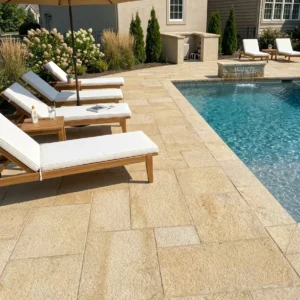
A honed surface is ground flat and left matte. It gives limestone an even, quiet tone, it takes a wet foot without turning glassy, and it cleans with a mop rather than a scrubbing routine. For interiors on the sheltered west and south coasts, honed is where most projects should start. Fine sand still scratches any calcareous stone, but on a matte surface those scratches read as patina instead of standing out the way they do on gloss. Buyers who ask us about honed limestone tile surfaces are almost always solving this exact problem.
Brushed and lightly textured surfaces
Brushing runs abrasive heads across the stone until softer material is worn back and the face takes on a gentle undulation. The result is grip you can feel with no sharp profile to punish bare skin.
- More underfoot confidence than honed once water is present, without the harshness of a flamed or bush-hammered face.
- Hides tracked-in sand and light traffic marks, which matters on the route from the pool deck to the house.
- Still mops clean, although a soft brush head beats a flat mop inside the texture.
- Reads slightly deeper in tone than the same stone honed, because the texture holds small shadows.
Tumbled and split faces
Tumbled stone has its edges and face knocked back until it looks worn in, which sits comfortably beside older coral-stone walls and rendered masonry. Split and riven faces go further and belong outdoors or in transition bays rather than in main rooms. The trade is maintenance: the deeper the texture, the more places sand and salt find to sit, and the more the cleaning routine matters. On the Atlantic side, where airborne sand is constant, that trade deserves real thought before a whole floor commits to heavy texture. A useful compromise is to keep the worn look for entrance bays, galleries and secondary rooms, and hold a flatter surface for the spaces where people sit for hours with bare feet on the floor.
Polished, and why it rarely survives here
Polished limestone looks superb on the day it is laid. Then bare wet feet arrive, sand comes in behind them, and the surface that made the stone glow becomes the surface that records every step. Gloss also amplifies the glare already bouncing off the water. In practice, polished limestone belongs on vertical work and small interior areas kept well away from the doors, never on an open floor that connects to a veranda.
Thresholds and transition zones
The band where outside becomes inside carries the hardest duty in the house.
- Step the texture up in the threshold bay so water is shed before it reaches the smoother interior field.
- Keep tone consistent even when the finish changes, so the eye reads one floor rather than a patch.
- Allow a mat well or a run of coarser stone where the pool route enters, to catch sand at the door.
- Make the finish change land on a joint line, never mid-tile, or the transition will always look accidental.
Testing finishes before you order
Samples are small, so use them precisely rather than hopefully.
- Wet each sample and stand on it barefoot, in the room it is meant for, at the hour you actually use that room.
- Scatter a little beach sand on a wet sample and scuff it, then rinse and study what remains.
- Leave one sample outside for two weeks on the exposed side of the house and compare it against an untouched twin.
- Put a drop of your usual cleaner on a hidden corner and watch for any change in sheen.
If you want to see how each surface is produced before choosing, our reference on how natural stone finishes differ walks through the milling and texturing steps in order.
What to write on the order
Vague finish language is where disputes start. Name the finish, name the approved sample, and say what you expect the edges to do.
- State the finish by name and reference the approved sample by number, not by a photograph.
- Confirm whether edges are sawn square or eased, since a wet barefoot floor prefers a slight ease.
- Ask for one batch, or ask to be told plainly that the order will span more than one.
- Agree in writing how much tonal variation is acceptable, before production starts.
A finish chosen against your own conditions still looks right in ten years, and one chosen from a photograph seldom does.