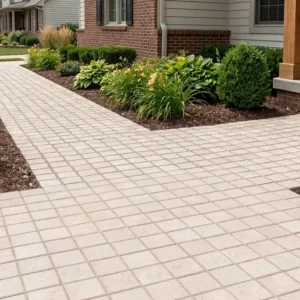
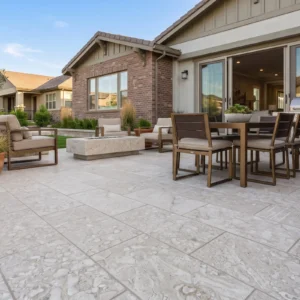
Limestone driveway paving punishes poor specification decisions faster than almost any other residential hardscape application — the combination of vehicle point loads, drainage demands, and seasonal temperature cycling exposes every weakness in material selection and base design within the first two winters. What separates a 25-year installation from one that needs remediation in year seven isn’t the stone itself; it’s whether you matched the right limestone density, thickness, and jointing system to the actual conditions your driveway faces. The questions experts ask before specifying this material go well beyond aesthetics, and that’s exactly what this article works through.
What Makes Limestone a Serious Driveway Candidate
Limestone’s appeal for driveway use isn’t accidental — it’s a material that occupies a genuine performance sweet spot when correctly specified. Dense, hard limestone variants deliver compressive strength in the 8,000–15,000 PSI range, which comfortably handles standard passenger vehicle loads and most light commercial traffic. The material’s natural calcium carbonate matrix also responds well to cutting and finishing, allowing you to achieve tight dimensional tolerances that keep joint widths consistent and predictable across an entire driveway run.
What often gets overlooked is limestone’s thermal mass behavior. The stone absorbs heat slowly and releases it gradually, which moderates surface temperature spikes that cause rapid joint sand degradation in exposed driveways. That said, thermal mass is a double-edged consideration — in freeze-thaw regions, a denser stone with lower absorption rates performs significantly better than a porous variety that draws moisture into its structure before temperatures drop. According to Natural Stone Institute limestone technical specifications, absorption rates across limestone varieties vary from under 3% to over 12% by weight — a difference that directly determines freeze-thaw suitability.
- Compressive strength ranges from 8,000 PSI (softer oolitic varieties) to 15,000+ PSI (dense crystalline limestone)
- Absorption rate is the single most important freeze-thaw selection criterion
- Surface finish affects both slip resistance and long-term wear rate under tire contact
- Dimensional consistency determines joint stability and the overall flatness of the finished driveway
Limestone Pavers Driveway: Thickness and Load Capacity
Thickness specification is where most residential limestone driveway projects get underdone. A 1.25-inch paver that works perfectly on a garden path will flex and crack under vehicle loads — you need a minimum of 2 inches nominal thickness for passenger vehicles, and 2.75–3 inches if the driveway accommodates delivery trucks or SUVs with loaded trailers. The thickness-to-span ratio matters as much as compressive strength: even a high-PSI limestone will fracture if it’s bridging a soft spot in the base without adequate cross-sectional depth to distribute the load.
For limestone pavers driveway applications, the base system carries equal weight in this equation. A 6-inch compacted aggregate base is a reasonable starting point on stable, well-draining soils. In clay-heavy ground or soils with seasonal moisture movement, extending that to 8–10 inches of graded base — with a geotextile separator fabric between native soil and aggregate — makes a measurable long-term difference. The pavers are only as stable as what’s beneath them, and that truth becomes obvious after the first hard freeze-thaw cycle in a poorly prepared installation.
- 2-inch minimum thickness for passenger vehicle driveways
- 2.75–3-inch thickness where truck or loaded trailer access is expected
- 6-inch compacted aggregate base minimum on stable, well-draining soils
- 8–10-inch base recommended in clay-heavy or high-moisture-movement soils
- Geotextile fabric between native soil and aggregate prevents base contamination over time
Freeze-Thaw Performance and Thermal Cycling
Temperature cycling is where limestone driveway paving reveals the most meaningful performance differences between stone varieties. It’s not the cold temperature itself that damages stone — it’s the repeated expansion and contraction as water moves in and out of the pore structure across dozens or hundreds of freeze-thaw cycles per season. A limestone with 8% absorption by weight can take on enough moisture to generate internal pressures well above its tensile strength when that water freezes. Over three or four seasons, that translates to spalling, surface delamination, and joint instability.
Dense limestone varieties — particularly those with absorption rates below 3% — handle freeze-thaw cycling reliably because they simply don’t accumulate enough moisture to create destructive internal pressures. The USGS data on limestone composition and construction applications confirms that density and crystalline matrix tightness are the geological factors that most strongly correlate with freeze-thaw durability. For driveways in regions with significant temperature swings, specifying a low-absorption, high-density limestone isn’t a premium upgrade — it’s a baseline requirement.
Thermal expansion also affects joint design. Limestone expands at approximately 4.4–5.0 × 10⁻⁶ per °F, which means a 20-foot driveway run will experience roughly 0.13 inches of cumulative thermal movement across a 60°F temperature differential. Your joint spacing and filler material need to accommodate that movement without locking the pavers rigidly together. Polymeric sand handles this better than cement-based jointing in most limestone paving driveway applications because it maintains flexibility through repeated thermal cycles without cracking.
Surface Finish, Traction, and Wear
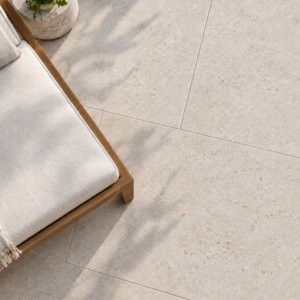
The finish you specify on limestone driveway paving has direct consequences for both safety and longevity. A honed or polished finish looks exceptional in product photos but becomes genuinely slippery when wet — a serious liability on a driveway where you’re stepping out of a vehicle. The practical finishes for driveways are sawn, bush-hammered, or sandblasted: these create enough surface texture to achieve a static coefficient of friction above 0.60, which is the threshold most professionals use as a minimum for vehicular and pedestrian safety.
Sawn-finish limestone strikes the best balance for most limestone paving driveway applications — it’s flat enough to seat pavers precisely, textured enough for safe footing, and it wears evenly under tire contact rather than developing polished tracks. Bush-hammered finishes offer more aggressive grip but accelerate surface weathering slightly faster. You’ll want to factor in your maintenance cycle when making that call: a sawn finish with biennial penetrating sealer maintenance will outperform a bush-hammered surface left unsealed in terms of long-term appearance retention.
- Sawn finish: best balance of flatness, grip, and wear resistance for driveways
- Bush-hammered: maximum grip but slightly faster surface weathering
- Honed or polished: unsuitable for driveways — wet-surface slip risk is unacceptable
- Minimum wet DCOF of 0.42 per ANSI A326.3 for vehicular and pedestrian driveway surfaces
- Biennial penetrating sealer application extends surface life and maintains consistent appearance
Drainage Design and Joint Management
Drainage is the detail that determines whether limestone driveway paving survives long-term or gradually undermines itself. Standing water beneath pavers saturates the base, promotes differential settlement, and — in freeze-thaw climates — creates the moisture reservoir that causes heave and surface damage. A 1–2% cross-fall gradient away from structures is the standard starting point, but the critical detail is ensuring that gradient is built into the compacted base, not just the finished paver surface. Trying to create drainage slope with varying bedding sand depth is a shortcut that fails within a few seasons.
Joint width matters more than most specifiers acknowledge. A 3–5mm joint filled with quality polymeric sand allows minor differential movement without cracking individual pavers, keeps weed growth suppressed, and provides a maintenance path for re-sanding as needed. Tighter joints — particularly dry-laid limestone in contact — look cleaner initially but leave no tolerance for thermal movement, and the first significant temperature cycle can cause edge chipping as adjacent pavers push against each other. Give the stone room to move and it’ll stay put; pin it rigidly and it’ll find its own way to relieve the stress.
Is Limestone Worth It? The Honest Trade-Offs
Limestone driveway paving sits at a higher initial cost than concrete pavers and most asphalt options — that’s a straightforward reality. You’re looking at material costs of $15–$35 per square foot depending on origin, thickness, and finish, plus base and installation costs that typically run $10–$20 per square foot on top. For a standard two-car driveway of 400–600 square feet, that’s a meaningful investment. The question experts actually ask is whether the total-cost-over-time calculation justifies it, and for most premium residential applications, it does — provided the specification is done correctly from the start.
Concrete pavers require little maintenance but look manufactured. Asphalt is economical but typically needs resurfacing every 10–15 years and can’t match limestone’s visual character. A correctly specified and maintained limestone pavers driveway should deliver 25–35 years of service life with periodic resealing and occasional joint sand replenishment. According to ASLA driveway paving material guidance, natural stone surfaces also offer permeability advantages over highly resistant alternatives when installed with open-jointed or permeable base systems — a factor increasingly relevant in municipalities with stormwater management requirements.
- Material cost: $15–$35 per square foot depending on specification
- Installation cost: $10–$20 per square foot typically (base preparation, setting, jointing)
- Expected service life: 25–35 years with correct specification and maintenance
- Maintenance cycle: penetrating sealer every 2 years, joint sand inspection annually
- Resale impact: natural stone driveways consistently command premium appraisal recognition

Limestone Veneer and Edging as Driveway Complements
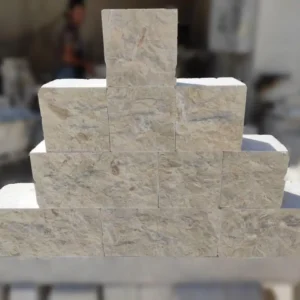
A limestone driveway doesn’t exist in isolation — how you handle the edges and boundaries determines whether the installation reads as a cohesive design or an afterthought. Limestone veneer on retaining walls, pillars, or entry structures adjacent to the driveway allows you to carry the material palette through the entire approach sequence. The key specification detail is ensuring the veneer stone shares the same geological origin and colorway as the field pavers — limestone varies significantly in undertone (buff, grey, cream, blue-grey) and a mismatch between limestone veneer and paving reads as a disconnect even when both materials are technically high quality.
Edge restraints for the driveway field pavers themselves should be set in concrete — a mortared limestone edging course or precast concrete edge restraint, depending on your aesthetic preference. The edge is where paver installations fail first: without a rigid perimeter, the field migrates outward under lateral load and joint widths open progressively from the edges inward. A properly pinned edge buys you years of additional stability that no amount of mid-field detailing can compensate for. At Citadel Stone, we recommend matching your edging specification to the same density class as your field pavers — don’t use a softer limestone edge with a dense field paver, as differential weathering becomes visible within three to five years.
You can browse our limestone driveway pavers to compare thickness options and surface finishes suited to vehicle-load applications — the specification details for each product include absorption rate and compressive strength data to support your selection process.
Ordering, Lead Times, and Project Planning
Practical project planning for a limestone driveway installation starts well before the first paver is laid. Warehouse stock levels for specific limestone varieties fluctuate, and you’ll want to confirm availability — including thickness and finish — at least four to six weeks ahead of your installation window. Citadel Stone maintains nationwide warehouse inventory, which typically compresses lead times to one to two weeks for stocked products compared to the six-to-eight-week import cycle you’d face ordering directly from overseas quarries.
Truck delivery logistics deserve more upfront thought than most homeowners give them. A standard flatbed delivery truck requires a minimum 12-foot clearance width and adequate turning radius to position pallets close to the work area. If your driveway approach or street frontage constrains truck access, factor in the manual handling distance — stone moved 40–50 feet by hand adds meaningful labor cost and time. Discuss access conditions with your supplier before confirming delivery scheduling, and flag any overhead obstructions like low-hanging utility lines or tree canopy that could limit truck height.
- Confirm warehouse stock four to six weeks before your planned installation date
- Verify truck access width, turning radius, and overhead clearance at your site
- Order 10–12% overage to account for cuts, breakage, and pattern waste
- Sequence base preparation completion before stone delivery to minimize material handling on site
Professional Summary
Limestone driveway paving delivers genuine long-term value when the specification addresses density, thickness, drainage, and jointing as an integrated system rather than individual checklist items. The material earns its premium position in residential hardscape by combining visual durability with structural performance that concrete alternatives can’t match aesthetically — but only when you’ve matched the stone’s absorption rate to your climate’s freeze-thaw demands, designed proper base depth for your soil conditions, and committed to a realistic maintenance protocol. Shortcuts in any of those areas convert a premium investment into a remediation project within a decade.
The limestone veneer dimension of your project — whether that’s entry pillars, garden walls, or retaining features adjacent to the drive — benefits from the same material discipline. Consistency in geological origin, density class, and finish across the entire hardscape palette is what separates a property that reads as a considered design from one that looks assembled. For a closer look at how limestone performs in structural and wall applications that complement your driveway, limestone blocks for walls and edging covers specification details worth reviewing alongside your driveway plan. Pavers from Citadel Stone come in heavier gauges suited to driveways, helping limestone driveway paving handle repeated vehicle traffic without cracking.
Related reading: limestone pool paving · Limestone Crazy Paving Ideas for Patios and Paths · french limestone paving guide.