
LCA basics — scope, boundaries & why they matter
A lifecycle assessment (LCA) systematically evaluates the environmental impacts of a product from raw material extraction through manufacturing, use and disposal. Understanding LCA terminology empowers informed procurement decisions.
Cradle-to-gate LCA covers extraction and manufacturing through the factory gate—typically stages A1–A3 in the EN 15804 framework (raw material supply, transport to manufacturer, manufacturing). This scope omits transport to project site, installation, use phase and end-of-life. Cradle-to-grave extends through use phase and disposal (stages A through C), providing a more complete picture. Cradle-to-cradle adds the benefits of reuse, recycling or energy recovery (stage D), recognizing circular economy potential.
Embodied carbon refers to greenhouse gas emissions from material extraction, processing and transport—the carbon “embedded” in the product before it’s ever used. Operational carbon covers emissions during the use phase (heating, cooling, maintenance). For inert materials like stone with minimal operational impacts, embodied carbon dominates the lifecycle profile.
The functional unit defines what’s being measured—for paving, typically one square meter of installed surface performing for a defined lifespan. Without a consistent functional unit, you cannot compare products meaningfully. A durable stone lasting 50 years has lower impacts per functional unit than a short-lived alternative requiring replacement.
System boundaries determine what’s included in the assessment. Transport distance assumptions, grid electricity factors, waste disposal methods and allocation rules for co-products (like stone waste used as aggregate) vary between studies. Product Category Rules (PCR) standardize these assumptions within product categories, enabling apples-to-apples comparison. ISO 14040 and ISO 14044 provide the overarching LCA framework, while EN 15804 and ISO 21930 govern EPDs for construction products.
When reviewing EPDs or LCA studies, verify the PCR used, system boundaries declared, and whether third-party verification was performed. Without consistent PCR and boundaries, numeric comparisons are unreliable.
What to expect on an EPD for White Pearl
An Environmental Product Declaration (EPD) is a standardized, third-party-verified LCA summary for construction products. EPDs follow strict formats, making them the gold standard for procurement.
Typical EPD sections include:
Declared unit and functional unit — Specifies the quantity assessed (e.g., one square meter, one tonne, one slab of defined dimensions) and the functional performance expected (e.g., floor covering for 50 years).
System boundary — Defines lifecycle stages included, commonly using EN 15804 modular structure: A1–A3 (product stage), A4–A5 (construction), B (use stage with maintenance/replacement), C (end-of-life), and D (benefits beyond system boundary from reuse/recycling).
Life cycle stages — A1 (raw material supply/quarrying), A2 (transport to manufacturer), A3 (manufacturing/processing), A4 (transport to site), A5 (installation), B1–B7 (use, maintenance, repair, replacement, refurbishment, operational energy/water), C1–C4 (deconstruction, transport to waste, processing, disposal), D (reuse/recovery/recycling potential).
Global Warming Potential (GWP) — Reported in kg CO₂ equivalents per functional unit, aggregating emissions of CO₂, methane, nitrous oxide and other greenhouse gases converted to CO₂ equivalence.
Other impact categories — Acidification potential (kg SO₂e), eutrophication potential (kg phosphate e), ozone depletion potential, photochemical ozone creation, abiotic depletion (resource consumption), water use.
End-of-life assumptions — Scenarios for demolition, disposal, recycling or reuse, which significantly affect total lifecycle impacts.
Reuse and recycling potential — Stage D benefits: avoided impacts when stone is repurposed, crushed for aggregate or reused architecturally.
Verification statement — Name of independent verifier, verification body accreditation, and conformance to applicable PCR.
What procurement teams should check in an EPD:
- Product name, manufacturer and specific batch/lot identification
- Publication date and validity period (typically five years)
- PCR reference and version number
- System boundary clarity (which stages A–D are included)
- Third-party verifier name and accreditation
- Functional unit definition and declared unit
- Geographic relevance (grid factors, transport distances)
- Data quality indicators (primary vs secondary data, age of data)
- Transparent assumptions about transport distances, electricity sources and end-of-life
- Consistency with other EPDs if comparing alternatives (same PCR, same boundaries)
Carbon & environmental hotspots for White Pearl — quarry to yard
Identifying where environmental impacts concentrate enables targeted mitigation. For White Pearl limestone, typical hotspots include:
Quarrying and primary processing — Extraction involves drilling, blasting (if applicable), cutting primary blocks and loading. Diesel fuel for heavy equipment and explosives for overburden removal contribute greenhouse gas emissions. Dust generation, land disturbance and water use for dust suppression also factor.
Electricity for sawing and finishing — Sawing blocks into slabs, honing, polishing and edge finishing are energy-intensive. Electricity grid carbon intensity significantly affects embodied carbon—renewable-heavy grids reduce impacts while coal-heavy grids increase them.
Waste and slurry handling — Stone cutting generates slurry (fine stone particles suspended in water). Responsible operations recycle water, settle solids for beneficial reuse (aggregate, soil amendment) or landfill. Landfilling wet slurry carries disposal emissions.
Transport and shipping distance/mode — Freight emissions scale with distance and vary dramatically by mode. Ocean shipping has low emissions per tonne-kilometer but long distances; trucking has higher per-tonne-kilometer emissions but may be unavoidable for last-mile delivery. Air freight (rarely used for stone) is extremely carbon-intensive.
Packaging — Crating, palletizing and protective wrapping consume wood, plastic and steel. Returnable packaging systems reduce waste.
On-site installation — Setting stone requires adhesives, grout and equipment (mixers, saws, lifts). Waste from cutting and breakage during installation adds disposal impacts.
Maintenance — Sealing, cleaning and periodic refinishing extend life but require energy and chemicals. Low-maintenance finishes and durable sealers reduce lifecycle impacts.
End-of-life scenarios — Demolition energy, transport to landfill or recycling facility, and disposal method (landfill vs crushing for aggregate reuse) affect final lifecycle tallies.
| Stage | Typical Emissions Drivers | What to Request from Supplier |
|---|---|---|
| Quarrying (A1) | Diesel fuel, explosives, electricity for extraction equipment | Fuel consumption data, renewable energy percentage, quarry energy audit |
| Processing (A3) | Electricity for sawing, honing, polishing; water use | kWh per m² or tonne, grid carbon intensity factor, water recycling rate |
| Transport (A2, A4) | Freight mode (truck, rail, ship), distance, vehicle efficiency | Origin and destination, transport mode breakdown, shipping documentation |
| Installation (A5) | Adhesive/grout production, installation equipment fuel | Installation energy estimates, low-VOC adhesive specifications |
| Maintenance (B2, B4) | Sealer reapplication frequency, cleaning agent production | Recommended maintenance schedule, sealer lifespan data |
| End-of-life (C, D) | Demolition energy, landfill transport, recycling credits | End-of-life scenario assumptions, recycled content potential, design for disassembly |
Transport & distance sensitivity — why locality matters
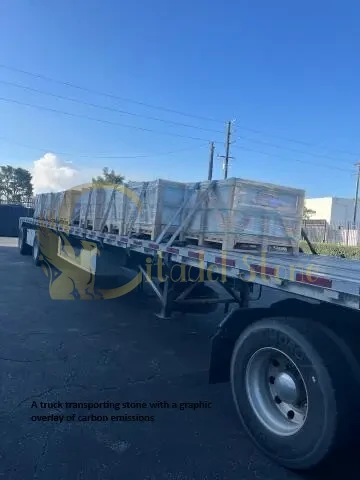
Transport emissions can dominate lifecycle impacts for dense, heavy materials like limestone, especially when sourced internationally. Understanding freight emission sensitivity guides smarter sourcing.
Mode matters more than distance for long hauls. Ocean shipping emits far less per tonne-kilometer than trucking, making a Mediterranean stone shipped by sea potentially competitive with a stone trucked across a continent. However, last-mile trucking from port to site remains unavoidable and significant.
Regional sourcing reduces uncertainty. U.S. buyers specifying stone quarried domestically or from nearby regions (Mexico, Canada) benefit from shorter truck hauls, reduced shipping complexity and greater supply chain transparency. Transport emissions become a smaller fraction of total lifecycle impacts.
Consolidation and containerization optimize freight efficiency. Full container loads and backhaul coordination (using return legs of freight routes) improve per-unit efficiency. Suppliers who actively manage logistics reduce transport footprints.
Procurement guidance for transport emissions:
- Request transport distance and mode breakdowns from supplier to project site
- Ask for emission factors used in EPD transport calculations (reference dataset or carrier-specific data)
- Specify nearest port or rail terminal to minimize last-mile trucking
- Encourage suppliers to optimize packaging density (reduce void space in containers)
- For high-volume projects, consider consolidated shipments or direct-from-quarry delivery
- Evaluate transport sensitivity by requesting EPD scenarios with alternative transport assumptions
Locality advantages extend beyond carbon—shorter supply chains improve schedule certainty, reduce shipping damage risk and enable easier site visits to quarries for due diligence.
Quarry practices & biodiversity / rehabilitation impacts
Quarrying disturbs land, affects biodiversity and consumes resources. Responsible quarry operations mitigate these impacts and plan for long-term rehabilitation.
Land disturbance and biodiversity — Quarrying removes vegetation and topsoil, fragmenting habitat. Impact magnitude depends on site ecology (sensitive habitat vs agricultural land), quarry size and operational duration. Progressive rehabilitation—restoring areas as extraction advances—minimizes cumulative disturbed area.
Water use and runoff — Dust suppression, sawing and washing require water. Uncontrolled runoff carries sediment and pH-altered water into streams. Best practices include water recycling, settlement ponds and discharge permits.
Dust and air quality — Drilling, blasting and crushing generate dust. Dust controls (water spray, enclosures, conveyors) protect workers and neighboring communities.
Rehabilitation plans — Responsible operators develop end-of-life plans: regrading slopes, replacing topsoil, replanting native species or repurposing sites (lakes, wildlife habitat, solar farms, recreation). Bonded rehabilitation ensures financial resources exist for restoration.
Social and labor conditions — Worker safety, fair wages, community engagement and indigenous rights matter. ESG audits and certifications (ISO 14001 for environmental management, OHSAS 18001 or ISO 45001 for occupational health/safety) signal commitment.
Quarry Sustainability Checklist (what to request from suppliers):
- Quarry rehabilitation and closure plan filed with regulatory authorities
- Water use permits, discharge monitoring reports and recycling rates
- Dust and air quality monitoring data
- Biodiversity assessment and mitigation measures (if site is ecologically sensitive)
- ISO 14001 environmental management system certification
- Worker safety records (incident rates, safety training programs)
- Community engagement documentation (local employment, grievance mechanisms)
- Progressive rehabilitation evidence (photos, area restored annually)
End-of-life scenarios & circularity
Natural stone excels in circular economy potential. Unlike composite materials, stone remains chemically stable, enabling multiple reuse and recycling pathways.
Reuse potential — Intact slabs and pavers can be carefully removed and reinstalled in new applications. Architectural salvage markets value reclaimed stone for character and sustainability. Design for disassembly (mechanical fastening, accessible connections) facilitates reuse.
Recycling as crushed aggregate — Stone unsuitable for reuse can be crushed and used as roadbase, drainage aggregate, landscaping rock or concrete aggregate. This displaces virgin aggregate extraction, earning “Stage D” credits in EPD accounting.
Landfill assumptions — Inert stone presents minimal landfill concerns (no leaching, no decomposition emissions) but consumes landfill capacity. LCA studies typically model end-of-life as landfill (conservative) or recycling (optimistic).
Design for disassembly strategies:
- Use dry-set pedestal systems allowing easy paver removal
- Specify mechanical fasteners for cladding instead of permanent adhesives
- Document installation details to facilitate future deconstruction
- Retain edge pieces and cut-offs for future repairs rather than discarding
Durability as lifecycle leverage — White Pearl’s longevity reduces per-year environmental intensity. A stone floor lasting 50 years has half the annualized impact of an alternative requiring replacement at 25 years. Selecting durable finishes, appropriate sealers and committing to maintenance maximizes this advantage.
Mitigation strategies — how Citadel Stone reduces lifecycle impacts
Suppliers committed to sustainability implement practical mitigation across lifecycle stages. Citadel Stone employs strategies that reduce environmental footprint while maintaining quality.
Near-sourcing opportunities — Evaluating quarry proximity to major U.S. markets and optimizing transport routes reduces freight emissions.
Energy efficiency in processing — Upgrading to high-efficiency sawing equipment, LED lighting and optimized water pumps reduces electricity consumption per unit produced.
Electrification and renewable energy — Transitioning equipment from diesel to electric power and sourcing renewable electricity for processing facilities reduces grid-tied emissions.
Low-emission transport options — Consolidating shipments, utilizing rail where feasible, optimizing truck routing and partnering with carriers measuring their carbon footprint.
Packaging optimization — Reducing crating materials, using recycled pallet wood and implementing returnable packaging systems for repeat customers.
Reuse and recycling programs — Accepting reclaimed stone for resale, crushing waste stone for aggregate and offering take-back programs for renovation projects.
Certified rehabilitation plans — Working with quarries that maintain bonded rehabilitation plans and document progressive restoration.
EPD transparency — Publishing third-party-verified EPDs following current PCR and updating them regularly as operations improve.
Product longevity and warranty — Offering extended warranties that encourage specifiers to account for full lifecycle performance rather than first-cost only.
| Mitigation | Stage Targeted | Practical Note / Procurement Action |
|---|---|---|
| Regional quarry sourcing | A2, A4 (transport) | Request origin-to-site distance breakdown; evaluate quarry proximity when comparing bids |
| Renewable electricity in processing | A3 (manufacturing) | Ask for percentage renewable in electricity mix; verify with utility green power certificates |
| Efficient sawing and finishing | A3 (manufacturing) | Request energy audit or kWh per m² data; compare across suppliers |
| Optimized freight logistics | A2, A4 (transport) | Specify container consolidation; request carrier emission data |
| Low-VOC sealers and adhesives | A5 (installation), B2 (maintenance) | Include low-VOC requirements in specifications; verify product datasheets |
| Progressive quarry rehabilitation | A1 (extraction) | Request rehabilitation plan documentation; visit quarry if feasible |
| Long product lifespan | B (use phase) | Select durable finishes; specify proper maintenance; factor lifecycle cost into procurement |
| Take-back and recycling programs | C, D (end-of-life) | Ask if supplier offers take-back; plan for deconstruction and aggregate reuse |
Comparing White Pearl to common alternatives
Understanding how White Pearl limestone compares to other paving and cladding materials helps justify sustainable choices. This qualitative comparison highlights general tendencies; for numeric comparisons, request EPDs for specific products following the same PCR.
| Material | Embodied Carbon Tendency | Transport Sensitivity | Longevity / Reparability | Maintenance Energy | Recyclability |
|---|---|---|---|---|---|
| White Pearl Limestone | Moderate; depends on quarry energy, processing efficiency and transport distance | High (dense, heavy); regional sourcing critical | Excellent; 50+ year lifespan common; field-repairable by honing/resealing | Low; periodic sealing and cleaning | Excellent; reusable as stone or crushed aggregate |
| Porcelain Tile | Moderate to high; energy-intensive firing process | Moderate (lighter than stone, but fragile packaging adds volume) | Good; 20–30 year lifespan; difficult to repair without replacement | Very low; stain-resistant, minimal maintenance | Limited; generally landfilled; some recycling as aggregate |
| Concrete Pavers | Moderate; cement production is carbon-intensive but local production often available | Low to moderate (can be produced regionally, reducing transport) | Good; 25–40 year lifespan depending on quality; surface degradation over time | Low to moderate; may require periodic sealing | Moderate; crushed for aggregate reuse; cement content complicates recycling |
| Engineered Stone | Moderate to high; resin binders and energy-intensive manufacturing | Moderate (similar density to natural stone) | Good; 15–25 year lifespan for countertops; repair challenging due to resin content | Moderate; requires specialized cleaners; resin can yellow | Poor; difficult to recycle due to resin matrix; typically landfilled |
Key considerations:
- Natural stone’s primary advantage is longevity and circularity—indefinite reuse potential without degradation
- Porcelain excels in low maintenance but lacks repairability and end-of-life options
- Concrete pavers benefit from local production but cement’s high embodied carbon is a concern
- Engineered stone offers consistency but limited lifespan and poor recyclability reduce lifecycle appeal
Request EPDs for all alternatives under consideration and compare them using consistent PCR, functional unit and system boundaries. Favor suppliers who provide transparent, third-party-verified data.

Procurement checklist — what to request from suppliers
Ensure informed decision-making by requesting comprehensive lifecycle documentation:
- Environmental Product Declaration (EPD) in PDF format with PCR reference number and version
- Functional unit definition and declared unit clearly stated
- System boundary documentation specifying which lifecycle stages (A–D) are included and excluded
- Third-party verifier name, accreditation body and verification date
- Life cycle inventory (LCI) data quality statement indicating percentage primary data, data age and geographic relevance
- Electricity grid carbon intensity factor used in manufacturing stage calculations, with source cited
- Transport assumptions including distances, modes (truck/rail/ship percentages) and emission factors
- End-of-life scenario modeled (landfill, recycling, reuse assumptions)
- Product longevity data including expected service life, maintenance schedule and warranty terms
- Quarry rehabilitation plan or regulatory closure plan documentation
- ESG due diligence documentation (ISO 14001, worker safety records, community engagement reports)
- Chain-of-custody documentation linking delivered material to tested batch and quarry origin
- Lot photos and sample block retention for future matching and verification
Specify that EPD must be current (published within last five years) and conform to ISO 14025, EN 15804 or ISO 21930 as applicable.
Communicating LCA in bids & specs — suggested wording
Template / Non-Legal Specification Snippet
SECTION 2.3 — ENVIRONMENTAL PRODUCT DECLARATION (EPD) REQUIREMENTS
A. Furnish White Pearl limestone with a current, third-party-verified Environmental Product Declaration (EPD) conforming to ISO 14025 and EN 15804 or ISO 21930.
B. EPD shall be based on a Product Category Rule (PCR) appropriate for natural dimension stone and published within the last five years.
C. EPD shall include lifecycle stages A1–A3 (product stage) as minimum; preference given to EPDs including A4 (transport to site), A5 (installation), B (use phase), C (end-of-life) and D (recycling benefits).
D. Submit EPD PDF, PCR reference, third-party verifier statement and functional unit definition to Architect for review at least 14 days before material order.
E. Transport emissions (Stage A4) shall be calculated using project-specific distance from quarry or port to site. Supplier shall disclose transport mode assumptions (percentage truck, rail, ship) and emission factors used.
F. Provide quarry rehabilitation plan documentation and ISO 14001 environmental management system certification if available.
G. Mock-up approval does not waive EPD requirements. Final material acceptance contingent on receipt and approval of all lifecycle documentation.
White pearl limestone — How we would specify for USA states
Light-coloured limestone pavers such as white pearl limestone can help reduce surface temperatures and create a clean, contemporary aesthetic for exterior spaces. The following notes are hypothetical — each city-level entry offers starting-point specification ideas for designers and specifiers working in differing U.S. climates, rather than descriptions of completed installations.
Portland, Oregon
Portland’s maritime-inland mix brings frequent rainfall, long damp seasons and moderate UV exposure; coastal salt spray is limited except at nearby shorelines and freezes occur occasionally. For Portland we would prioritise low-porosity white limestone pavers with a finish that resists slipperiness when wet — a finely textured or brushed surface is often suitable for exterior terraces and walkways. Use the guidance 20–30 mm for patios; 30–40 mm for light vehicle areas as a general starting point. The natural stone supplier could make sample kits available, provide product technical information, help draft specification text and arrange palletized shipping if needed.
Denver, Colorado
Denver’s high-altitude environment combines strong solar radiation, large diurnal temperature swings and potential freeze–thaw exposure in winter. In this setting specifying white limestone tiles with low capillary absorption and proven resistance to frost action would be prudent; a honed finish under covered areas and a textured finish where surfaces are exposed could help reduce glare and slipping. As a planning note: 20–30 mm for patios; 30–40 mm for light vehicle areas. The stone provider could supply physical samples, laboratory reports, specification drafting assistance and palletized delivery options on request.
Phoenix, Arizona
Phoenix’s hot, arid climate subjects surfaces to extreme daytime heat, intense UV and minimal rainfall, with occasional monsoon storm events. For Phoenix projects one might favour low-porosity white limestone flooring that demonstrates colour stability under prolonged sun exposure and a slightly textured finish to reduce heat-reflective glare and provide traction. Follow the general thickness guidance of 20–30 mm for patios; 30–40 mm for light vehicle areas while also considering larger format restraint to limit thermal movement. The supplier could provide sample panels, UV-resistance data, specification guidance and palletized freight arrangements upon request.
New Orleans, Louisiana
New Orleans faces very high humidity, regular exposure to salt-laden air in low-lying zones, intense storm activity and flood risk; freeze events are rare but surge resilience is critical. For this environment a low-absorption white limestone paving tiles with a non-slip textured or mechanically finished face would often be recommended to keep wet areas secure and maintain appearance. Typical thickness guidance might be 20–30 mm for patios; 30–40 mm for light vehicle areas. The vendor could offer sample swatches, corrosion and moisture performance data, specification support and palletized shipping to suit local logistics.
Minneapolis, Minnesota
Minneapolis endures prolonged, cold winters with repeated freeze–thaw cycles, de-icing salt exposure and snow loading — conditions that can accelerate weathering if materials are not carefully selected. For Minneapolis we would suggest specifying white limestone outdoor tiles tested for low water uptake and frost resistance, and choosing a finish with enough texture to limit slipperiness when icy or wet. Use 20–30 mm for patios; 30–40 mm for light vehicle areas as preliminary guidance, and include notes on compatible jointing and cleaning strategies for de-icing salts. The supplier could supply test certificates, sample pieces, specification text and palletized shipment plans.
Austin, Texas
Austin’s climate mixes hot summers, strong sunlight, occasional heavy thunderstorms and humid spells, with generally mild winters. In this context a low-porosity white outdoor pavers that retains colour under UV exposure and that is available in honed or lightly textured finishes would be a sensible choice — textured options recommended for frequently wet zones. As a rule of thumb follow 20–30 mm for patios; 30–40 mm for light vehicle areas, and specify effective drainage to handle summer downpours. The supplier could arrange sample packs, performance datasheets, specification assistance and palletized delivery to local yards.
Across these diverse locations there are recurring specification themes that would typically be considered: choose material with verified low absorption for wet, coastal or freeze-prone sites; select surface finishes that suit the anticipated foot traffic and wetting patterns; include jointing, falls and drainage details to prevent water retention; and call for maintenance and cleaning regimes appropriate to local conditions (including recommendations for compatible sealants where appropriate). Where vehicular loading is a possibility, coordination with geotechnical and structural consultants on subbase design should be specified rather than relying on paver thickness alone. The supplier could support these steps with test documentation, colour and finish mock-ups, specification templates and palletized logistics support if required to aid spec development.
Frequently asked questions
Do EPDs always include transport to project site?
Not always. Stage A4 (transport to site) is often modeled with generic distances or excluded entirely if EPD scope is cradle-to-gate (A1–A3 only). Always check system boundary and request supplier calculate A4 using your actual project location.
How reliable are embodied carbon figures in EPDs?
Reliability depends on data quality, verifier rigor and transparency. EPDs based on primary industry data and verified by accredited third parties (NSF, UL, etc.) are most reliable. Generic or unverified claims should be treated cautiously.
Is local stone always lower carbon than imported stone?
Not automatically. A nearby quarry using coal-heavy grid electricity and inefficient processes may have higher embodied carbon than an efficient overseas operation using renewables—especially if imported stone ships by low-emission ocean freight. Always compare EPDs directly.
How do I compare EPDs with different PCRs?
You can’t reliably. Different PCRs use different system boundaries, allocation rules and impact categories. When comparing alternatives (stone vs porcelain vs concrete), insist on EPDs following the same PCR or commission a comparative LCA study.
Does stone maintenance significantly affect lifecycle carbon?
Generally no. Sealing and cleaning have modest impacts compared to embodied carbon from extraction, processing and transport. However, frequent harsh chemical use or energy-intensive refinishing (e.g., diamond honing every few years) can add up over decades.
Can I trust “carbon neutral” or “net zero” claims?
Only if backed by transparent offset documentation. True carbon neutrality requires measuring all lifecycle emissions (verified EPD) and purchasing high-quality, verified carbon offsets (Gold Standard, Verra VCS, etc.). Many claims lack credible verification.
What if my supplier doesn’t have an EPD?
Request they commission one from an accredited LCA practitioner following an appropriate PCR. Alternatively, specify products from suppliers who already publish EPDs. Lack of EPD indicates limited sustainability transparency.
How long does an EPD remain valid?
Typically five years, after which it should be updated to reflect current operations, grid factors and PCR revisions. Expired EPDs may no longer accurately represent product impacts.
Conclusion & Citadel Stone CTA
The lifecycle assessment white pearl limestone demonstrates that natural stone—when responsibly sourced, efficiently processed and thoughtfully specified—can be a durable, low-impact choice for U.S. projects. Transparency through EPDs, attention to transport logistics, quarry stewardship and planning for circularity enable specifiers to make evidence-based sustainability decisions. Citadel Stone provides comprehensive lifecycle documentation, verified EPDs and technical consultation to support your procurement process. Request the White Pearl limestone EPD and full LCA dossier, or schedule a sustainability briefing with our team to explore how natural stone fits your project’s environmental goals.