Slopes Shape Most Antiguan Sites
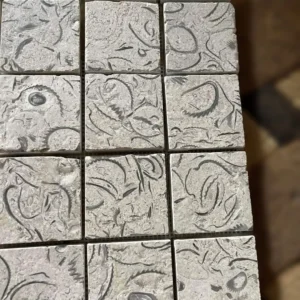
The south-west of Antigua rises into the Basal Volcanic Suite, a mass of dacite, quartz basalt, andesite, agglomerate and tuff laid down in the Oligocene. Run a tape across a hillside plot above Falmouth Harbour or behind Jolly Harbour and you rarely find a level rectangle anywhere on it. The Central Plain Group flattens out as it runs from St John’s toward the south-east, and the north-east sits on the fossil-rich limestone of the Antigua Formation, exposed for anyone to see at Devil’s Bridge. Barbuda is the outlier, a low coral-limestone island whose oldest rock rises only about one hundred and twenty feet above the sea. Most paving decisions in this country are therefore slope decisions first and finish decisions second.
Read the Ground Before Choosing a Size
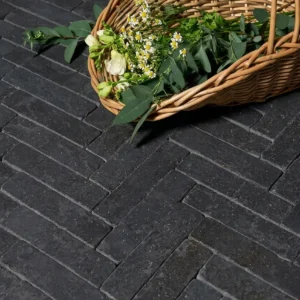
Setts work on slopes because they are small. A small unit follows a falling surface without the rocking, ponding and lipping that a large slab produces on exactly the same ground. Before picking a format, walk the site and write down what you actually find.
- The steepest fall along the line people will really walk or drive
- Cross-fall, which is the fall that trips people rather than the one they notice
- Whether the subgrade is weathered volcanic rock, imported fill or old base course
- Where surface water goes today, and where the cistern inlet sits
- The narrowest access point between the road and the working area
Depth of Unit Does the Real Work
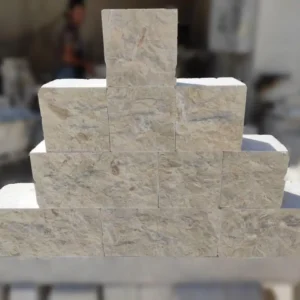
On a grade, the depth of a sett matters far more than the size of its face. A deeper unit presents more side area to the bedding and to the jointing around it, so it resists creeping downhill under braking, turning and heavy rain. That is why a hillside drive and a flat pool terrace should never carry the same build-up, even when they carry the same stone off the same pallet. Depth is also what lets a mason shave a bed to chase a level without losing the unit. Our range and gauging for sett paving on sloping ground is set out for these islands.
Bedding and Bond on a Grade
Loose-laid work belongs on flat ground. Once the fall becomes meaningful, the build-up has to hold units in place through wind-driven rain and the short, violent downpours that cross these islands every wet season.
- Bed and bond anything steep or exposed rather than relying on friction alone
- Give every falling run a positive restraint at its lowest point, usually a haunched edge or a curb course
- Keep joints tight and consistent so the field behaves as one single plate
- Use non-ferrous or stainless fixings wherever salt aerosol reaches, which is most of the coast
Water Runs Toward the Cistern
There are no permanent streams or rivers on Antigua or Barbuda. Fresh water comes from surface storage, groundwater and domestic catchment, and new houses are fitted with rainwater collection and storage, normally an underground cistern. In a country classed at extremely high water stress, a driveway is part of the water system and not simply a place to leave a vehicle.
- Grade the sett field so it delivers clean water exactly where you want it
- Keep anything that might taint catchment out of the joints entirely
- Size the falls for short, high-intensity bursts rather than for steady rainfall
- Check that runoff off the drive cannot reach a cistern inlet uncontrolled
Steps, Ramps and Awkward Transitions
Most slope failures start where one surface meets another. A ramp flattening into a terrace, a step landing inside a paved field, a gate threshold cut across a falling run: these are the places water collects and units begin to move. Detail them first and let the field follow. Setts help here, because a small unit closes up against a riser or a channel without a cut that looks like an apology, and a mason can bleed a few millimeters of fall across several courses instead of fighting one long straight edge. If you are scoping a whole property rather than a single terrace, our stone supply across the islands page covers the wider service.
Getting Setts to a Hillside Site
Delivery here is simpler than in most of the Eastern Caribbean. Tropical Shipping sails directly from the Port of Palm Beach in Florida into the Deep Water Harbour at St John’s, so pallets are not worked through a hub before they reach you.
- Land and quote everything at St John’s, then plan the haul up to the plot separately
- Treat Barbuda as its own leg, since boats land at River Wharf with no container crane waiting
- Appoint a customs broker, which Customs requires once a shipment passes six lines or EC$5,000
- Allow for CARICOM common external tariff duty on CIF, plus 17% ABST charged on duty as well as value
- Ask your broker to price the Revenue Recovery Charge and the throughput and waste levies
Specify Once, Then Order in One Go
Split orders are expensive on an island. Confirm depth, format and total area for every falling run before the first pallet moves, and add a real allowance for cuts at steps, channels and curved edges. Order small samples early so a mason can lay a test panel on the actual slope, then go and look at it wet. Get the fall, the depth and the restraint right, and a sett field on an Antiguan hillside will outlast everything else on the plot.