Why Cayman ground is never quite level
The Cayman Islands read as flat country from the air, and most of Grand Cayman genuinely is low and gentle. Get down to garden scale and the picture changes. Old ironshore shelves break the surface near the water, fill placed decades ago has settled unevenly, and the ground behind a sea wall almost never matches the ground at the house. Add a driveway that has to climb from the road crown to a floor slab set well above grade, and a paved area on a Cayman lot is usually a series of small height changes rather than one clean plane. That is not a problem you solve with a bigger stone. It is a problem you solve with a smaller one.
Reading the slope before you order
Walk the area with a string line and a level before anyone prices material. What you want is not a single number but a picture of where water goes and where the ground moves under load.
- Total fall from the highest point to the lowest, and whether it arrives gradually or in one step.
- Cross fall across the width, which decides whether rain sheets into a garden bed or into a doorway.
- Soft spots that flex underfoot, usually old fill rather than the dolostone underneath it.
- Hard shelves that will not excavate without breakers, common on East End and North Side lots.
- Fixed heights the paving has to meet: thresholds, pool coping, gate tracks, existing steps.
Setts versus slabs on a grade
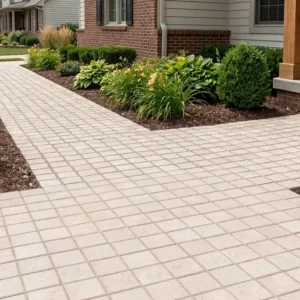
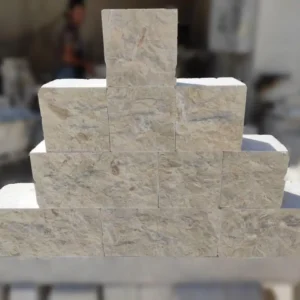
A large slab is a rigid plane. Put it on ground that is not a plane and something has to give, so either the bedding gets thickened until it becomes the weak layer, or the slab rocks and eventually cracks. A sett is a small, deep unit, and a field of them behaves like a flexible mosaic. Each piece takes its own line, so a run can roll through a foot of fall without a single visible break in the surface. That is the reason Cayman cobblestone sett formats stay in the specification on sloping sites long after slabs have been ruled out, and the reason later repairs stay local instead of turning into a full lift.
Ironshore ledges and shoreline edges
Ironshore is not simply a nuisance to be removed. It is a named feature in local siting rules, and coastal setback distances in the planning regulations are measured with reference to it, so the shape of the shoreline rock can decide where hard paving is allowed to begin. Where a terrace runs out toward that edge, setts are the forgiving option. They can be cut and closed against an irregular rock line, they step down in small increments instead of one abrupt drop, and a damaged section can be lifted and reset without disturbing the rest of the terrace.
Bedding and drainage in a storm climate
Hurricane Ivan in 2004 remains the reference event on these islands, and it changed how people think about water as much as wind. On a slope, the failure you are designing against is rarely the storm itself. It is the water that moves under the paving while the storm is happening.
- Compact in layers, because a single thick lift of fill on a grade is the usual cause of later dishing.
- Give the bedding somewhere to drain instead of trapping water against a buried edge.
- Restrain the low edge properly, since gravity is working on every joint above it.
- Keep joints tight and full so wash-out has nowhere to start.
Steps, ramps and transitions
Most Cayman houses sit above grade, so the route from a parked car to a front door usually involves a ramp, a few risers, or both. Setts help here because the same unit serves the tread field, the ramp and the landing, and the eye reads the whole thing as one surface.
- Mark a transition with a change of laying direction rather than a change of material.
- Keep riser heights equal, because an odd step is the one people trip on.
- Run the ramp in the same unit so no hard joint line catches a wheel.
- Check the landing falls, since water standing at a threshold is a problem forever.
Getting pallets up a sloped site
George Town is a lighterage port. Ships lie off and cargo comes ashore on barges rather than across a deep-water container berth, so stone is handled more times than it would be on the mainland. It arrives palletized and heavy, and that extra handling matters more on a sloping lot than a flat one. Plan the last hundred feet as carefully as the ocean leg. Buyers working across the districts can start from the Cayman Islands stone hub and work backward to a delivery plan the site can actually absorb.
- Where a truck can stand without blocking a single-lane access road.
- Whether pallets can be split at the gate and moved in stages by barrow.
- Ground protection for any machine crossing finished landscaping.
- Dry storage space that stays clear of the other trades on site.
Care after the first season
Salt haze reaches well inland here, and a freshwater rinse is ordinary maintenance rather than a special measure. On sloped work, walk the low edge and the joints immediately above it after the first heavy rains, top up anything that has migrated, and the surface settles into decades of quiet service. Small units forgive the ground; large ones argue with it. Ground that refuses to sit flat is exactly the ground setts were invented for.