La Romana wrote the Caribbean’s estate-resort playbook before most of its competitors broke ground: a sugar town that grew a vast villa-and-sport estate on its eastern flank, golf holes hung over the sea, a marina at the river mouth, and – above the Chavón gorge – a stone-built artisan village whose craftsmanship has been schooling the region’s designers since the late seventies. The estate register here is the country’s most established, and its stone brief carries half a century of standards. This guide walks the Chavón standard.
The Estate Model, Original Edition
The great estate’s model – private villas inside a managed resort frame, sport amenities at championship grade, security and services at community scale – became the template the region’s newer developments copy. For stone work the model means the governed-luxury canon at full maturity: villa packages inside long-standing design language, amenity surfaces specified for decades of member use, arrival sequences maintained as permanent institutions, and a property-management culture whose files go back generations of renovations. Building here means joining a standard, not setting one.
The Village Above the Gorge
Altos de Chavón is the estate’s crown: a Mediterranean-style artisan village built in stone above the river gorge in the late seventies and early eighties – coursed walls, stone-paved lanes, an amphitheatre that seats thousands, a design school that made the village a working arts community rather than a set. Its lesson for the region’s builders is craftsmanship as placemaking:
- Hand-laid coursing and honest stone construction age into authority – the village looks better at fifty than at five.
- Stone lanes and plazas handle five decades of visitor traffic on maintenance, not replacement.
- The gorge-edge siting shows what benched platforms and parapet craft make possible.
- Working artisan culture keeps the fabric alive – the village repairs itself with its own skills.
Villa Country
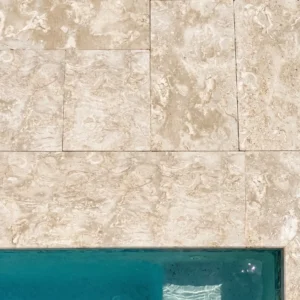
The estate’s villa neighborhoods run the mature-luxury brief: generous lots under old trees, architecture spanning five decades of tastes, and a renovation market as strong as the new-build one – each generation updating the last’s villas to current outdoor living. The stone work is villa-canon plus continuity: pool packages and terraces in the estate’s pale register, renovations matched to standing context, and the boutique-grade detailing the ownership expects as baseline. small-luxury detailed properly maps the finish literacy this market brings to a breakfast terrace.
The Seaside Holes
The estate’s golf is its global signature – the celebrated seaside course whose holes play along the coral edge, waves in the sightline of half the round – and the golf-ground stone brief runs championship-hospitality: tee and path networks at tour standard, comfort stations and halfway houses at member grade, clubhouse terraces built for spikes, ceremonies and sunset in equal measure, and the coral-edge exposures answered with the marine fixing schedule. Golf ground here is estate showcase; its surfaces are specified for television as much as play.
The Marina at the River Mouth
Where the Chavón meets the sea, the estate’s marina runs the dock-to-door register at Mediterranean polish: quaysides serving serious yachts, a piazza-style village of restaurants and boutiques, and the working-marine specification dressed for evening – dense textured stone at the water’s edge, hospitality floors a step behind, salt-rated fixings throughout, and the promenade craft that keeps a working quay photogenic. The register is the harbor-capital canon in resort form, and it hosts the estate’s social calendar at the waterline.
The Working Town Beside
La Romana town remains the working half of the pairing – the sugar heritage, the port, the airport, the labor pool that built and staffs the estate – and the town’s own building market runs the country’s domestic register: commercial thresholds, family courtyards, church and plaza fabric. The two economies trade daily, and the practical consequence for projects is depth: the region’s most experienced estate crews live ten minutes from the gate, and the supply chains that serve the estate serve the town’s upgrades on the same trucks.
The Event Estate
The estate’s amphitheatre and venues host the country’s marquee events – concerts above the gorge, weddings in the stone village, tournaments on the famous grass – and the event infrastructure runs the pulse-day canon at institutional grade: plazas and lanes absorbing thousands, staging and service routes engineered into the fabric, and the reset disciplines that return the village to its artisan mornings. Half a century of events has proven the stone ground; the specification’s job is keeping the proof current.
Keeping the Standard
The estate’s age is its argument: surfaces installed decades ago still serving, renovations matched from institutional memory, and a management culture that measures suppliers against a standard it helped invent. Orders here run on documentation and deference – batch records for continuity, samples against standing context, and craftsmanship worthy of the village on the cliff. the neighboring mega-coast shows the volume edition of Dominican resort supply; La Romana keeps the heritage edition’s keys.
The Standard That Started It
La Romana’s brief is continuity with the standard that started the region’s estate era: craftsmanship the village on the gorge can approve of, surfaces that age into authority, and supply disciplined enough to join a fifty-year file. Build to the Chavón standard – hand-worthy stone, documented continuity, estate-grade patience – and the original estate makes room in the register it wrote.
The Design School Thread
The village above the gorge is not a museum piece because it works: the design school at its heart – part of the region’s serious arts education – keeps studios lit, students on the stone lanes, and an artisan community whose crafts stock the village’s galleries. The working-arts thread shapes the estate’s cultural brief:
- Studio and gallery premises maintained at working-heritage grade – floors that take clay, stone dust and student traffic inside fabric that photographs like the seventies masterpiece it is.
- Exhibition courts staging openings on the village’s plazas.
- The apprentice continuity that keeps the village’s own repair skills alive – the fabric maintained by hands it trained.
The school thread is the standard’s living guarantee: a village that teaches its crafts never forgets how to repair itself, and the estate’s stone culture inherits the discipline. Suppliers join a conversation where the client’s own artisans judge the material – the most honest quality control the region offers.
Why a Village Above a Gorge Set the Standard
Altos de Chavon works because it was built as a whole rather than decorated afterwards. Stone walls, stone paving, stone thresholds and stone steps were specified as one system, and the result has aged into something that reads as older than it is. The estate register around La Romana still follows that logic, which is why detailing is argued about here more than material names are.
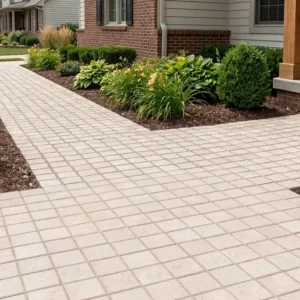
- Match walling, paving and steps as a family rather than three separate purchases
- Keep coursing and joint width consistent between vertical and horizontal work
- Use the same stone at thresholds so the transition reads as one surface
- Allow for hand-worked edges where machine precision would look wrong
The wider cultural layer around the sugar estates is documented in the UNESCO record of the Cocolo dance drama tradition, which grew from the same estate communities.
Estate Detailing That Survives Forty Years
Estate work is judged in decades, and the difference between a terrace that ages well and one that fails is almost always in the bedding and the joints rather than in the stone.
- Full bed, no spot fixing, especially under copings and treads
- Movement joints designed in rather than cut in later
- Drainage that can be rodded without lifting the surface
- Edge restraint that can be reset when a tree root eventually moves it
The practical case for this is set out in the guidance on detailing natural stone paving for long term durability.
Working Around a Property That Never Closes
La Romana estates run guests, members and events continuously, so construction has to behave like a service rather than a disruption.
- Deliver outside guest movement hours and stage material off the main routes
- Work in short, fully finished sections rather than opening a long trench
- Protect adjacent surfaces before the first pallet arrives
- Agree a daily clean-down standard in the contract
Delivery routes and timings across the country are covered in our Dominican Republic supply overview.
La Romana estate stone, held to the Chavon standard
The area has an unusually clear benchmark, and buyers here tend to know it. Meeting it is a matter of coherence rather than expense.
- Specify walling, paving and steps together
- Detail for forty years, not for handover photographs
- Keep the site working while the work happens
- Record batches so later repairs still match
The village above the gorge proved the point decades ago, and the estates below it have never really argued with it.