Inland from the dive coast, Bonaire keeps its countryside: the kunuku – the smallholding landscape of farmsteads, goat pens, dry-stone walls and living cactus fences that fed the island for centuries. Some kunukus still farm, many drowse, and a growing number are finding new lives as restored homesteads, guest retreats and weekend places for families who want the island’s quiet interior. The revival has a stone craft at its center, because the kunuku always did.
The Anatomy of a Kunuku
The traditional kunuku is a lesson in dry-country pragmatism: a modest house sited against the wind, a cistern catching the roof’s rain, walls of stacked coral stone dividing pens and gardens, and the island’s signature boundary – the cactus fence, planted close and grown into a living barrier no goat argues with. Every element answers scarcity: water budgeted, shade cultivated, stone gathered from the very fields it now encloses. The revival keeps the logic and upgrades the comfort.
The Dry-Stone Inheritance
The kunuku’s walls are the island’s largest heritage structure, mile upon mile of hand-stacked coral stone crossing the countryside:
- Standing walls are kept and repaired in kind – stacked dry, in the old rhythm, by hands that learn it quickly.
- Fallen sections are rebuilt rather than replaced; the wall’s line is the property’s history.
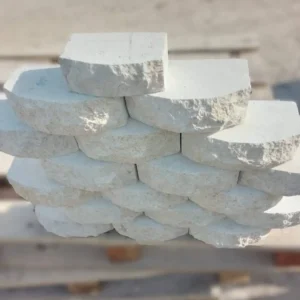
- New garden walls quote the coursing in modern engineered form – the heritage look, structurally honest.
- Old wall stone never migrates to new construction elsewhere; it belongs to its line.
The Restored Farmyard
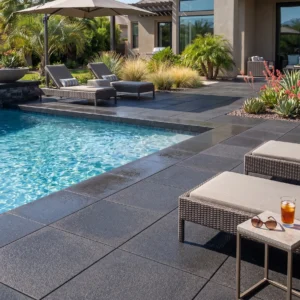
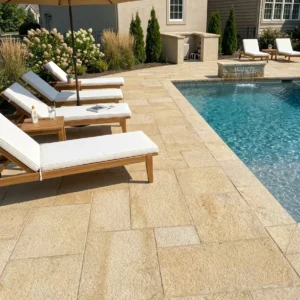
The revival’s centrepiece is the farmyard reborn as outdoor living: the working court between house and outbuildings paved in pale stone, the cistern head kept as the yard’s monument, shade structures where the wind and sun agree, and the old pens re-walled as garden rooms. The specification is dry-country standard – textured pale limestone, generous falls to planted ground, gravel courts between stone edges – and the palette sits naturally against the kunuku’s grays and greens. gardens that obey the rainfall maps the same design honesty on another dry island, and the kunuku wrote the original draft centuries earlier.
Living Fences, Stone Gates
The cactus fence remains the countryside’s best boundary – alive, free, self-repairing and utterly goat-proof – and the revival’s craft is the junction where living fence meets built entrance: stone gate piers holding the gap, a paved threshold carrying vehicles over the drip line, and wing walls settling the transition from planted boundary to built yard. The detail is small and constantly seen; done in coursed pale stone it gives the kunuku the front door its new life deserves without breaking faith with the fence line’s logic.
The Cistern Still Rules
Kunuku water is still budgeted – cistern rain first, trucked or piped supply as backup – and the hard landscape participates as it always did: roof and court falls feeding collection, paved surfaces that deliver clean water rather than dusty runoff, and planting held to the drought-schooled palette the countryside already grows. A restored kunuku that ignores its water logic has restored only the look; the ones that keep the budget find the island’s driest months no threat at all.
The Goat Reality
The countryside’s free-ranging goats are charming, persistent and hard on gardens, and kunuku landscaping is designed around them with the countryside’s good humor: cactus fences and walls doing the real defense, gates that close by habit, tender planting inside protected rooms, and stone surfaces – which the goats can neither eat nor undermine – carrying the ground plan everywhere the animals roam. It is the least glamorous specification input on the island and one of the most decisive; every kunuku owner learns it, most within the first week.
The Retreat Economy
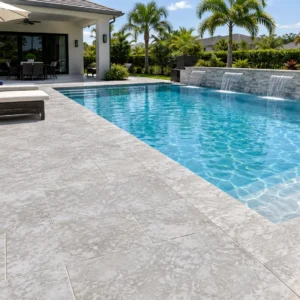
Restored kunukus are quietly joining the island’s hospitality inventory – countryside retreats offering what the coast cannot: silence, stars, morning birdsong and the interior’s green after rain. The guest brief adds hospitality touches to the farmstead register: courts and paths lit low for night navigation, outdoor showers in textured stone, a pool where the budget allows sited in the wind’s lee. The properties that succeed keep the kunuku honest – guests come for the countryside, and the stone’s job is to make the countryside comfortable, not to replace it.
The Aloe Memory
Before tourism, Bonaire’s countryside exported aloe – the bitter harvest that filled the island’s ledgers for generations – and the kunuku landscape still remembers the crop in field lines and family stories. The revival is replanting the memory as landscape: aloe beds as sculptural planting inside stone-edged garden rooms, rows quoting the old field geometry along walls and paths, and the plant’s architectural rosettes doing against pale limestone exactly what the dry garden asks of its punctuation. The horticulture is effortless – aloe wants precisely the conditions the kunuku has – and the heritage note is honest: this is what the countryside actually grew. A restored farmstead with aloe against its walls is quoting its own ledger, and the island reads the citation with pleasure.
The Countryside, Continued
The kunuku revival succeeds where it continues the countryside rather than colonizing it: walls repaired in kind, water budgeted, fences alive, new stone in the old palette. The dry-flat parallels one sea north are mapped in the borderland’s dry-country patterns, and the two landscapes share a rulebook. Restore the kunuku on its own terms – stone, shade and scarcity respected – and the countryside repays with the quietest good life on the island.
The Windpump Yard
The kunuku’s tallest survivor is often its windpump – the metal wind wheel that lifted well water for stock and garden through the dry decades, still turning on many farmsteads and still working on some. The revival treats the pump as the yard’s landmark and builds its setting accordingly:
- A stone-paved court at the pump’s base keeps the working area clean and gives the landmark its plinth.
- The old trough line – stone or concrete – is repaired in place where it survives; it is the yard’s history in section.
- Working pumps keep their access clear; restored-but-still ones anchor seating courts and garden rooms.
- New water infrastructure runs underground nearby, letting the old machine keep the skyline.
A turning wind wheel above a stone court is the kunuku revival’s signature image – the countryside’s old economy and its new life in one frame – and the properties that keep the pump in service, even ceremonially, hold a piece of working heritage every visitor asks about. The countryside’s icons are few and tall; building them a worthy ground is the least a restoration owes.
The old walls were built for a reason
Kunuku country is organized by dry stone. Field walls, corrals and boundary lines were laid without mortar from what the ground provided, and they have survived because that construction tolerates movement, drains completely and can be rebuilt by one person with no equipment. Any new work out here is joining a system that already solves the same problems, and the sensible move is to learn from it rather than to import a suburban vocabulary.
- Study the existing wall coursing before designing a new boundary
- Keep new walls low, repeated and rebuildable by hand
- Allow walls to drain rather than sealing them with mortar
- Reuse material already on the plot wherever it is sound
Goats decide what survives
Free-roaming livestock is the defining maintenance factor in this landscape. Anything plantable gets browsed, anything climbable gets climbed, and a boundary that is merely decorative will not stay a boundary. That reality favors hard landscaping over soft, and it changes the whole balance of a garden design out here.
- Structure delivered by stone and level change rather than by planting
- Boundaries built to actually exclude animals, not to suggest a line
- New planting protected individually until it is well established
- Gates and gaps detailed so they are used rather than climbed over
An arid climate with a violent wet season
The rainfall pattern is the other constraint. The climatology published by the National Hurricane Center runs the Atlantic season from June through November with a peak on September 10, and although this island sits at the southern margin of the basin, the systems that do arrive drop a disproportionate share of the year at once. Dry ground sheds that rather than absorbing it, so erosion rather than saturation is the risk.
- Cutoff drains across slopes to break up overland flow
- Gravel and surfacing sized so it stays put on a gradient
- Water directed to storage or planting rather than off the plot
- Bare ground stabilized before the season rather than after it
Choosing kunuku country stone that belongs out back
The material argument follows the setting. The Natural Stone Institute overview of limestone and travertine shows how much density and absorption vary within one name, and out here the right choice is whatever weathers into the landscape and can be rebuilt by the person who lives on it.
- Materials that read as agricultural rather than as resort finish
- Formats a single person can lift and reposition
- Dry-laid construction wherever the detail allows
- A surplus left on the plot for future repairs
Our Bonaire stone supply guide sets out the formats, finishes and lead times that suit this island. Out here the best new wall is the one nobody can date.