Heritage Here Is Lived, Not Staged
Saint Lucia is not a museum island, and its older places are working places. A yard behind a Castries shopfront still takes deliveries. An estate house at Laborie still has a family in it. Kwéyòl is spoken by almost the whole population alongside English, and Jounen Kwéyòl is a national observance rather than a tourist item, which tells you something about how living the culture is. Paving in that context has a modest job: to be flat, safe and quiet enough that the building keeps the attention it has earned. The temptation with heritage work is to design a statement. The better instinct is to design a background, and then to spend the saved effort on getting the levels, the falls and the joints right.
Soufriere and the Pitons Management Area
Anything near Soufriere sits in the shadow of the Pitons Management Area, a UNESCO World Heritage site of 2,909 hectares containing Gros Piton and Petit Piton, linked by the Piton Mitan ridge. There is a Green Buffer Zone around it, and UNESCO has repeatedly flagged intrusive building and the absence of a proper enforcement mechanism. That is not background trivia. It means development in that area is genuinely contested, and hardscape choices there are watched. Nobody should be pitching a scheme in or near the management area without planning consent already in hand, and material choices in that landscape should be quiet, low in reflectance and closer to the ground than to the view.
Consent Comes Before the Pallet
Planning is governed by the Physical Planning and Development Act 2001, as amended, and administered by the Development Control Authority, which locals simply call the DCA. Get that sequence right and the rest of the project is calm.
- Establish whether your works need permission before you commit to a material.
- Ask early what the DCA expects to see for external surfaces on your particular site.
- Remember the OECS Building Code applies, adapted from the Caribbean Uniform Building Code.
- Keep drawings and material samples together, because approvals move faster with both.
- Allow lead time for shipping after consent rather than ordering on optimism.
Choosing a Sett That Does Not Shout
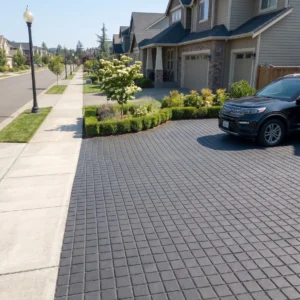
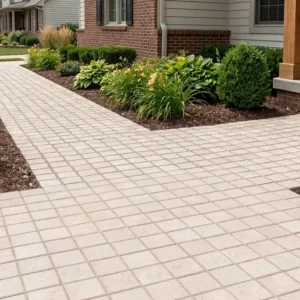
The instinct in a heritage yard is to reach for something dramatic, and it is nearly always the wrong instinct. Small units in a narrow tonal range read as ground rather than as decoration, and they age into a place instead of sitting on it. Irregularity helps: slight variation in size and face means a new surface does not look printed. Darker basalt suits a working yard and hides the stains a working yard produces, while a softer limestone tone sits better against pale rendered walls. Scale matters as much as tone: a unit that looks correct in a wide modern courtyard can look coarse in a narrow lane between two old buildings. Our quiet sett formats for conservation sites are chosen with that discipline in mind, and we would rather send a sample than a rendering.
Finish, Reflectance and Old Walls
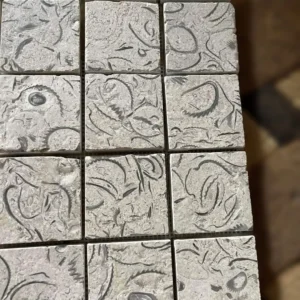
Finish does more work than tone in a historic setting. A polished face throws light back at a building and reads instantly as modern, and in a climate with this much rain it is also the least sensible surface underfoot. Tumbled, bush-hammered, sandblasted and flamed faces all scatter light, keep grip when wet and take a patina rather than a scratch. If you are unsure how a treatment will sit against old stonework or timber, compare quieter surface textures for heritage work side by side in daylight on the actual site rather than on a screen, because the wall behind the sample changes everything.
Patching, Reuse and Honest Repair
Most heritage work is repair rather than replacement, and repair has its own rules. The aim is never to make the patch invisible, which rarely succeeds anyway, but to make it unremarkable.
- Lift and set aside sound existing units before anyone brings a machine near them.
- Use salvaged material in the most visible areas and new stone where it is least seen.
- Accept a visible difference rather than faking an aged face badly.
- Match the joint width and the laying direction of the original work first.
Working With Local Aggregate, Not Against It
Saint Lucia has a long-established, locally owned quarry sector, and any heritage job will use it.
- Wilrock operates at Saphyr Estate in Laborie, producing aggregate, blocks, ready-mix and armor stone.
- Concrete and Aggregates has supplied ready-mix and crushed rock since the late 1980s.
- Quarry Products and RG Quarry are familiar names on any contractor’s list.
- Shuga Sand and Stone rounds out a sector that builds the base course on this island.
A Slower Way to Buy
Heritage projects reward patience, and the buying process should match the pace of the work rather than the pace of a sales cycle. Rushing the material decision is how a good restoration ends up with the one element everybody notices.
- Ask for a small hand sample and live with it on site through a week of weather.
- Agree the batch and the sorting before the container is packed, not after it lands.
- Plan delivery around access, since older yards rarely take a full articulated load.
- Order a modest reserve so a future repair can be made from the same batch.
Old buildings forgive slow decisions far more readily than they forgive loud ones.