A Country That Keeps Its Built History
For a small country, Antigua and Barbuda carries an unusual weight of surviving built fabric. The Antigua Naval Dockyard and Related Archaeological Sites were inscribed on the World Heritage List on 16 July 2016, with a core zone of roughly 255 hectares in Saint Paul parish and a buffer zone of about 3,873 hectares around it. The Georgian dockyard was built from 1725 by enslaved African craftsmen, and no honest account of that ground leaves the fact out. English Harbour and Falmouth Harbour sit inside or immediately beside the protected zone, which means paving there is not a free choice. It is a controlled surface within a designated landscape. Beyond that boundary the same instinct still applies across the country, because St John’s, the older estate buildings and the villages carry plenty of fabric that is not formally listed but is very much worth respecting.
What Heritage Ground Actually Demands
Heritage work is less about looking old and more about being reversible, honest and quiet. Before anything is specified, a project in a sensitive setting has to answer a short list of questions.
- Is the existing surface historic fabric, a later repair, or a modern replacement
- Can the new work be lifted later without damaging what sits beneath it
- Does the module and the joint width read at the same scale as the surroundings
- Will the surface change how water moves across a site that has managed it for centuries
- Who has to approve the change, and how long will that approval actually take
Reading an Old Surface Before Replacing It
Old paving is a document. Before a single unit is lifted, photograph it, measure it and record it, because the information disappears the moment work starts and cannot be recovered afterward. That record is what lets a specification be argued for later, and it is exactly what an officer reviewing the application will ask to see.
- Face sizes and depths, measured in several places rather than assumed from one
- How courses run around obstacles, thresholds, drains and changes of level
- Whether joints were laid tight or generously open, and what filled them
- How the surface shed water, and where that water was historically sent
- How the stone has worn, since old traffic patterns stay legible in the surface
Matching Without Copying
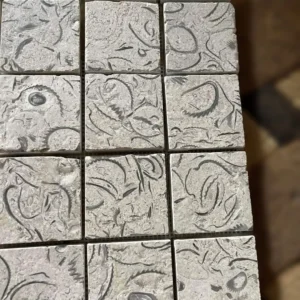
Good conservation practice does not ask for a forgery. It asks that new work sit comfortably beside old work without pretending to be it. In practice that means matching the module, the joint and the surface texture rather than chasing an exact tone, because tone shifts with weather and time anyway while scale never does. A hand-dressed face reads differently from a sawn one at every hour of the day, and that difference is what the eye picks up long before it registers color. The same logic governs the joint: a wide, softly filled joint belongs beside old work, while a hairline joint announces that the paving arrived last year. Get those two decisions right and the material choice becomes almost secondary. Our hand-dressed setts for historic streets options are chosen with that in mind.
Permissions Come Before Pallets
Nothing costs more on a heritage job than material sitting in a yard while an approval works its way through. Build the sequence backward from the consent, not forward from the order.
- The Development Control Authority administers planning under the Physical Planning Act 2003, amended in 2024
- Planning permission and a building permit are separate steps with separate timelines
- Work inside or beside a protected zone attracts extra scrutiny of surface materials
- The 1996 building code was based on the Caribbean Uniform Building Code
- A revised national code adapted from the 2016 OECS code is heading to Parliament
New Work in Old Settings
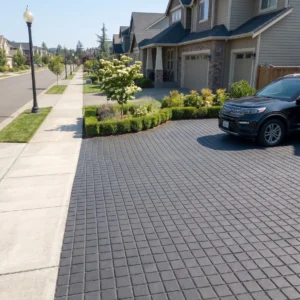
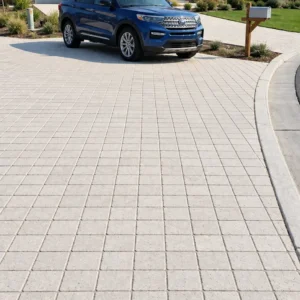
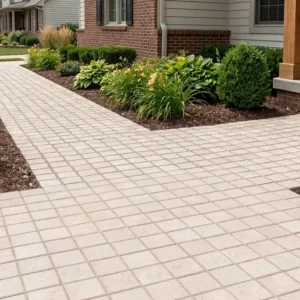
Most heritage-adjacent paving in this country is not restoration at all. It is a new terrace beside an old wall, a courtyard behind a restored shopfront in St John’s, or a marina apron looking across at a protected shoreline. Those projects need to be good neighbors rather than reproductions. Keep the module modest, keep the joint honest, let the edge details do the talking, and resist any temptation to add pattern where the setting is already doing the work. There is also a practical argument for setts in these places. Access is usually poor, machinery cannot always reach the working face, and a small unit can be carried through a gate and laid by hand where a large slab simply cannot be delivered to the spot it needs to sit. If you want the wider picture of what we deliver locally, see our Antigua and Barbuda service for the full range.
Samples, Trials and Sign-Off
Approvals in sensitive settings are won with a physical panel, not a rendering. Order small samples, lay a trial area on site next to the surviving surface, and view it in morning light, in afternoon glare and soaked with water. Photograph the panel and put those images in the submission. It is the cheapest insurance available on a heritage project, and it turns an argument about taste into a conversation about evidence that anyone can check for themselves. Keep the panel in place until the approval is granted, and reuse the units in the finished work. In a setting this carefully protected, the surface underfoot deserves the same care as the walls around it.