What heritage means on a young island
Cayman heritage is not cathedral heritage. It is a low cottage with a shaded porch, a wall built from what the ground gave up, a yard that was swept rather than paved for generations. The building stock that carries the island’s memory is domestic in scale and unshowy in material, and much of what survived the twentieth century had to survive Hurricane Ivan in 2004 as well. Anything laid beside that fabric has to earn its place quietly. The test is not whether a surface looks historic in a photograph. It is whether a visitor notices the paving at all before they notice the building. Scale is the first discipline. A wide sweep of paving in front of a small cottage overwhelms it however good the stone is, while a narrower path with planting at its edges will almost always look older and better.
The fabric you are working beside
Before choosing a stone, look hard at what is already there. Older Cayman work has a vocabulary of its own, and paving that ignores it will always sit slightly wrong.
- Rough coastal rock in walls, laid to fit rather than to a coursing rule.
- Rendered and lime-washed surfaces that carry a soft, uneven face.
- Capped garden walls, where the cap line becomes the level everything else answers to.
- Mortar-set terraces from earlier eras, often on a shallow base by modern standards.
- Mature planting that has grown into the geometry and should not be re-planned around new paving.
Caymanite and the respect it is owed
Any honest discussion of stone here has to mention Caymanite. It is a rare banded dolomite formed in ancient voids within the Bluff Formation, found only on the Cayman Brac bluff and at East End on Grand Cayman, and its layered earth tones come from the different mineral content of each band. It is set in gold and worn as jewelry. It is a national ornament, not a paving material, and nobody should try to make it one. The right posture toward Caymanite is admiration and distance. Imported paving stone is not a competitor to it and should never be presented as one. Knowing that story also settles a question buyers sometimes ask. There is no local supply of calibrated paving to compete with here, because the island’s own rock is worked as fill and aggregate rather than cut to a consistent thickness.
Choosing a sett that does not shout
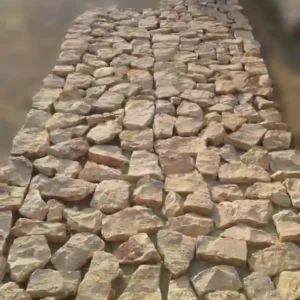
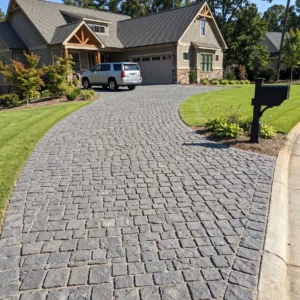
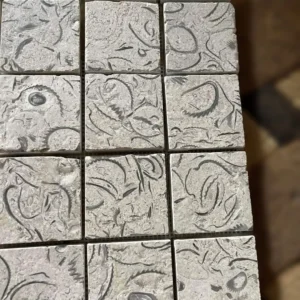
Heritage settings punish uniformity. A perfectly repeating field of identical units reads as a product, while a field with slight variation in tone and face reads as a surface. That is the practical case for cobblestone options for older properties, where the small module and the textured face do most of the work before any pattern is chosen. Keep the tone close to the walls rather than in contrast with them, and let the joint, not the color, provide the rhythm across the surface. Format helps as well. A mixed-size field, where courses vary in width, breaks up the regularity that gives new work away, and it echoes the way older walls were built to fit rather than to a rule.
Joints, mortar and the look of age
More heritage schemes are spoiled by joints than by stone selection. A hard, bright, wide joint pushes a surface forward visually and reads as recent work from clear across a courtyard.
- Keep joints narrow and consistent so the eye reads stone rather than grid.
- Choose a joint tone close to the stone, never brighter than it.
- Match the mortar to the setting when working against older walls, and take advice on lime-based fabric.
- Avoid heavy sealers, which add a sheen no traditional surface ever had.
Planning consent and the public edge
Development in the Cayman Islands runs through the Central Planning Authority under the Development and Planning Act (2021 Revision), and the regulations reference ironshore in coastal setback distances, which can affect where hard surfacing is permitted near the shore. Ground-level work in a sensitive setting is worth raising early rather than late. Buyers coordinating several elements at once often begin with stone supply for the Cayman Islands and bring their consultant into the material discussion while the options are still open. The same caution applies to levels at a boundary. Raising a terrace against an old wall changes how water reaches it, and that is a conversation to have with whoever knows the building best.
Living with a heritage terrace
A heritage surface is meant to age, but aging well is not the same as being neglected. Salt haze reaches inland across these islands and a freshwater rinse is routine maintenance rather than an intervention.
- Rinse with fresh water after long dry spells, when salt has built up on the faces.
- Top up joints each year rather than waiting for a section to loosen.
- Keep roots and heavy planting back from the edges of the field.
- Leave the weathering alone, since a scrubbed surface takes years to look settled again.
The patina is the point. New stone laid with restraint becomes hard to distinguish from old stone within a few seasons, and in this climate that happens faster than most owners expect. That is the whole objective. Heritage paving succeeds when it looks like it was always there.