Where the World Heritage boundary runs
The Historic Area of Willemstad, Inner City and Harbour was inscribed by UNESCO in 1997. It covers four districts, Punda, Otrobanda, Pietermaai and Scharloo, together with the harbor, and it holds 743 listed monuments. Most of the fabric inside that boundary dates from between 1650 and 1900. Anyone planning hardscape work in those districts is working inside a World Heritage area, and that single fact reorders the project: what may be laid, how it may be laid, and who has to agree before any of it happens.
Two desks, not one
A building permit is not the only approval in play. The Monuments Office sits within the Department of Urban Planning, Development and Housing and is responsible for the protection and conservation of monuments and the historic townscape; funding for that work runs through the Meerjarenprogramma Bijdrageregeling monumentenzorg. Separately, Stichting Monumentenzorg Curacao manages more than 120 monuments of its own, among them town houses, forts, plantation houses and a former synagogue. The Monuments Office is charged with the historic townscape as well as individual monuments, which is why a ground surface between two houses belongs to the protected setting rather than sitting outside it.
- Building permits are governed by the Bouw- en Woningverordening Curacao.
- Applications go to Ruimtelijke Ordening en Planning, the spatial planning department.
- Work touching the historic townscape also goes past the Monuments Office.
- The statutory decision period is a month, with six to eight weeks in practice.
- Treat approval time as part of the schedule, not as an afterthought.
Establish what the property actually is
Before tone, texture or format, the question is what the building and its surroundings are actually made of. Coral stone and quarry stone finished with lime plaster, with brick used for detailing, is the traditional Curacao wall material, and where it survives it deserves careful handling rather than a confident guess. The fabric around a given courtyard may equally be render, block, timber or later concrete, and the right answer for a paving specification changes with it.
- Identify the wall material and its finish before choosing a stone tone.
- Check whether the surface you are replacing is original, later or a repair.
- Photograph the existing ground surface in dry light and again wet.
- Ask the Monuments Office what is recorded for the address itself.
Tone and the argument with glare
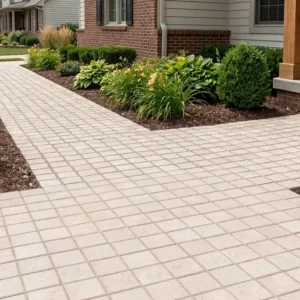
Reflected light has been a local subject for two centuries. In 1817 the governor banned the painting of houses white on the grounds that the glare damaged the eye. Whatever weight you give the story, the underlying condition has not changed: under a very high sun on a semi-arid island, a bright, smooth paving surface throws light back into faces, into windows and into every photograph anyone takes of the building behind it. Tone is therefore a comfort question as well as a conservation one, which is why it pays to settle it before pattern when you draw up sett sizes for monument settings.
Texture, dressing and old work
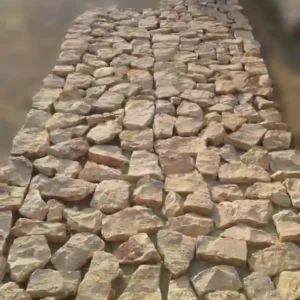
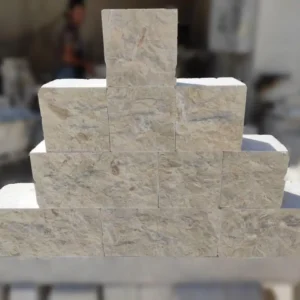
New stone laid against old fabric is judged on surface before it is judged on anything else. A sawn face reflects; a dressed, riven or tumbled face scatters light and settles more quietly next to lime plaster and weathered masonry. Constant trade-wind grit works on any exposed surface here, and a textured face carries that abrasion without looking damaged, where a polished one dulls unevenly. If you are matching a face rather than a stone type, start by comparing the dressing options on each face.
- Sawn faces read as new and send back the most light.
- Tumbled and riven faces break up reflection and hide fine abrasion.
- Bush-hammered faces give grip without the gloss of a polished surface.
- Any candidate should be judged wet as well as dry, outdoors.
Outside the boundary: the landhuizen
Not every sensitive site sits inside the inscribed area. Landhuizen, the plantation houses scattered across the island, stand on their own grounds with their own approach routes, forecourts and terraces, and work there raises the same questions of tone, texture and jointing without the same statutory route. The safe assumption on any older property is that the ground surface is part of the setting rather than a neutral background, and that a decision taken for drainage or for cost will still be read as a design decision by everyone who visits. An approach route and a forecourt were built to be arrived at, and the surface underfoot is the first thing a visitor reads.
Samples, trial panels and approvals
Approvals go better when the conversation is about something physical. A small hand sample answers tone and texture; a laid trial panel answers pattern, joint width and how the surface behaves in the light at the actual address.
- Order samples early, while the drawings can still change.
- View them at the site, against the wall they will sit beside.
- Wet them, because a wet surface is a different tone and a different grip.
- Keep a signed reference sample once a choice has been agreed.
Supply and the honest position
Curacao produces the material under a pavement rather than the pavement itself. Mining Company Curacao, operating since 1874, supplies crushed aggregate, sand, base coarse and industrial limestone powders; a cut or hand-dressed paving unit is a separate product category imported over the top of that base. On the freight side, the Port of Willemstad takes ocean cargo directly, with no transshipment leg required, which removes one of the less predictable variables from a restoration schedule. In a World Heritage district the approval route sets the timetable, so start it before the stone.