Jamaica already has a paving language
Anyone who has walked the older streets of Falmouth or crossed the square at Spanish Town knows that Jamaican towns are not blank pages. Georgian frontages, stone thresholds, timber verandahs and worn steps set a rhythm underfoot, and new paving either joins that rhythm or argues with it. Port Royal carries the same weight in a different key. When a client asks for setts in a setting like this, the brief is rarely make it look old. It is usually closer to make it look as though nobody redecorated the ground, which is a harder and far more interesting problem to solve. The same question turns up in Kingston courtyards behind older townhouses, where a flat modern surface can strip the character out of a space that took two centuries to earn it.
What a heritage setting changes about the spec
Historic surroundings pull the decision away from catalog choices and toward matching behavior.
- Unit size, since older surfaces almost always used small pieces set by hand
- Joint width, which dates a surface faster than the stone itself ever will
- Surface texture, because a sawn, sharp-edged face reads as modern from ten paces
- Coursing discipline, since old work wandered and a laser-straight line looks wrong beside it
- Edge treatment where new paving meets an old threshold, drain or wall base
Matching without faking
The trap in heritage paving is imitation. Artificially distressed stone tends to look distressed rather than old, and it ages badly because the wear is decorative rather than earned. The better route is to get the geometry and the surface behavior right and let time do the rest. Choose a stone with a natural split face, keep the plan size honest, and accept the small variations that hand work produces. A quietly correct new surface sits beside an old one without competing for attention; a theatrical one shouts across the courtyard for the next thirty years. It also pays to work out what the original surface was doing. Old yards were laid to move water toward a drain, a garden or the street, and copying the appearance while ignoring that drainage logic produces a very handsome puddle.
Great house grounds and estate approaches
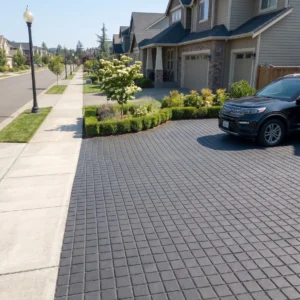
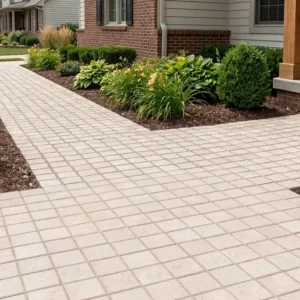
Estate work is the most common heritage brief on the island: an approach drive to a great house, a carriage circle, a courtyard between service buildings, a path running from a terrace down into a garden. These surfaces are seen slowly and mostly on foot, which means the eye has time to find every flaw in the setting out. They also carry occasional vehicles, so the build-up has to be honest even where the appearance stays gentle. For work of that kind we supply sett paving for historic yards in plan sizes that suit hand-laid coursing rather than machine-set speed.
Finishes that age honestly
Finish is where heritage projects are won or lost, and it deserves deciding before quantities are fixed.
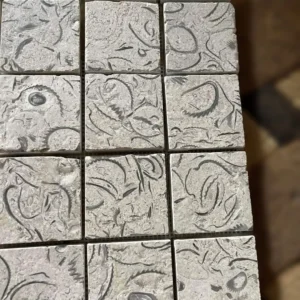
- Split or riven tops for the most convincing older surface and the best grip when wet
- Flamed faces where a slightly more even texture suits a formal court
- Tumbled edges to soften arrises without pretending the stone is antique
- Sawn sides for tighter joints where the architecture demands real discipline
If you are weighing texture against upkeep, the comparison of surface finishes on natural stone sets out how each option behaves once it is wet, shaded and walked on daily.
Rain, shade and the upkeep an old yard really gets
Jamaican heritage sites are usually well planted, and shade combined with mountain rainfall means damp stone for long stretches of the year. Moss and algae are the local condition rather than a defect, so plan around them instead of fighting them.
- Keep falls positive so water leaves the surface instead of sitting in it
- Avoid dead corners where leaf litter collects and stays wet for weeks
- Clean gently twice a year rather than blasting the surface once every five
- Keep harsh chemicals well away from planting beds and older masonry
Agree that routine with whoever will actually carry it out before the job finishes, rather than after the first wet season has taken hold.
Approvals, access and working in an old town
Historic sites are rarely convenient to build on. Access is narrow, storage space is short, and the surrounding fabric is fragile enough to punish carelessness.
- Confirm the approval route with the parish authority before the design hardens
- Check what the Building Act 2018 and the National Building Code of Jamaica require of the works around the paving, not only the paving itself
- Agree delivery windows that do not block a working street for a whole day
- Protect thresholds, wall bases and existing drainage for the duration
- Get a sample to site early and look at it in the actual light of the courtyard
Jamaican stone, stated plainly
Jamaica is a limestone island with marble on its own non-metallic minerals list, and quarrying is supervised by the Mines and Geology Division under the Mining Act and the Quarries Control Act. Historic Jamaican buildings were raised from local stone and lime, and any honest heritage conversation starts by saying so. What the island does not run is a calibrated dimension-stone line producing setts to a consistent depth for hand-laid paving, and that is the gap imported material fills. Samples are small, so ask for one early rather than late. Send us a photograph of the surface you are matching and we will supply stone that belongs beside it.