Wet Is the Normal Condition Here
A short, heavy squall can soak a terrace in minutes and leave under sunshine, so paving is repeatedly wet even in a dry stretch. Add sea spray on exposed frontages, pool water tracked across a surround, and the morning rinse after a salty night, and the wet state stops being an edge case. It is the condition the surface has to be safe in. That single reframing changes how a finish should be chosen, because a face that grips only when dry is a face that fails exactly when it is needed. It also explains why so many retrofit complaints on this island are about texture rather than about the stone itself.
What a Bush-Hammered Face Does Underfoot
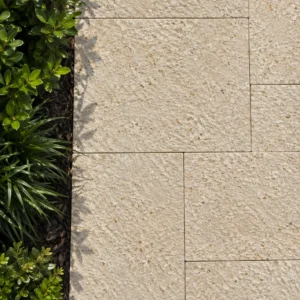
Bush hammering works the surface into a dense field of small pitting, producing an even, deliberately textured plane rather than a smooth one. Water breaks up across the texture instead of forming a continuous film, and the raised points give a bare foot something to hold. It is the most confident wet-grip finish in the common range, and it suits ramps, steps, sloped runs and anywhere a slip would matter most. The texture also softens the appearance of a pale stone, taking the hardness out of strong midday reflection, which is a useful side effect on an open terrace.
Brushed and Honed: The Middle Ground
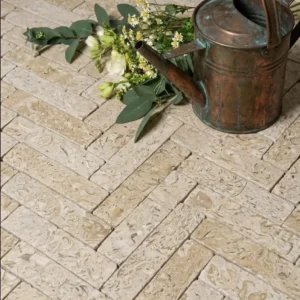
A brushed face is worked with abrasive brushes until the surface takes on a gently undulating, slightly open texture. It gives real wet grip while staying comfortable enough for long barefoot use, which makes it the default choice on many terraces. Honed sits a step smoother again, offering an even matte plane that reads calmly and cleans easily, though it asks for more caution where slopes and constant water meet. Between the three, most residential schemes can be solved without ever reaching for a polished surface, which has little business outdoors in this climate. The useful habit is to stop thinking of a finish as a style choice and start treating it as a performance specification that happens to look a certain way.
Texture Against Cleaning: The Real Trade
Every gain in grip costs something in ease of cleaning, and it is better to decide that consciously than to discover it later.
- Deep texture holds grip superbly but catches sand, salt film and organic debris
- Smoother faces rinse quickly but need more care on wet slopes and around water
- Textured surfaces disguise minor marks, which suits high-traffic family areas
- Whatever the finish, a soft brush and fresh water beat aggressive chemical cleaning
Bare Feet, Furniture and Wheels
Grip is not the only thing a texture affects. A finish that feels secure can also feel coarse after an hour of standing, drag on chair legs, or make a service trolley awkward. Balance the requirements by area rather than picking a single face for the whole property.
- Long barefoot standing areas: brushed, comfortable rather than aggressive
- Steps, thresholds and sloping runs: bush-hammered, safety before subtlety
- Dining zones with chairs moving constantly: brushed or honed, easier on furniture
- Service routes and wheeled access: a smoother face with a textured border for grip
Rainwater, Catchment and What You Apply
Water supply here moves through the limestone aquifer, and harvesting rain into on-lot storage is normal practice rather than an eccentricity. That makes paved areas part of a water path, not just a surface, and it is a good reason to prefer grip that is built into the stone over grip that arrives in a bottle. Households comparing limestone paving for Barbadian homes often find the finish decision quietly removes the need for aftermarket fixes.
- Anything applied routinely in a catchment route deserves a second thought first
- A face that grips on its own merits reduces the pull toward chemical solutions
- Coatings wear unevenly and need renewal, while built-in texture does not wash away
- Keep falls and drainage working so water leaves rather than sitting on the surface
Choosing a Finish Zone by Zone
Walk the property and mark where water will actually be, then assign the face to each area rather than to the project as a whole. Do it after rain if you can, because the puddles and the slow-drying corners announce themselves far more honestly than a plan ever will.
- Wet feet leaving water: highest grip available, no exceptions
- Shaded areas that dry slowly: texture helps, since damp lingers longer than expected
- Salt-exposed windward runs: texture plus a tight stone, and plan for rinsing
- Sheltered courtyards used dry most of the time: comfort can lead the choice
Test the Finish, Not the Photograph
A finish photographs almost identically whether it grips or not, which is why every serious specification ends with a physical test. Wet a small piece, tilt it, stand on it, and try it barefoot rather than in shoes. Ask for slip resistance measured wet on the exact face you intend to buy, not on the material in general, and ask which test method produced the figure. If the difference between two options is unclear on paper, comparing textured stone surface finishes in the hand settles it in about a minute. The right finish is the one that still feels safe when the surface is running with water.