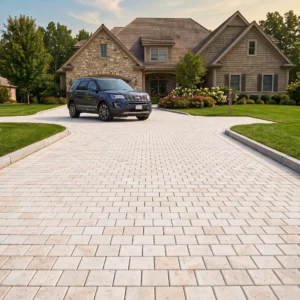
Salt, Not Frost, Is the Governing Exposure
Plenty of paving specifications arrive in the islands carrying a freeze-thaw clause inherited from a temperate template. It is dead weight. What actually attacks a surface here is salt: salt-laden air corrodes standard metals rapidly, and salt crystallization works inside porous material as moisture cycles through it. That is why the durability property to interrogate is absorption and density, and why the fixings schedule deserves as much attention as the stone schedule. Get those two right and the rest of the detailing follows naturally, zone by zone, from the splash line to the back of the plot.
Zone One: Beachfront and Splash
The band nearest the water is the harshest environment on the plot and the one most likely to be under-specified because it is also the most photographed. Wind-driven spray reaches further inland than anyone expects, especially on an open frontage, so treat this band as its own specification with its own budget line.
- Specify low-absorption, dense stone and ask for documented absorption figures.
- Use stainless fixings throughout and avoid cast zinc alloys entirely.
- Bed and bond rather than dry-lay, so surge and storm water cannot lift units.
- Detail a robust restrained edge where paving meets sand or planting.
- Plan for fresh water rinsing as routine maintenance, not as a repair.
Zone Two: Pool Decks and Open Terraces
Pool decks combine chlorinated or salt water splash with barefoot use and unshaded sun. The material has to be safe when wet and tolerable at midday, which is a narrower window than most people allow for. Test any candidate surface wet and barefoot in the middle of the day, because that is the only test that counts here.
- Choose light-toned, low-heat-gain surfaces so the deck stays usable barefoot.
- Pick a textured face for wet grip rather than a polished one.
- Fall the deck away from the pool and size the drainage for sudden downpours.
- Keep coping details simple so they can be lifted and rebedded if needed.
- Match the terrace stone in tone but not necessarily in finish.
Zone Three: Inland Courtyards and Driveways
Set back from the water, salt loading eases but never disappears, because the air across these islands carries it everywhere. The governing loads inland are mechanical rather than chemical: vehicles, service traffic and thermal movement across large unshaded areas. This is where you can widen the material palette, use a slightly higher absorption stone if the numbers still make sense, and spend the saved budget on depth and bedding instead. Shade from planting and buildings changes the surface temperature more than the material choice does. Working out paving detailed for salt exposure zone by zone usually costs less overall than applying a single worst-case specification to the whole plot.
Metal Is the Weak Link
On most island projects the stone outlasts everything holding it in place. Salt-laden air corrodes standard metals rapidly, so the fixings schedule is where a good paving job quietly fails.
- Use stainless steel fasteners as the default, not as an upgrade.
- Avoid cast zinc alloys, which perform badly in this atmosphere.
- Prefer stainless railings and balustrade fixings around decks and steps.
- Check that drainage gratings, channels and covers are non-ferrous too.
- Reinforced poured concrete is the recommended structural approach and gives paving a sound base.
Rain Arrives All at Once
The islands are arid to semi-arid and receive about 43 inches of rainfall a year, but it arrives in heavy concentrated periods that demand adequate drainage. That is a very different design problem from steady rainfall, and a flat limestone platform does not shed water quickly. Weighing finish choices for salt zones that keep their grip when soaked is part of the same calculation.
- Size falls, channels and the discharge point for the burst, not the average.
- Keep water away from thresholds and off any route people walk barefoot.
- In low-lying areas, keep lower levels for utilities rather than living space.
- Design for storm surge alongside rainfall on any low coastal plot.
What Ike and Irma Changed
The islands have real reference points for how hard the season can hit. Hurricane Ike passed just south in September 2008 with winds around 135 mph, damaging most homes on South Caicos, flooding the airport and sweeping away boats that had been towed ashore. Building codes were strengthened afterward. When Hurricane Irma crossed as a Category 5 on 7 September 2017, with sustained winds in excess of 156 mph, damage was severe nationwide and worst on South Caicos, Grand Turk and Salt Cay, though much of it was classed as minor roof damage, a result credited to those post-Ike code upgrades. Paving detailed to that same seriousness survives the season with it. Detailing that assumes an ordinary year is detailing that assumes the wrong year.
Detail Now for the Season You Will Get
Storm-season detailing is not exotic; it is a handful of decisions taken early and never revisited. Zone the site, specify absorption and density rather than frost resistance, use stainless throughout, bond the paving to a sound slab, and size the drainage for a downpour rather than a drizzle. Order small samples and test them against the water on your own site before committing to a single pallet. Stone specified for salt and surge quietly outlasts everything fixed to it.