The Storm the Territory Measures Against
Hurricane Irma crossed the British Virgin Islands as a Category 5 storm on 6 September 2017, with sustained winds reaching 185 miles per hour. Around 85 percent of the housing stock, roughly 4,200 homes, was damaged or destroyed, property damage was estimated at 3.6 billion US dollars, and Hurricane Maria passed south as another Category 5 just two weeks later. Recovery was slow; about 30 percent of power was restored 67 days afterward. Nobody in the Territory needs this recited to them. It matters here only because it changed how people build, and because buildings put up to current standards performed markedly better than older stock, with roofing and fixing weaknesses exposed most sharply.
Zoning a Site Before Choosing Stone
Exposure is not uniform across a property. A single villa can hold four conditions, and treating them identically means overspending in one place and failing in another.
- Windward frontage taking salt spray and driven rain directly
- Leeward courts sheltered by the building itself or by the slope
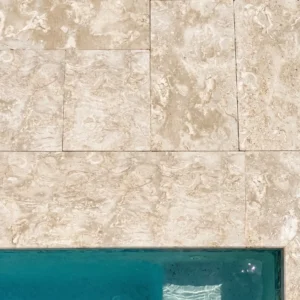
- Pool surrounds carrying chlorinated splash and constant wet traffic
- Ridge and gap positions where wind accelerates over a saddle
- Shaded terraces that stay damp and grow biological film
Wind Uplift Is a Hardscape Problem Too
The lesson from 2017 was fixings. Anything not held down becomes something that hits something else. Hardscape is usually left out of that conversation and should not be, because loose or lightly laid units on an exposed terrace are stored energy. Specifying paving built to stay put in exposed positions means substantial unit weight, positive restraint and bedded construction rather than loose laid.
- Bed exposed paving rather than laying dry on a sand course
- Restrain every free edge, including steps and level changes
- Favor heavier units where wind can get under a leading edge
- Fix or weight loose site furniture that sits on the paving
Rainwater Capture Changes the Drainage Brief
This is the detail that makes a Virgin Islands specification different from anywhere else in the region. The Territory is dry and water stressed. More than 90 percent of the population relies on rainwater harvesting, with rain collected from roofs into cisterns often built into the house foundation, and desalination carries the rest, with five plants on Tortola and the first installed back in 1988. Water is not a nuisance to be shed. It is a resource to be caught.
- Decide early whether hardscape runoff feeds collection or drains away
- Keep collection surfaces clean, with jointing that does not shed fines
- Separate vehicle areas from any surface feeding a cistern
- Take local advice on what materials are acceptable in a collection path
- Design falls so clean water reaches the right place, not the wrong one
Salt, Density and the Atlantic Side
Marine exposure is island-wide, and the northern coasts face open water. Dense, low-absorption stone resists salt crystallization better than porous material, and the difference shows up over years rather than months as surface fretting on the windward face of a terrace. Density also helps with the wind argument, since the same physical property that keeps salt out keeps mass in the unit. Ask for absorption and density figures for the specific stone you are considering, and compare them against the exposure zone you have just drawn. A sheltered inner courtyard can carry a softer, more absorbent material happily for decades, while the same stone on an open frontage facing the sea will not repay the saving.
Texture for Sudden Rain on Steep Ground
Rain here arrives hard and leaves fast, and it arrives on ground that slopes. A finish that feels pleasant dry and turns slick wet is a real hazard on a hillside path. Reviewing textures that shed rain cleanly alongside your layout is worth doing before the order rather than after the first heavy shower. Bush-hammered, brushed and honed surfaces all behave differently underfoot, and the right answer changes between a shaded stair and an open pool deck.
Joints, Beds and What Fails First
Failures start at the edges and the joints, never in the middle of a well-laid field. Open joints let water into the bed, a saturated bed loses support, and unsupported units rock under load until the corners break. On a slope, the same sequence runs faster because water has energy behind it. Detail the perimeter as carefully as the surface, keep joints filled, and give the bed a route for water to leave rather than a place for it to sit. Steps and level changes deserve particular attention, because they concentrate both foot traffic and runoff into a narrow band, and because a cracked riser is the first thing an owner notices. None of this is expensive at construction stage; all of it is expensive afterward, on an island where every repair brings its own freight bill.
A Pre-Season Walk Around the Paving
Half an hour before the season is worth a week of repairs after it. Walk the whole scheme with an owner or caretaker and look for the small things that become big ones.
- Rocking units, open joints and any edge that has lost its restraint
- Blocked outlets, silted channels and downpipes discharging onto paving
- Loose furniture, planters and light fittings standing on the terrace
- Cracked bedding at steps, where movement concentrates
Zone the exposure, restrain the edges and decide where the water goes, and the paving will still be there when the season ends.