A wind that never really drops
Bonaire sits under a steady north-east trade wind averaging around 7 m per second, roughly 25 km/h or 15 mph. That is not weather, it is a standing condition, and it does two things to a paved surface continuously. It drives salt aerosol onto every exposed face, and it accelerates evaporation from anything damp, which concentrates whatever the water was carrying. Design for a permanent load rather than a seasonal event, and the specification changes from the base up.
Salt crystallization, not frost
In colder markets the failure mode is freeze-thaw, and specifications are written around it. Here the equivalent mechanism is salt crystallization. Solution enters pore space, sun and wind pull the water back out, and the salt left behind grows crystals inside the stone. The defense is low porosity and low absorption, plus details that let a surface dry evenly instead of trapping damp under an impermeable layer. Two stones that look identical on a sample board can behave very differently once absorption is measured, which is why the data sheet is worth more than the photograph.
Rain is scarce, and that changes upkeep
Annual rainfall runs only about 350 to 450 mm, roughly 14 to 18 inches, with a wetter spell from October into January and the heaviest months in November and December. Plan maintenance around that reality.
- Natural rinsing cannot be relied on to remove salt deposits, so washing down becomes a scheduled task.
- Use fresh water for washdown, and let surfaces dry fully rather than staying damp under covers.
- Expect deposits to concentrate on windward faces and at the base of walls and steps.
- Keep sealer decisions late, and test on an offcut in position before committing a whole terrace.
Sorting frontage into exposure bands
Not every surface on a plot faces the same conditions, and one specification across all of them wastes money in one place and fails in another. Read the aspect first, then choose.
- Splash and shoreline zones, wetted directly and drying under wind, where absorption matters most.
- Windward frontage taking the trade wind and its salt load with no screen in front of it.
- Sheltered courtyards and lee-side terraces, where the daily load is lighter but not absent.
- Interior floors, protected from wind but still handling salt tracked in on feet and equipment.
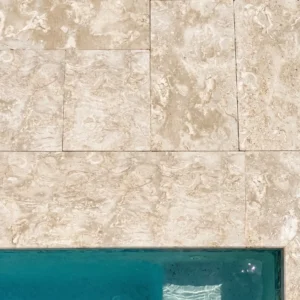
Choose limestone units graded for salt loading for the exposed bands, and keep softer, more absorptive material for sheltered ones if you use it at all.
The park starts at the high-water mark
Bonaire National Marine Park covers all water around Bonaire and Klein Bonaire, from the high-water mark down to 60 m, managed by STINAPA Bonaire. A shoreline terrace is therefore built at the park boundary. Four Ramsar wetland sites, Washington Slagbaai, Klein Bonaire, Lac Baai and Pekelmeer, were extended with a 500 m buffer in 2021. Sediment control is not paperwork here: silt in runoff reaches the reef, and permeable jointing, positive falls to planted areas and proper cut-off during construction are the practical answers.
Outside the belt is not out of reach
Bonaire lies at roughly twelve degrees north, outside the core hurricane belt, and the island carries a low historic hurricane risk. Outside the belt is not the same as immune. Hurricane Lenny in November 1999 was the only hurricane on record to form inside the Caribbean Sea and track east-north-east, generating large waves across the southern and eastern Caribbean and reaching the normally sheltered leeward coast, with coral and beach erosion recorded at Pink Beach and several west-coast dive sites. Hurricane Omar followed in October 2008. That record does not make shoreline design here identical to design on an exposed Atlantic island, but it does rule out treating the leeward side as permanently sheltered.
Bedding and jointing in a salt landscape
What sits under and between the units decides how long the surface stays flat and how much salt it holds.
- Never plan to take sand, shells or coral from the shore; collecting natural material is an offense, with fines cited between $100 and $500, and a permit from the bestuurscollege is required to remove material within the park.
- Coral stone carries further weight here: the small houses of 1850 at White Pan and Orange Pan are protected monuments to the enslaved people who worked the salt pans, and imported stone is the lawful route to a cut paving surface.
- Use imported or licensed bedding material with a known grading rather than beach material carrying its own salt load.
- Favor permeable joints where runoff would otherwise be channeled toward the shore.
- Design edge restraint to resist scour from wind-driven water as well as from traffic.
Faces that keep working in blown salt
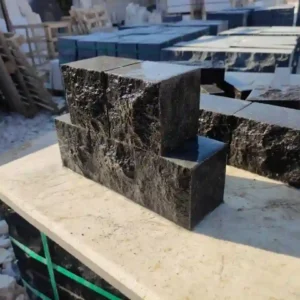
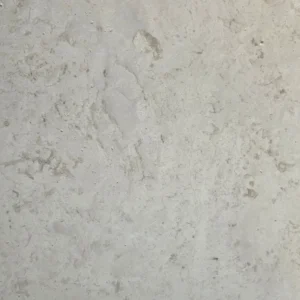
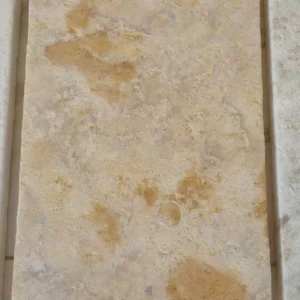
Surface texture governs glare, grip and how readily deposits sit on a face, so compare finishes on a physical sample under island light rather than from a photograph. Reviewing how a worked face behaves outdoors alongside absorption data tells you more than any product description will.
- Wet the sample and check grip with a bare foot as well as with a shoe.
- Leave a piece outdoors in the wind for a few weeks and look at what settles on it.
- Wash it with fresh water and see whether deposits lift cleanly or stay in the texture.
- Compare the same stone in two finishes side by side at midday, outdoors rather than indoors.
Specify the exposure band and the stone almost chooses itself.