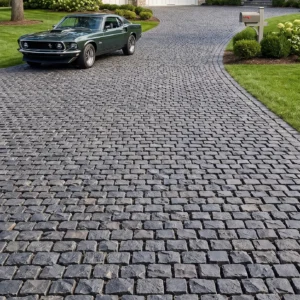
The Apron Works Harder Than the Drive
The apron is the short piece of paving where a driveway meets the road, the gate or the garage slab. It is a few hundred square feet at most, and it takes more punishment than everything behind it combined. Vehicles brake there, stop there, wait there and, above all, turn there. On a Tortola hillside they do all of that on a gradient, often reversing into a bank because there is nowhere else to swing.
Aprons also absorb the abuse nobody plans for: a concrete truck reversing during a build, a container delivery on a tight schedule, a service van that parks in exactly the same spot every week for years. That is why setts belong on an apron even where the rest of the drive is concrete or asphalt. Small units carry point loads through a deep section, they can be replaced one at a time, and they give a driver visual and audible warning that the surface has changed.
What a Turning Wheel Actually Does
A rolling wheel presses down. A turning wheel pushes sideways, and side load is what destroys paving.
- Steering while stationary drags the tire face across the joint line, scuffing and rotating shallow units.
- Power steering multiplies that force well beyond anything a person could apply by hand.
- Braking on a downhill apron drives units forward into the joint ahead of them.
- Repeat the cycle daily and any unrestrained edge migrates outward until the field opens.
Depth, Base and Bedding for Vehicle Duty
Vehicle-duty setts are not patio setts laid harder. Depth is the first defense, because a deep unit resists rotation the way a fence post resists a push at the top. Below the unit, the base carries the load and the bedding only distributes it, so the base has to be formed, compacted and drained before anyone opens a crate. On a sloping apron the base also has to resist creep, which usually means a bound construction or a concrete bed rather than compacted aggregate alone. Bedding thickness deserves the same attention, because an over-thick bedding layer behaves like a cushion and lets units migrate under repeated side load. When cobble setts sized for aprons are specified, we quote depth first and face size second, because depth is what survives the turning.
The Edge Is the Whole Job
Every apron failure starts at a free edge. Once the outermost course can move, the second course follows within a year.
- Set a buried restraint on the road side, where wheels track over the boundary.
- Haunch the edge in concrete on any side that faces open ground or planting.
- Use curbstone edging for apron margins where the apron meets a bank, so soil above is held as well as paving below.
- Finish gate thresholds with a full unit, never a thin cut piece that a wheel can lever out.
Wind, Water and Where It Goes
Two BVI conditions shape apron detailing. The first is storm exposure. Hurricane Irma passed directly over the Territory on 6 September 2017 as a Category 5 system, and the long rebuilding that followed made unit weight and fixing a normal conversation rather than a technical one. Loose or lightly bedded paving in an exposed position is a liability. The second condition is water. In a territory where rainwater harvesting supplies most households, a driveway apron is exactly the surface you do not want feeding a cistern, so its drainage should be deliberately separated from clean roof and terrace catchment. Both conditions point the same way: heavier units, bedded construction, and drainage that is drawn on the plan rather than assumed on site.
Left-Hand Drive on Left-Hand Roads
Traffic in the Virgin Islands keeps left, while most vehicles are left-hand drive and imported from the United States. That hybrid has practical consequences for an apron.
- Drivers judge the near-side edge from an unfamiliar seat position, so that edge takes the most tire contact.
- US-spec pickups and delivery trucks are wide, and the swept path at a gate is wider still.
- Deliveries arrive on US pallet and tail-lift equipment, which needs firm standing to unload.
- Container cargo clears at Port Purcell in Road Town and travels the last miles on tight hill roads.
Sizing an Apron on a Steep Entrance
Measure the swept path rather than the gate. Have the vehicle that actually uses the property drive the maneuver while someone marks the outer wheel line with chalk or pegs, then pave to that line plus a comfortable margin.
- Add length at the road end on steep entrances so a vehicle can stand level while a gate opens.
- Size for the delivery truck, not the family car, because the largest visitor sets the width.
- Check the line a reversing vehicle takes as well as the forward path, since the two rarely match.
- Keep the paved apron clear of the drainage channel so wheels never sit in the run of water.
Aprons sized on a drawing alone are almost always too small at the pinch point and too generous where nothing ever drives.
Get It Into the Drawing Set
Because a locally registered architect or surveyor files the planning application under the Physical Planning Act, 2004, the person holding your details is on the island even when the owner is not. Give them the sett depth, the bedding method, the restraint type and the swept path drawing as one package. An apron built for the turn, not just the traffic, is the cheapest insurance on the whole driveway.