Three Centuries of Building in Coral Stone
This island is a limestone cap lifted out of the Atlantic, and its coral limestone has been cut and laid here since long before anyone shipped paving across an ocean. Great houses, parish churches, boundary walls, sugar works and the fabric of Historic Bridgetown and its Garrison, a UNESCO World Heritage property, all read as one continuous material tradition. Coral stone is not a regional curiosity. It is a national identity material with a living quarry industry and masons who understand it in the hand.
Any imported stone arriving here enters that conversation as a guest. Treated that way, it works beautifully. Treated as a replacement, it looks imposed no matter how good the material is.
Why the Question Is Never Which Stone Wins
Buyers sometimes arrive expecting a comparison chart. It is the wrong frame. Coral limestone carries the character, the local knowledge and the continuity with everything standing nearby. Imported limestone brings consistent calibration, repeatable thickness, a defined finish range and predictable supply of matched units across a large area. Those are different strengths, and a well-run project uses both rather than forcing one material to cover every role. The framing also protects the budget, since local material carries no freight, duty or broker’s fee, while the imported portion earns its cost only where consistency genuinely matters.
Where the Two Materials Naturally Divide
On most residential projects the split becomes obvious once you stop thinking in terms of loyalty and start thinking in terms of task.
- Walls, piers, feature elevations and repairs: coral stone, cut and laid by local masons
- Large paved fields needing even thickness and joint width: calibrated imported units
- Heritage frontages and anything read from the street: local material, every time
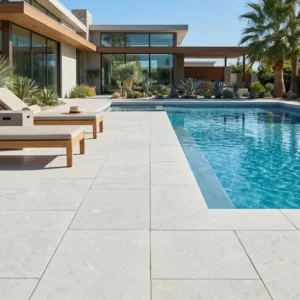
- Pool surrounds and terraces needing a specific finish and grip: imported, spec-led
- Steps, thresholds and copings: whichever material the detail actually calls for
Matching Tone Without Pretending
Trying to make an imported stone impersonate coral limestone rarely succeeds, because coral stone has a fossil texture and a light-catching irregularity that is entirely its own. Aim instead for a companion tone: something within the same warm, pale family that sits quietly beside the local stone rather than competing with it. Small differences in tone read as depth. Near misses read as a mistake.
- Compare samples against the existing coral stone outdoors, never under a roof
- Judge the pairing wet as well as dry, since rain deepens both materials unevenly
- Stand back to walking distance, where fossil detail stops registering
- Accept a visible difference in texture rather than chasing an imitation
Joints, Thresholds and the Places They Meet
Most of the risk in a mixed-material scheme sits at the junctions. That is where thickness differences, movement, drainage and workmanship all arrive at once, and where a good design either resolves cleanly or looks improvised.
- Decide the level relationship before ordering, since thickness is fixed at supply
- Use a deliberate transition such as a border course rather than an abrupt butt joint
- Keep drainage falls consistent across the change so water does not pond at the seam
- Agree the joint width and mortar tone with the mason before the first unit is set
Working With Masons Who Know Coral Stone
Local craftsmen have generations of experience with the island material, and they will tell you quickly if a proposed detail fights it. Bring them in early rather than presenting a finished drawing. In practice their input tends to shape three things: how the imported paving is bedded, how the two materials meet at corners, and how much of the scheme should stay local. Their objections are usually practical rather than protective, and a mason who has laid coral stone through decades of island weather can often predict where a detail will collect water long before a drawing shows it. Buyers exploring limestone slabs shipped into Bridgetown get better results when the mason has seen the material before the container is booked.
Heritage Areas Need an Early Conversation
Planning here runs through the Town and Country Development Planning Office under the Planning and Development Act, with the General Development Order covering matters including on-lot water storage. Coastal setbacks apply near the shoreline, and work in or around the historic areas of Bridgetown and the Garrison carries additional sensitivity.
- Confirm which consents your scheme needs before fixing materials or quantities
- Check coastal setback implications on any shoreline plot at concept stage
- Expect extra sensitivity to visible materials near the historic core and Garrison
- Keep on-lot water storage requirements in the drawings, not in a later revision
A specification that anticipates the review is far cheaper than one revised after a submission comes back.
One Project, Two Materials, One Intention
The properties that age well here are not the ones that chose the most expensive stone. They are the ones where each material was given a job it could hold, and where the island stone was allowed to lead. Consistent supply and calibration are worth importing for. Character, continuity and craft are already here, and a scheme that acknowledges as much tends to sit in its setting instead of announcing itself. Owners planning that balance can talk it through with a stone supplier serving Barbados before the quantities are fixed. Let the coral stone speak first, and bring the imported material in to support it.