Hilly Ground and What It Does to Paving
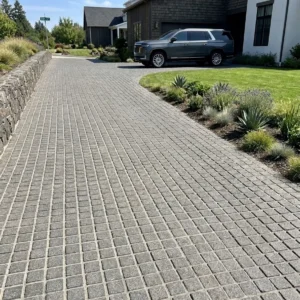
The Dutch side covers about 34 square kilometers. The Sint Maarten Hills and the Cole Bay Hills run through it, and Sentry Hill reaches roughly 341 meters, or 1,119 feet. Plots are carved into that relief: driveways climb, terraces step down in stages, and the fall between a garage slab and the road edge is often the whole design problem rather than a late detail.
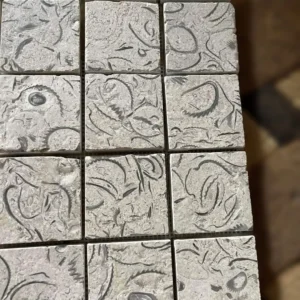
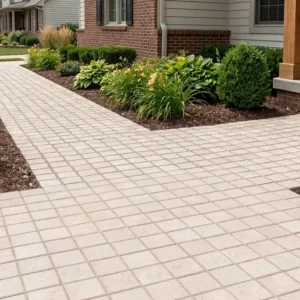
Small stone units handle that well. A sett is short enough in plan that the surface can change direction gradually across a run of joints instead of breaking at a hard edge.
Why Small Units Follow a Fall
A large slab has to sit in one plane. Put it on ground warping in two directions and either the slab rocks or the bed below is built up to manufacture a plane the site does not have. A sett makes no such demand. Each unit takes its own bearing and the joint beside it carries the difference.
The trade is joint count: more hand placement and more jointing material. It also buys a surface that can be lifted and reset in patches.
The Wet Months Are the Design Case
The island sees roughly 1,047 mm of rain a year, with the drier stretch running from January into July. The wettest months are September through November, which is also the peak of hurricane season. The heaviest water arrives with the strongest wind behind it.
So the design case is not gentle runoff finding a gully. It is wind-driven rain and, on exposed ground, scour at the weakest line in the build-up, which on a gradient tends to be a joint, an edge, or the point where one bedding layer meets another.
Bedding and Restraint on a Gradient
Because the failure modes sit in the build-up rather than the unit, what happens below and around the setts deserves more drawing time than the paving schedule. These points apply equally to sett paving for hillside ground and to a level courtyard.
- Decide early whether the paving is bedded rigidly on concrete or laid flexibly on a compacted bed, then hold that decision across the run.
- Step the sub-base rather than raking it, so each terrace of the slope bears on its own platform.
- Restrain every free edge. On a fall, an unrestrained edge is where the first unit moves and the rest follow.
- Specify the jointing material in its own right and check how it behaves when water arrives fast.
- Set falls and drainage lines before setting out the pattern, because the pattern has to follow them.
What the Island Supplies Underneath
Sint Maarten is built on volcanic rock: andesite tuff and tuff breccia from the Eocene, intruded by hypabyssal basalt and quartz diorite, with limestone and marl deposited later over the eroded volcanics. The Point Blanc formation, a layered rock dated at about 15 million years, has a sample in the Sint Maarten Museum. There is a documented history of aggregate quarrying on the island.
That local material forms sub-base and concrete on hardscape work here, and imported stone is not a substitute for it. What a 34 square kilometer island does not produce is dimension-sawn paving in calibrated thicknesses and repeatable finishes, lot after lot. The distinction is processing and supply, not quality.
Groundworks Permits Come First
Cutting into a slope is regulated. The Ministry of VROMI issues civil works permits for activity that alters terrestrial, coastal and marine terrain, and that scope names excavation. Those permits are prerequisites for the bouwvergunning, granted through VROMI’s Department of Permits under the National Building Ordinance.
- Excavation for a paving sub-base can fall inside the civil works permit rather than outside it.
- Coastal terrain alteration is named in the permit scope, which matters on shoreline plots.
- Approved permits are published biweekly in the National Gazette.
- A six-week objection window follows publication, so allow for it.
Sizes and Depths That Suit a Slope
Unit choice on a gradient balances how closely the surface must follow the ground against how much hand labor the budget carries.
- Tight radii and steep cross-falls generally want the smallest sett in the range.
- Long straight runs down a slope take a larger unit without losing the line.
- Thickness follows traffic, not gradient; a terrace and a driveway on the same fall are different specifications.
- Mixed sizes in one field absorb waste more easily where the ground is irregular.
- Keep a single depth per bedding type so the setting bed does not vary across the job.
Getting Stone onto a Hillside Site
Freight from the United States discharges directly at Point Blanche, where Port St. Maarten’s Captain David Cargo Quay operates a multipurpose terminal around the clock: 540 meters of berth, 10.5 meters alongside, a 3,000 TEU yard and Gottwald HMK 260E mobile harbor cranes rated at 100 tonnes each. Customs Sint Maarten describes itself as mainly a law enforcement agency rather than an import duty collecting organization, and says the only tax it levies is excise on unleaded gasoline. Goods are still declared and cleared; a tariff line does not apply.
- Check truck access and turning space at the plot before the pallet layout is fixed.
- Say early if the material has to be broken into smaller loads for a steep approach.
- Order edge restraint in the same consignment as the paving.
- Keep the crate and lot references so a later phase can be matched.
If you want specification and delivery handled together, the Sint Maarten stone hub works from your drawings and photographs. Send us the fall, the traffic and the access, and we will size the setts around them.