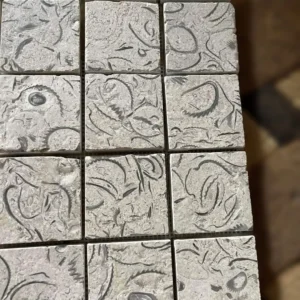
Ground that steps rather than slopes
Aruba is a low island, but low is not flat. The land reads as a series of Quaternary limestone terraces built up over roughly the last two and a half million years, and where a plot crosses the lip of one of those terraces the ground changes level over a short run. Add cut and fill, thin soil over rock, and a drive climbing from the road edge to a gate, and a fall turns up whether the drawings anticipated one or not.
The useful question is not whether the surface can be laid level, but where the fall gets absorbed: in the bedding, in the units, or in a step.
Why small units win on a fall
A large slab has to sit on one plane. Put it on ground that changes gradient and it rocks, sits proud at a corner, or forces the bedding to compensate. A sett is small enough to follow the ground instead of fighting it.
- Every unit takes its own bed, so a change of gradient is shared across dozens of joints rather than loaded onto one edge.
- Cross-fall and longitudinal fall can run together without the finished surface reading as twisted.
- A widening or an awkward return closes with sorted units instead of a saw cut through an expensive slab.
- The joint grid adds grip on a rising run that a smooth panel cannot offer.
Setting out the fall before the first sett
Draw the fall rather than discover it. Fix the levels that cannot move first: the threshold at the house, the gate line, the top of any pool coping, and the road or apron where the drive meets it. Everything between those is negotiable, and moving a step on paper costs nothing next to rebuilding a bay because the gradient ran out short of the door. On a long run, breaking the fall with a landing or one generous step gives the layer a clean place to reset the coursing.
Bedding and restraint on a grade
On a grade the bed and the restraint carry the whole detail. Water that would sit and evaporate on a level terrace instead runs, taking bedding fines with it if nothing stops them.
- Move to a bound or semi-bound construction once the gradient is meaningful, because loose sand beds migrate downhill under traffic.
- Restrain the foot of the run first and work upward, so courses close against something solid rather than creeping.
- Give the sub-base the same fall as the surface, so bedding depth stays even instead of thickening at the low end.
- Plan drainage at the bottom of the slope before the paving reaches it, not after.
- Check restraint at every direction change, since corners on a fall are where movement starts.
Depth matters more here than on level ground, and this is where hand-cut setts for graded ground repay a thicker unit: more stone in the bed, more resistance to rotation, and a longer joint face holding the neighbor.
Wind, salt and what fills the joints
Aruba’s specification problem is not the storm. The island sits below the main Atlantic hurricane track, and the working calendar here does not stop for a season. The trade wind does not stop either. It crosses the island every day carrying salt off the sea and fine abrasive dust off dry ground, and both end up in the joints. On a slope that matters twice over: the wind fills the joint, then rain moves what the wind delivered downhill. Choose the jointing for stability rather than for the handover photograph.
Depth, format and sorting
Format follows duty. On a graded pedestrian run the unit can be modest; where the fall crosses a drive it needs depth and tighter coursing.
- Gentle pedestrian falls: smaller setts in a shallower depth, laid tight.
- Stepped runs: consistent unit height matters more than face size, so risers stay true.
- Vehicle crossings on a grade: heavier units on a bound bed, coursed across the direction of travel.
- Order a sorting allowance, because graded work needs a choice of unit height at every course change.
Landing the stone at Barcadera
Cargo for Aruba goes to Barcadera, the island’s cargo port since it opened on 12 April 2016. Oranjestad now handles cruise and passenger traffic, so name Barcadera on the bill of lading rather than the older address that still appears on some paperwork.
- Value is assessed on a CIF basis, so freight and insurance form part of the figure the border works from.
- Where freight and insurance are not itemized separately, Aruba Customs adds a 16.5 percent uplift to invoice value on shipments from the Americas.
- Customs duty runs roughly 2 to 22 percent by product line, so confirm the classification that applies with your broker before pricing.
- Turnover tax has been collected at the border since 1 August 2023 at a combined 7 percent: BBO 2.5, BAVP 1.5 and BAZV 3.
- Invoice in dollars, since the florin is pegged at 1.79 to the US dollar.
Citadel loads in the United States, and because the island sits outside the storm track you can set a delivery window in any month; how we supply Aruba projects sets out ordering and clearance in sequence.
Getting the slope detail right first time
Getting a slope right is mostly deciding early where the fall goes and what holds it. Draw the fixed levels, pick the restraint, then pick the depth that suits the duty crossing it. Setts will not remove a gradient, but bedded properly and held at the foot they make one look deliberate.