What a slope does to paving in Jamaica
Very little of Jamaica sits level. Kingston climbs into the foothills within minutes of the harbor, the north coast rises from the sea in short steep steps, and the interior parishes fold into ridge and gully country. That geography decides paving long before anyone chooses a stone. A wide slab wants a flat plane, and it cannot follow a grade that changes twice in ten feet without lipping, rocking or cracking through the middle. A small unit can. Setts work on Jamaican ground for a plain mechanical reason: each piece is short enough to sit on its own patch of bedding and absorb the change by itself.
Reading the ground before you order
Hillside jobs here fail on ground behavior, not on stone quality. Walk the site during a downpour if you can, and write down five things.
- Where the water arrives from, and where it will go once the yard is sealed
- Whether the fall is one clean plane or a run of benches, hollows and old terraces
- How deep the cut and fill goes, and whether that fill was ever properly compacted
- The vehicle route, since a car climbing a ramp loads paving differently from one rolling down
- Whether a retaining wall or gabion is already carrying part of the slope
Water is the real load on a hillside
Rain does not fall evenly across this island. The Blue Mountains lift moist air and wring it out, so windward slopes take far more water than any coastal average suggests, and runoff arrives fast and loaded with fines. The Building Act 2018 came into operation on 15 January 2019 and brought the National Building Code of Jamaica, published by the Bureau of Standards Jamaica, into force, alongside national mapping of seismic, wind, rainfall, flood-plain and land-slippage hazard. That mapping matters to a paving contractor: a yard on a mapped slippage slope is a drainage question before it is a paving question, and the surface should carry water away in a controlled line rather than sheet it into the toe of the bank.
Base and bedding when the grade keeps changing
Setts forgive an imperfect subgrade, but they do not forgive a weak base. On a slope the base must resist downward load and creep at once, and the bedding must stay where it was screeded through the first heavy rain.
- Compact the sub-base in thin lifts and step it into the slope rather than wedging it
- Keep bedding thickness consistent, because a thick spot on a grade becomes a settled hollow
- Use a bound bedding and jointing system where the fall is steep or vehicles brake on the surface
- Build the edge restraint first, uphill and downhill, before a single sett is placed
- Give every low point a real outlet rather than a hopeful gap in the perimeter
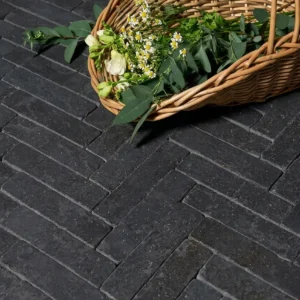
The format you order changes how easily that work goes. Our cobblestone setts for Jamaica arrive cut to consistent thickness bands, which lets a crew hold a level string down a fall instead of shimming every third piece.
Formats that suit a slope
Not every sett makes a good hillside sett. Smaller plan sizes and squarer proportions turn a curve or a camber more easily, and a split or flamed top gives grip where shade keeps a slope wet.
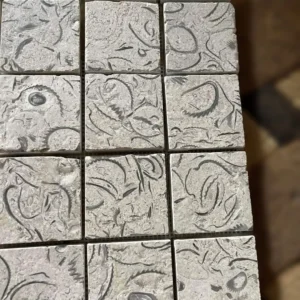
- Small square setts for tight radii, ramp transitions and awkward benching
- Rectangular setts for coursed runs that follow contour lines across a bank
- Deeper units wherever the slope also carries vehicles
- Textured surfaces rather than smooth ones anywhere shade keeps the stone damp
Where these jobs actually land
The pattern repeats across the island. Kingston hillside houses want a drive that climbs to the gate without a slip risk at the top. Resort properties above the north coast road at Ocho Rios and Rose Hall need service routes and guest paths on ground stepping down toward the sea. Boutique owners around Treasure Beach want something that reads as handmade rather than poured. In every case the argument is the same: the ground is uneven, and small units absorb unevenness better than anything else.
Getting stone up to a hill site
Most material lands at Kingston, or at Montego Bay for the resort belt. From there the problem is the last mile: narrow approach roads, tight gateposts and turning circles that will never take a full trailer.
- Split the order into pallet sizes your site vehicle can actually receive
- Confirm crane or forklift access before the container is booked, not after it sails
- Plan a laydown area that is not on the slope you are about to pave
- Allow clearance time with the Jamaica Customs Agency, since duty, General Consumption Tax, the environmental levy and the standards compliance fee are all assessed on CIF value
Rates and classifications move, so confirm current figures with your broker. For the wider picture of freight, formats and clearance, our stone supplier hub for Jamaica sets out how an order runs from port to yard.
Where local stone fits in the picture
Limestone underlies roughly two thirds of Jamaica, and the Mines and Geology Division supervises quarrying under the Mining Act and the Quarries Control Act. The non-metallic list includes limestone, silica sand, marble, marl and clay, so nobody should pretend this is a country without its own stone. What local operations supply is aggregate, fill, marl and block, not calibrated dimension setts with documented thickness and absorption. Imported setts complement that supply, and on a slope the calibration is what buys a level, long-lived surface. Send us the fall, the vehicle load and the delivery access, and we will size the sett order around all three.