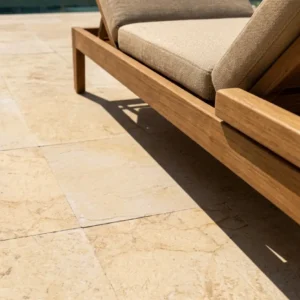
What salt haze actually does
Cayman does not need a storm to put salt on your floor. The trade wind carries a fine haze inland every day of the year, and it settles on terraces, steps and window sills long before it becomes visible to anybody. Salt is not corrosive to limestone the way it is to metal, but it crystallizes inside surface pores as water evaporates, and repeated crystallization is what dulls a face and lifts loose material over a period of years. That is exactly why freshwater rinsing counts as standard island maintenance rather than an optional refinement. It is also the cheapest insurance in the whole maintenance calendar, because it needs no product, no contractor and no permission from anybody.
The weekly rinse
The single most effective thing you can do for exterior stone here costs nothing but water and ten minutes of attention.
- Rinse exposed terraces and steps with fresh water weekly, more often on a beachfront elevation.
- Rinse after any windy period, whether or not it actually rained.
- Sweep sand off first, so you are not grinding it into the face as you wash.
- Let the surface dry naturally; there is no need to squeegee an outdoor floor.
Ten minutes with a hose on a Saturday morning does more for an exposed terrace than any annual deep clean, and it costs nothing beyond the water itself.
Cleaners to use and cleaners to avoid
Limestone is a calcium carbonate stone, which means acid attacks it directly and quickly. A large share of the damage people blame on the climate is actually damage from the wrong bottle under the sink.
- Use a pH-neutral stone cleaner, diluted as directed and rinsed off properly afterwards.
- Avoid vinegar, lemon, descalers and any bathroom cleaner sold for limescale.
- Avoid chlorine splash from pool dosing; dilute and rinse straight away if it happens.
- Keep pressure washers at low pressure on a wide fan, held well back from open joints.
If a bottle does not say pH neutral on the label, assume it is not, and test it on an offcut long before it ever touches the installed floor.
What sealing does and does not do
A sealer buys you time to wipe up a spill. It does not make stone waterproof, it does not stop etching from acid, and it does not replace cleaning. On the island the practical choice is an impregnating sealer that soaks in and leaves the face breathing, rather than a film-forming coating that sits on top of it. Films look impressive on handover day and then blush, peel and trap moisture in a climate where the substrate is rarely bone dry. If you want the detail behind sealing limestone tile floors here, start with the material page and then test on an offcut. Interior floors in conditioned rooms often run many years between coats, while an exposed beachfront terrace works harder and asks sooner. Behavior tells you when, not the calendar.
A year on the island
Maintenance is far easier as a rhythm than as a rescue operation, and the calendar below suits most exposed island properties.
- Weekly: fresh water rinse on exposed surfaces, sweep interiors, check the mats.
- Monthly: pH-neutral wash of terraces, and check joints and grout for open gaps.
- Before storm season: clear drains, secure loose furniture, photograph the floor for records.
- After storm season: full wash, inspect for movement, reseal only where water no longer beads.
Storm season and what Ivan taught
Hurricane Ivan in September 2004 remains the local benchmark, and its lessons for paving are mundane rather than dramatic. Loose furniture becomes projectiles that chip edges and crack corners. Blocked drains turn a terrace into a shallow pool that pushes water under thresholds. Salt water flooding leaves a heavy salt load in the stone that needs several fresh water washes rather than one. None of this argues against stone, since a properly mortar-set terrace usually comes through better than the alternatives. It simply argues for the boring preparation island owners already do for the rest of the building. The other lesson is documentation: photographs of a finished floor, taken before the season starts, make any insurance conversation afterwards a great deal shorter.
When to bring someone in
Most maintenance here is homeowner work with a hose and a soft brush. A few jobs are not, and calling early is far cheaper than calling late.
- Etch marks or dull patches that need honing back rather than cleaning.
- A failed film coating that has to be stripped before anything else can happen.
- Efflorescence that keeps returning, which usually points at a water path, not the stone.
- Hollow or rocking tiles, which need lifting and rebedding rather than more grout.
None of these are emergencies when they are caught early, and every one of them becomes expensive when it is not.
Test before you treat
Whatever product you plan to use, prove it on a spare piece first. A small offcut kept back from the original order is the most useful maintenance tool in the house, and if you no longer have one it is easy to test a small stone sample before you commit a whole terrace to a new sealer. Remember too that everything arriving here is barged ashore at George Town, so replacement material takes planning rather than a same-week trip to a yard. Keep the offcut somewhere you will find it again, labeled with the room it came from. Rinse often, seal rarely, and never let an acid bottle near the floor.