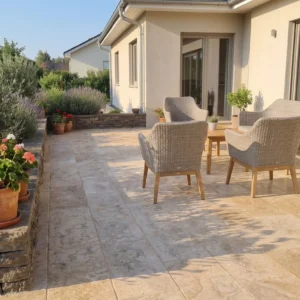
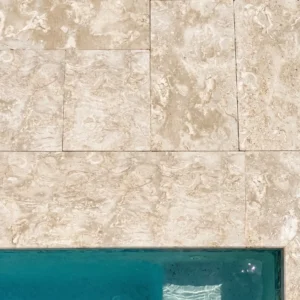
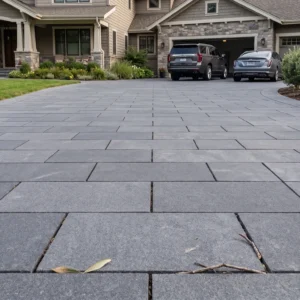
What Classic Ivory Travertine Actually Delivers
Classic ivory travertine earns its reputation not from marketing copy but from a measurable set of physical properties that hold up under real-world conditions — and understanding those properties before you specify is what separates a satisfying long-term installation from a costly replacement cycle. The material’s open-pore calcium carbonate structure gives classic ivory travertine a surface temperature advantage over dense igneous stone, keeping it markedly cooler underfoot than granite or basalt in direct sun exposure. That same porosity, however, creates the variable that most specifiers underestimate: absorption rate. Standard honed ivory travertine typically tests between 3.5% and 6.5% water absorption by weight, and where you land in that range determines your sealing schedule, your grout selection, and ultimately your maintenance commitment.
The cross-section hardness of classic ivory travertine sits around 3 on the Mohs scale — softer than granite at 6–7, but adequate for residential and light commercial foot traffic when finished correctly. Tumbled and brushed finishes introduce a textural roughness that raises the dynamic coefficient of friction above 0.6, clearing the threshold that safety-conscious specifications demand for wet areas. Polished finishes drop that coefficient significantly, which is why you’ll want to restrict high-gloss polished ivory travertine to interior dry applications and never default to it for pool surrounds or outdoor terraces.
Reading the Stone: Finish Options and What They Mean
Your finish selection isn’t just aesthetic — it directly controls how classic ivory travertine performs across moisture, UV, and traffic variables. Each finish modifies the stone’s surface geometry, sealing response, and maintenance interval in a way that matters to the specification.
- Honed finish: matte, light-diffusing surface that shows veining naturally; absorption rate is higher than polished but sealing is straightforward with a penetrating silane-siloxane product
- Polished finish: closes surface pores partially through mechanical compression; visually striking but requires more frequent re-polishing and is unsuitable for outdoor wet zones
- Tumbled finish: rounded edges and an aged surface texture that reads as antique; the micro-texture dramatically improves traction and suits pool surrounds, entry paths, and garden terraces
- Brushed finish: wire-brushed to open the surface slightly and emphasize natural veining; sits between honed and tumbled in traction performance and is a strong choice for bathroom floors
- Unfilled vs. filled: unfilled travertine retains its characteristic voids, which are visually dramatic but trap debris and moisture; filled varieties use grout or resin to close the pores, reducing maintenance load at the cost of some natural texture
For travertine bathroom applications in particular, the brushed or tumbled finish with a filled surface gives you the safest wet-traction performance alongside a manageable sealing cycle. The polished version looks extraordinary in a dry master bath but becomes a liability the moment steam condensation hits an unsealed section.
Thickness and Sizing Specifications
Classic ivory travertine is available in a range of thicknesses, and getting that specification wrong is one of the most common — and expensive — mistakes in field installation. The thickness you select should follow the substrate, the expected load, and whether the installation is bonded or mortared.
- 3/8 inch (10mm): interior wall cladding and vertical surfaces only — not suitable for any flooring application under foot traffic
- 1/2 inch (12mm): light residential interior flooring over a fully bonded, flat substrate with no flex — requires perfectly level backer board
- 3/4 inch (20mm): the standard residential floor tile thickness; handles typical foot traffic and allows for minor substrate imperfections
- 1.25 inch (30mm): recommended for exterior paving, pool surrounds, and any installation over a sand-set or mortar-bed base
- 2 inch (50mm): heavy-duty exterior applications, driveway-adjacent paving, and any surface receiving occasional vehicle overhang or heavy wheeled loads
For classic ivory travertine pavers in outdoor settings, the 1.25-inch specification is the professional default for a reason. Thinner tiles crack under the differential settlement that outdoor bases inevitably experience. Going to 2-inch where driveway proximity is a factor adds meaningful structural margin without dramatic cost increase.
Base Preparation: The Variable That Decides Longevity
The detail that separates a 10-year installation from a 25-year one isn’t the stone itself — it’s the 6 to 8 inches of compacted aggregate base beneath it. Classic ivory travertine does not forgive movement. Its calcium carbonate matrix is rigid, and differential settlement produces cracks that run through tiles rather than along joints. Your base preparation has to eliminate that differential movement before the first tile is set.
For mortared exterior applications, a minimum 4-inch compacted crushed-stone base topped with a 1.5-inch dry-pack mortar bed is the correct specification. Sand-set installations require a minimum 6-inch compacted aggregate base with a 1-inch bedding sand layer screeded to a tolerance of ±1/8 inch across a 10-foot straightedge. Any deviation beyond that tolerance will telegraph through to the surface within two freeze-thaw cycles. According to NSI travertine properties and outdoor suitability, the material’s performance in exterior applications is directly tied to substrate stability and drainage geometry — not just the stone’s inherent hardness.
Drainage is the second non-negotiable. Classic ivory travertine’s absorption rate means that standing water beneath a poorly drained installation saturates the base, softens the bedding, and creates the differential movement that breaks tiles. Your surface slope should maintain a minimum 1/8-inch-per-foot cross-fall toward drainage channels, and your base aggregate must be free-draining with no clay content above 5%.
Sealing Protocols for Classic Ivory Travertine
Sealing classic ivory travertine is not optional for exterior applications — it’s a scheduled maintenance activity that determines how the stone ages. The question isn’t whether to seal but which product type, at what interval, and how to confirm the seal has failed before staining penetrates the matrix.
- Penetrating silane-siloxane sealers: the professional standard for exterior ivory travertine; they fill the pore network without forming a surface film, maintaining the stone’s natural texture and breathability
- Topical acrylic sealers: create a surface coat that shifts the color slightly warmer and adds a sheen; suitable for interior applications but trap moisture vapor in exterior use, causing delamination and efflorescence
- Impregnating fluoropolymer sealers: premium-grade option that outperforms silane-siloxane in high-traffic and high-UV zones; cost is higher but resealing interval extends to 4–5 years versus the standard 2–3 years
- Color-enhancing sealers: deepen the ivory and beige tones of the stone for a richer appearance; test on a sample tile before committing — the color shift is permanent until the sealer wears
The water-bead test tells you when resealing is due: sprinkle water on a representative section and watch for immediate absorption versus beading. Absorption within 30 seconds means the sealer is exhausted and staining risk is high. For tuscany ivory travertine and similar warm-toned varieties with higher iron oxide content, staining from tannins and iron-rich groundwater is a particular risk — fluoropolymer sealers give you the best protection against those specific stain vectors. Tuscany ivory travertine’s warmer undertones also make color-enhancing sealers worth testing on a sample tile before committing to a full application.
Installation Timing and Seasonal Scheduling
Scheduling your classic ivory travertine installation around temperature windows is practical field management, not precaution for its own sake. Setting mortars and adhesives have specific cure windows that ambient and substrate temperature directly controls, and deviating from those windows costs you bond strength in ways that won’t reveal themselves until the first thermal cycling season.
The ideal installation window for mortared travertine sits between 50°F and 85°F ambient temperature, with substrate surface temperature staying above 40°F through the full 28-day cure. Below 40°F, Portland cement-based mortars stall their hydration reaction and never develop full tensile strength — you end up with a bonded installation that reads fine initially but debonds at the grout joints within 18 months. Above 90°F substrate surface temperature, the mortar bed loses moisture too rapidly and shrinks before the tile achieves mechanical key. In hot periods, the practical workaround is to schedule setting work in the early morning — before 10 a.m. — when surface temperatures are still manageable, and to use a wet burlap cure on the mortar bed if you’re working in direct sun exposure.
For adhesive-set interior applications like travertine bathroom floors, temperature windows are less critical but still relevant. Standard polymer-modified tile adhesives require a minimum 41°F and should not be applied to tiles or substrates that have been in cold storage — the chill in the back of a delivery truck can drop tile temperature below the adhesive’s working range, causing peel-back within days of installation. Let tiles acclimatize to room temperature for at least 24 hours before setting if they’ve come directly off a cold truck delivery. According to ASTM C1527 travertine dimension stone specifications, dimensional stability during installation is a function of both material properties and the ambient conditions under which bonding occurs — confirming that installation environment is a specification variable, not an afterthought.
Ivory Premium Travertine: Colour Variation and Grading
The ivory tones in classic ivory travertine aren’t uniform across a quarry block, and understanding the grading system is essential before you commit to a large-format order. Ivory premium travertine designation refers to the first-grade selection process — quarry blocks selected for consistent ivory-to-warm-beige toning with minimal grey veining intrusion and low void frequency.
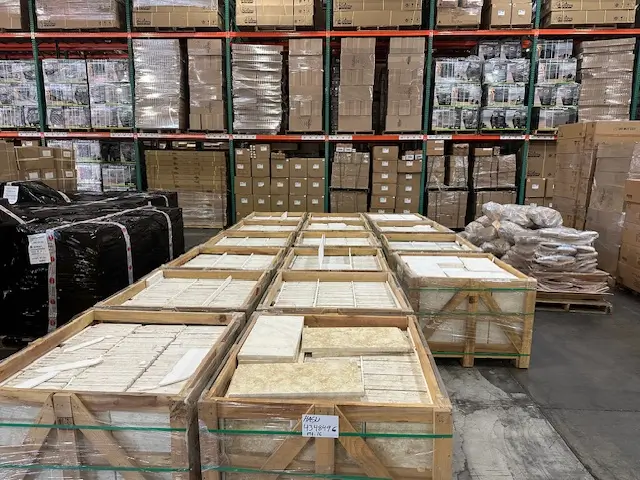
At Citadel Stone, we sort material at the warehouse before it ships, pulling tiles that fall outside the agreed tone range and flagging them for secondary-grade batches. That sorting step is what protects your installation from the mid-project colour surprise that happens when a late pallet arrives with noticeably cooler or darker tiles. You should confirm with your supplier whether their warehouse conducts post-import grading or relies entirely on origin-country grading certificates — the difference in consistency is significant.
Colour variation within a single batch is natural and desirable to a point. The hallmark of quality classic ivory travertine is a tonal range that reads as unified from 5 feet but reveals natural character variation on closer inspection. What you want to avoid is categorical colour breaks — tiles that read as a distinctly different stone from adjacent tiles. That outcome signals mixed-grade stock and is the result of either inadequate warehouse grading or batch substitution mid-order. Explore our classic ivory travertine range to see the graded selections available with documented tonal consistency across full project quantities.
Joint Spacing, Grouting, and Movement Accommodation
Classic ivory travertine has a thermal expansion coefficient of approximately 4.5 × 10⁻⁶ per °F — lower than most porcelain tiles but enough to demand correctly specified joint widths and movement joints in larger installations. The standard 1/8-inch grout joint used for porcelain tile is insufficient for exterior travertine work. Exterior applications should run minimum 3/16-inch joints to accommodate thermal movement without edge chipping.
- Interior dry areas: 1/8-inch joints with unsanded grout are appropriate for tiles up to 12×12; larger format tiles should move to 3/16-inch sanded grout
- Interior wet areas (travertine bathroom applications): 3/16-inch joints minimum with a polymer-modified sanded grout; epoxy grout is the premium choice for shower installations where mold resistance is a priority
- Exterior paving: 3/16 to 1/4-inch joints with a flexible sanded grout; movement joints every 10–12 linear feet using a matching silicone sealant rated for exterior UV exposure
- Pool surrounds: 1/4-inch joints minimum with a pool-grade epoxy grout; the constant wet-dry cycling and chemical exposure from pool water make polymer-modified cementitious grout a marginal choice here
Movement joints are the specification detail most often omitted in field installations, and their absence is the single most predictable cause of mid-field tile cracking in large exterior travertine layouts. Spec them in at the perimeter of every field, at any change in substrate plane, and at every 10–12 foot grid intersection for fields larger than 200 square feet.
Ordering, Logistics, and Project Planning
Your classic ivory travertine order quantity calculation needs to account for a minimum 10% overage for cuts, waste, and breakage — and for large format tiles above 24×24 inches, 12–15% is the more realistic buffer. Order all tiles from the same production batch. Batch consistency for natural stone is not guaranteed across separate production runs, and a second order to fill a shortfall may arrive with a colour shift that’s immediately visible against the first delivery.
Lead times from the warehouse for in-stock classic ivory travertine typically run 1–2 weeks for standard pallet orders. Custom sizes or thickness specifications sourced to order carry a 6–8 week import lead time, which means your project schedule needs to account for that window well before the installation phase begins. Citadel Stone maintains warehouse stock of core ivory travertine formats nationally, which removes the import delay for the most commonly specified sizes — but you should confirm current stock levels before locking in a project timeline, particularly for orders above 500 square feet where partial warehouse fulfillment is a scheduling variable.
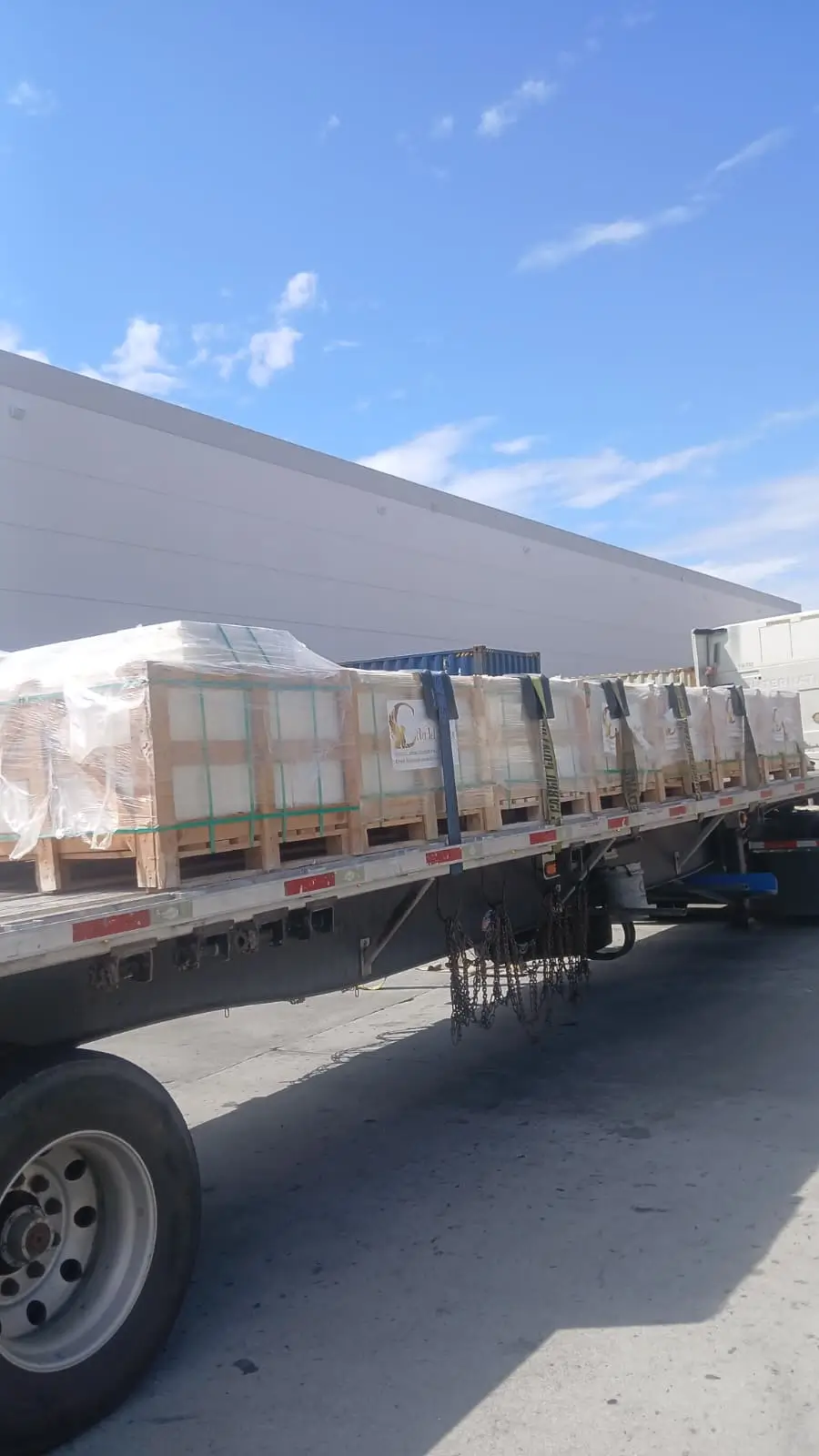
Truck delivery logistics affect your site readiness planning. Standard travertine pallets run 2,200–2,800 lbs each, and a typical truck delivery for a mid-size residential project may involve two to three pallets. Your site needs a clear unloading zone and ideally a forklift or pallet jack — hand-bombing 2×2-inch travertine tiles off a truck adds unnecessary chip and edge-damage risk. According to USGS natural stone geological data, travertine’s calcium carbonate composition makes its edges inherently more vulnerable to impact damage than harder igneous materials, reinforcing the importance of careful material handling from truck to installation surface.
Long-Term Maintenance and Performance Expectations
Realistic performance expectations for classic ivory travertine in well-specified installations run to 25–35 years before any remediation is required — but that number assumes biennial resealing, prompt stain treatment, and maintained joint integrity. The material doesn’t degrade catastrophically; it degrades through accumulated neglect of small maintenance tasks that compound over time.
- Resealing interval: every 2–3 years for exterior applications with penetrating sealer; every 4–5 years with a premium fluoropolymer product; annually for pool surrounds due to chemical and UV exposure
- Stain response: organic stains from leaves, iron-rich groundwater, and tannins respond to a poultice treatment with hydrogen peroxide and diatomite; oil-based stains require a petroleum-solvent poultice applied under plastic and left for 24–48 hours
- Joint maintenance: check grout and silicone movement joints annually; cracked or missing joint material allows water infiltration that destabilizes the mortar bed and accelerates tile debonding
- Surface etching: acidic cleaning products and spilled citrus or wine etch the calcium carbonate surface; the etch mark can be honed out professionally but prevention through pH-neutral cleaning is far simpler
- Efflorescence management: white salt deposits on the surface signal moisture migration through the base; address the drainage cause before treating the surface symptom with a diluted efflorescence cleaner
The Natural Stone Institute’s technical guidelines confirm that travertine’s long-term performance in exterior environments is primarily a function of sealer maintenance and drainage integrity rather than the stone’s inherent strength — which means your maintenance schedule is as important as your original specification. Per NSI travertine outdoor suitability data, properly sealed and maintained travertine retains its structural integrity across decades of thermal cycling in diverse climate conditions.
Expert Summary
Classic ivory travertine rewards the specifier who engages with its specific properties rather than treating it as a generic natural stone option. Your finish selection, thickness specification, base preparation standard, sealing protocol, and joint design each contribute to a performance outcome that either meets or falls short of the material’s genuine 25-plus-year potential. The stone itself is consistent and reliable — the variables that determine project success sit in the specification decisions you make before the first tile is set.
For projects that extend into surface texture variety, exploring related travertine applications adds dimension to your material palette. If split-face wall cladding or textured vertical surfaces are part of your scope, ivory split-face travertine for wall cladding provides the technical detail you’ll need to specify that application correctly alongside your floor and paving work.
At Citadel Stone, we source travertine through direct quarry relationships and run warehouse-level grading checks on every import batch to ensure tonal consistency meets project requirements before material ships. That process matters most on large orders where colour continuity across hundreds of square feet isn’t negotiable. Travertine from Citadel Stone arrives direct from quarries in Turkey, the Mediterranean, and beyond, selected for even ivory coloring.
Related reading: travertine vs ceramic tile · ivory travertine vs porcelain tile · porcelain pool tile vs travertine.