Stone mosaic material selection trips up even experienced specifiers at a single critical juncture — the gap between what a stone looks like in a sample chip and how it actually performs once it’s cut to tessera scale and bonded into a matrix. The physical properties that govern a full tile’s behavior shift meaningfully when that tile is reduced to pieces measuring 10mm to 50mm across. Porosity gradients become more exposed, structural weak points in the crystal lattice fall closer to cut edges, and thermal movement has less material mass to absorb it. Your selection process needs to account for each of these scale-dependent variables before you commit a material to production.
Why Material Properties Change at Tessera Scale
Most stone performs predictably as a large tile because mass distributes stress across a wide field. Cut that same stone into individual tesserae, and the load dynamics invert — each small piece carries edge stress independently. For stone mosaic material selection, that distinction isn’t academic; it determines whether a field mosaic experiences edge spalling within two years or holds cleanly for two decades.
Water absorption is the most consequential property to re-evaluate at tessera scale. A limestone slab rated at 3.5% absorption by ASTM C97 testing will expose that absorption more aggressively once cut, because the ratio of edge surface to face surface increases dramatically. In freeze-thaw regions, this accelerated absorption at cut edges becomes the primary failure point — not the face of the tessera.
- Edge-to-face surface ratio increases by 200–400% compared to a full tile at equivalent thickness
- Crystal boundary exposure at cut faces concentrates moisture entry in crystalline stones like marble and granite
- Cleavage planes in foliated materials like slate run parallel to the cut path in some orientations, creating delamination risk
- Vein structures in marble tesserae can create stress concentration points under thermal cycling
- Sedimentary layering in limestone affects how individual pieces respond to point loads differently than the parent slab
The Natural Stone Institute stone variety specifications provide baseline physical property data by stone type — but your specification needs to go further and factor in how those properties translate at the dimension range your mosaic design requires.
Stone Types for Mosaic Work: A Performance Comparison
Your material choice ultimately depends on the installation context — interior wall, exterior floor, pool feature, or decorative panel — but certain stone families perform consistently better as mosaic tesserae regardless of application. Understanding the trade-offs across material types is the foundation of sound stone mosaic material selection.
Marble Tesserae: Performance and Limits
Marble remains the dominant mosaic stone for interior applications because it cuts cleanly, holds fine detail at small tessera sizes, and produces highly consistent color fields. Calcite-based marbles like Carrara and Thassos achieve compressive strength in the 16,000–22,000 PSI range, which handles interior installation loads with significant margin. The limitation is acid sensitivity — any marble tessera in a kitchen backsplash or bathroom floor will develop etching from routine contact with cleaning agents, citrus, or acidic tile setting residues unless the spec accounts for finish and maintenance protocol.
- Honed finishes on marble tesserae show etching less than polished finishes — specify accordingly for wet environments
- White marbles with high calcite purity (Thassos, White Sivec) offer maximum reflectance but lowest porosity tolerance
- Dolomitic marbles provide slightly better acid resistance than pure calcite types
- Book-matched vein patterns in large-format mosaic panels require tessera cutting from consistent slab orientation
Granite Tesserae for Demanding Applications
Granite tesserae perform exceptionally well in exterior mosaics and high-traffic floor applications where marble would be at risk. The interlocking crystalline structure of granite produces compressive strength above 25,000 PSI in most varieties, and its near-zero water absorption rate (typically under 0.4% by ASTM C97) makes it the correct choice for any mosaic installation exposed to standing water or freeze-thaw cycling. The trade-off is workability — granite’s hardness makes precision cutting more tool-intensive, which affects production cost per square foot.
According to ASTM C615 granite dimension stone standards, granite dimension stone must meet minimum flexural strength of 1,500 PSI and maximum absorption of 0.40% — specifications that translate directly into tessera durability in wet or exposed applications.
Limestone Tesserae: The Nuanced Option
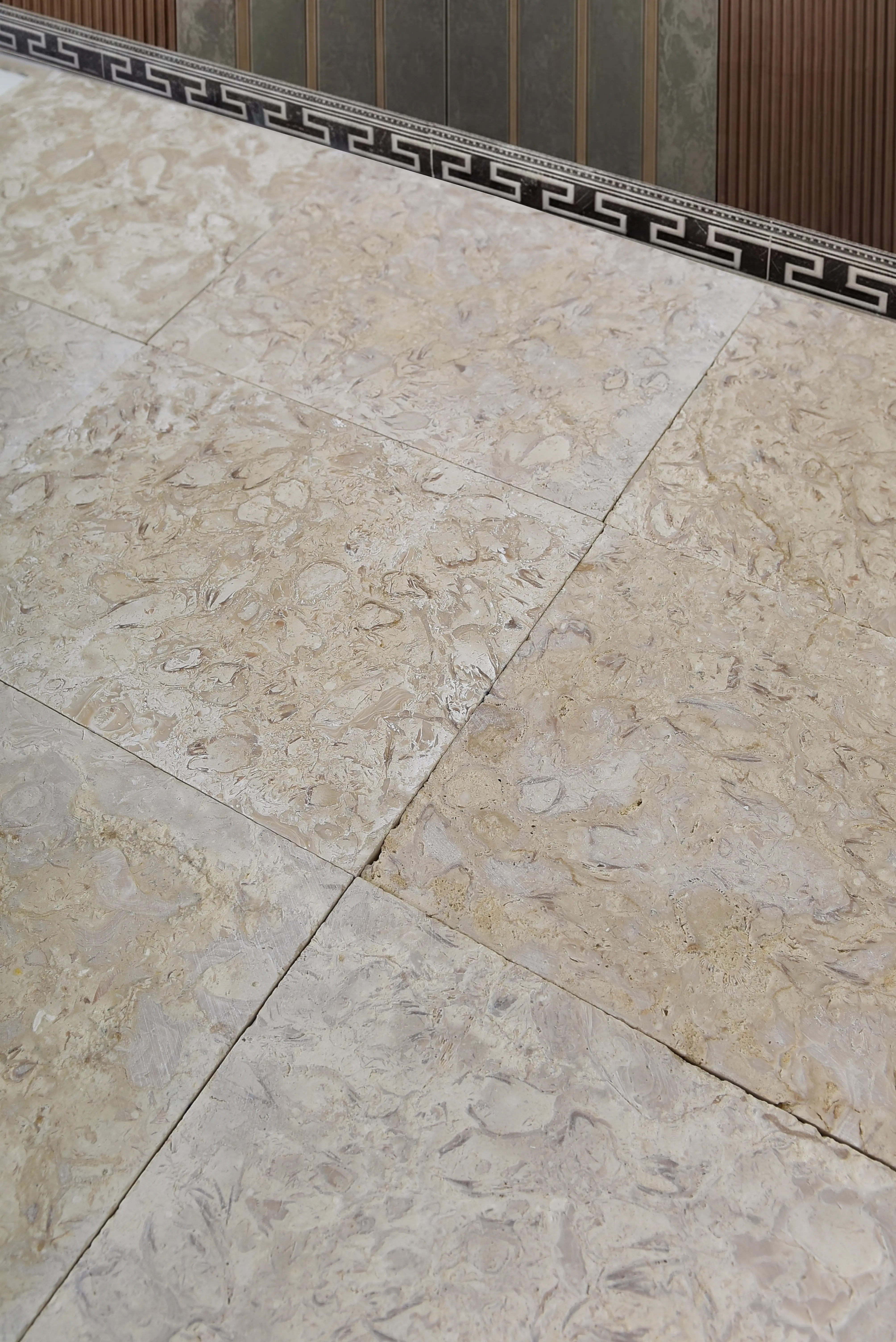
Limestone cuts well and offers a warm, textured aesthetic that both marble and granite can’t replicate. For stone mosaic material selection, limestone requires the most careful porosity vetting of any common stone type. Dense limestones like Belgian Blue or Jura achieve absorption rates below 1.5%, making them viable for exterior and wet applications. Softer, more porous limestones (absorption above 4%) should be restricted to interior dry environments where freeze-thaw and sustained moisture exposure aren’t factors. Your specification should state the maximum allowable water absorption figure, not just the stone name.
Travertine and Onyx: Specialty Considerations
Travertine tesserae introduce the void-fill question — the characteristic pitting that defines travertine’s aesthetic is structurally vulnerable when individual pieces are small. Filled travertine (epoxy or grout-filled voids) performs adequately in wall applications, but unfilled travertine at tessera scale can crack along void boundaries under point load. Onyx is a high-reward, high-risk material for mosaics. Its translucency is unmatched for backlit panel work, but onyx is among the softest usable mosaic stones (Mohs 3–4) and requires full-bed adhesive contact with no void beneath any tessera to avoid flexural failure.
Thickness, Grading, and Calibration Requirements
Tessera thickness calibration is one of the variables that stone mosaic material selection guides consistently underweight. For mesh-mounted mosaic sheets, thickness variation across a production run greater than ±0.3mm creates trowel-depth inconsistency that produces lippage at grout joints once installed. This sounds like an installation problem, but it originates in the sourcing decision — specifically, whether you’ve verified calibration tolerance at the mill or warehouse level before the material ships.
At Citadel Stone, we recommend requesting a mill certificate that specifies thickness tolerance alongside standard physical property data. A tolerance of ±0.5mm may be acceptable for large format tiles but creates visible problems in fine mosaic work where tessera edges are the visual unit.
- For tesserae under 25mm, specify maximum thickness variation of ±0.3mm across any production lot
- For opus regulatum (grid) patterns, consistent calibration is critical — irregular thickness creates alignment errors across the field
- For opus vermiculatum and free-form work, slightly looser tolerance (±0.5mm) is acceptable because joint width variation is part of the aesthetic
- Request sample sheets from at least two production lots before approving a material for large-format mosaic projects
- Verify that grading removes any tesserae with visible lamination, surface cracks, or vein intrusions that cross the full tessera face
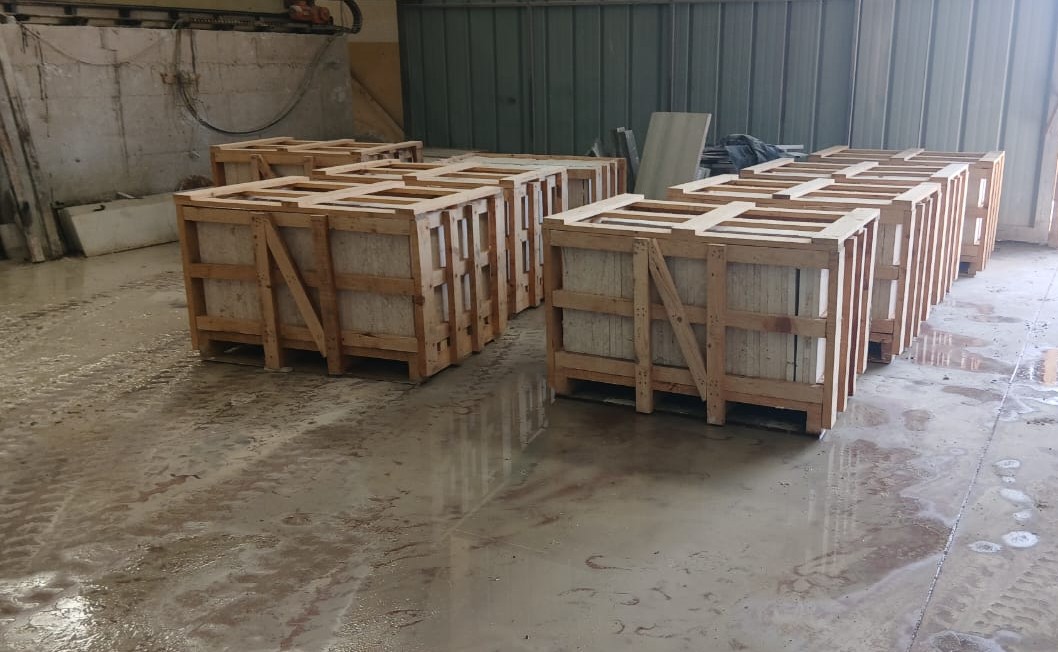
Your warehouse receiving inspection should include a random pull of 10% of tessera sheets from each pallet, checking for thickness deviation and edge chipping. Material that passes mill certification can still arrive with transit damage — this is a handling and packing quality issue, not a stone quality issue, but it affects your installed result equally.
Finish Selection and Its Functional Impact
The finish specification for mosaic tesserae carries more functional weight than it does for large format tiles, because the scale of the individual piece means the finish determines both slip resistance and light behavior across the entire installed surface simultaneously. A polished marble tessera mosaic floor is visually striking and extremely difficult to maintain safely in any wet environment — the combination of calcite sensitivity and smooth finish produces a dynamic coefficient of friction (DCOF) that falls below the 0.42 minimum recommended for wet floor applications.
Tumbled and brushed finishes add measurable slip resistance and partially conceal the efflorescence and minor staining that any porous stone accumulates over time in high-traffic applications. Honed finishes represent the practical middle ground — matte enough to provide adequate grip, dense enough to resist most staining when sealed at installation.
- Polished: appropriate for interior wall mosaics and decorative panels only — not wet floors
- Honed: versatile for floors and walls, requires biennial sealing for porous stone types
- Brushed: best for exterior and pool surround mosaics where grip is a safety requirement
- Tumbled: high character finish, highest grout-joint variation tolerance, best for rustic installation styles
- Split-face: for three-dimensional mosaic wall applications — not suitable for floor installation at tessera scale
Cost Factors and Sourcing Economics
Material cost for mosaic stone occupies a smaller share of total project cost than most designers expect when they first encounter it. For a typical interior mosaic installation, stone material cost represents 20–30% of the total budget — labor, substrate preparation, adhesive system, and grouting account for the rest. This ratio matters because it shifts where value engineering is most effective. Upgrading from a $12/sq ft limestone tessera to a $28/sq ft marble tessera adds roughly $16/sq ft in material cost but adds it against a total installed cost of $80–$120/sq ft — the relative impact is contained.
Where the economics shift significantly is in freight. Mosaic stone is dense and ships in substantial weight per square foot of coverage. For projects sourcing mosaic stone through Citadel Stone, national warehouse distribution means your freight distance calculation is more predictable than going direct to import — and lead times from domestic warehouse stock typically run 1–2 weeks versus 6–10 weeks for a direct quarry order.
Labor market conditions across different regions affect total cost more than freight does. In high-labor-cost markets, the material-to-labor ratio can reach 15:85 for complex mosaic work. In those environments, any sourcing decision that reduces site rework — thicker adhesive bed requirements due to calibration variance, for example — delivers outsized savings. Specifying tighter calibration tolerance and paying slightly more per square foot for premium-graded tesserae is almost always a net positive in high-labor markets.
- Request delivered pricing, not ex-warehouse pricing, for accurate budget comparison across suppliers
- Factor pallet surcharges and liftgate delivery fees — mosaic stone typically ships on full pallets at 1,500–2,500 lb each
- Truck access at your project site affects delivery scheduling — narrow or restricted access may require a smaller vehicle and split delivery, which increases freight cost
- Cushion stone material budgets by 12–15% for waste in complex pattern work; simple grid patterns can run at 8–10% waste allowance
- Order from a single production lot for color-critical projects — mixing lots mid-project is a common cause of visible color breaks in large mosaic fields
Adhesive Systems and Substrate Compatibility
Your adhesive specification must match the thermal movement characteristics of your selected tessera stone, not just the generic substrate type. Marble and limestone tesserae have lower thermal expansion coefficients than vitrified porcelain or glass mosaic, which means they’re well-suited to standard polymer-modified thinset on a properly prepared substrate. However, the total mosaic assembly — stone, adhesive, mesh backing, and substrate — behaves as a composite, and the weakest thermal compatibility point determines the assembly’s expansion behavior.
For exterior mosaic installations, epoxy-modified adhesives provide better long-term bonding and resistance to water intrusion at the adhesive interface than standard cement-based thinsets. The trade-off is open time — epoxy mortars in warm-weather installations can skin over in under 20 minutes, requiring smaller working sections and careful temperature management during placement.
- For interior wall mosaic on cement board: standard ANSI A118.4 polymer-modified thinset performs reliably for marble and limestone
- For exterior mosaic on concrete: ANSI A118.15 epoxy-modified adhesive provides superior bond strength and moisture resistance
- For mosaic over in-floor radiant heat: use a flexible thinset rated for thermal cycling — standard thinset becomes brittle over active heating elements
- Back-buttering individual mesh sheets before bed placement significantly reduces void formation under tesserae — particularly important for polished stones where any flex telegraphs through the finish
Grout Selection and Joint Width Specification
Grout selection for stone mosaic work is one of the details that differentiates a durable installation from one that requires remediation within three years. The fundamental rule is that joint width drives grout type: joints under 1/16 inch (1.6mm) require unsanded grout, joints between 1/16 and 1/8 inch require fine-sanded grout, and joints above 1/8 inch can use standard sanded grout. For mosaic work, most traditional grids sit in the 1/16–1/8 inch range — meaning fine-sanded grout is the standard specification.
Color selection for mosaic grout has aesthetic consequences that aren’t reversible without full re-grouting. Dark grout on light stone creates a grid effect that dominates the visual composition — this is sometimes intentional in geometric patterns but usually undesirable in pictorial or flowing designs. Matching grout color closely to the dominant stone color minimizes joint visibility and allows the stone pattern to read without interference. According to the TCNA natural stone tile installation standards, grout color uniformity depends on consistent mixing ratios and working in sections small enough that the mix doesn’t begin setting before placement — a detail that matters more in mosaic work than in large format tile because the grout-to-stone surface ratio is higher.
Quality-Vetting Your Stone Mosaic Supplier
Sourcing quality from stone mosaic suppliers requires you to assess three things independently: the stone itself, the cutting and calibration quality, and the mesh or paper mounting system. A supplier can offer excellent stone but inconsistent calibration. Another may have tight calibration but mount tesserae on a mesh that degrades in alkaline adhesive environments — causing sheets to delaminate mid-installation.
The mesh backing specification matters operationally. Fiberglass mesh performs reliably in thinset applications. Paper-faced sheets (where tesserae are mounted face-down on kraft paper) must be wetted for removal, which adds a step and requires careful timing — too early and adhesive pulls with the paper, too late and the paper tears. For high-production installations, fiberglass-mesh-backed sheets typically reduce labor time by 15–20% compared to paper-face alternatives. The NSI stone specification resources for design professionals provide additional guidance on evaluating stone product quality and conformance documentation from stone mosaic suppliers.
- Request a full technical data sheet for every material in your specification, not just color samples
- Ask for ASTM C97 water absorption and C170 compressive strength test results — legitimate suppliers have these on file
- Verify that the mosaic production facility maintains consistent stone sourcing from a single quarry per lot — multi-source production creates color variation that appears after installation
- Inspect mesh adhesion: individual tesserae should resist finger-pressure removal from the mesh — if they release easily, the mounting adhesive is substandard
- Check edge quality under a loupe at 10x — clean, unchipped edges indicate precision cutting; ragged edges indicate worn tooling that will translate to visible joint irregularity
Final Recommendations
Stone mosaic material selection rewards the specifier who treats the process as a series of confirmable decisions rather than a single material choice. The stone family determines the aesthetic range and base physical properties. The finish specification determines slip resistance, maintenance demands, and light behavior. The calibration tolerance determines installation quality and labor efficiency. The adhesive system determines long-term bond performance under thermal and moisture cycling. Getting each of these right independently — and verifying each at the warehouse before committing to production quantities — is what separates a mosaic installation that performs reliably for twenty years from one that requires intervention at seven.
As you plan your material specification, it’s worth considering how stone selection extends across project types. Natural stone decisions in one area of a project often inform adjacent applications — for those exploring related applications in carving and artistic stonework, stone selection for sculpting and artistic work covers how material properties translate into a different but closely related context. At Citadel Stone, we maintain warehouse inventory of mosaic stone materials with documentation available for every production lot — which means you can confirm physical property data and grading consistency before your specification is finalised. Installers and designers sourcing through Citadel Stone can assess tessera grading firsthand — an important step before specifying mosaic stone for large-format projects.
Related reading: why stone on railway tracks · stone road construction guide · How Ballast Stone Is Specified: A Buyer’s Guide.