The grade and gradation of your driveway rock matter far more than most project owners realize — and getting those two variables wrong is the fastest way to end up with a surface that ruts, migrates, or drains so poorly it undermines the base within a single freeze-thaw season. Choosing driveway rock isn’t simply picking a stone that looks appealing; it’s specifying a layered system where each particle size plays a structural role. The selections you make at the specification stage determine whether your driveway performs for eight years or twenty-five.
Why Stone Grade Defines Driveway Performance
Grade refers to the particle size range within a given crushed stone product, and it controls three critical performance variables simultaneously: compaction density, drainage rate, and load distribution. A well-graded aggregate — one with a continuous range of particle sizes from coarse to fine — achieves compaction densities that approach 95% Modified Proctor without significant void space. That density is what resists rutting under vehicle loads.
Open-graded mixes, by contrast, use a narrow size range that intentionally preserves void space. These drain exceptionally well — permeability rates can exceed 1,000 inches per hour in properly installed open-graded layers — but they sacrifice surface stability. You’ll see them used primarily as base course drainage layers beneath more stable surface aggregates, not as finished wearing surfaces. Understanding that distinction is the foundation of every sound driveway rock specification.
According to ASLA driveway paving material guidance, the interaction between surface permeability and base drainage is the single most critical factor in long-term driveway performance, particularly in areas that experience significant seasonal rainfall or freeze-thaw cycling. That guidance aligns directly with what field performance data consistently shows: failures trace to drainage system breakdowns, not to the surface material itself.
Common Driveway Rock Types and Their Applications
The natural stone market for driveways includes several distinct material categories, each with different structural and aesthetic properties. Choosing driveway rock means matching the material’s physical characteristics to your specific load conditions, drainage requirements, and visual goals.
- Crushed limestone: High compaction density, angular particles that lock together tightly, compressive strength typically 8,000–12,000 PSI — excellent for primary wearing surfaces in residential and light commercial applications
- Crushed granite: Superior abrasion resistance (Mohs hardness 6–7), performs exceptionally under heavy vehicle traffic, excellent freeze-thaw durability in cold climates
- River gravel and rounded stone: Lower interlock because of smooth, rounded particle geometry — suitable for aesthetic accent driveways with low traffic, not recommended as a primary structural layer
- Decomposed granite (DG): Fine-grained, compacts to a firm surface in dry conditions, but requires stabilizer binders in wet climates to prevent erosion and surface softening
- Crusher run (processed gravel): A blend of crushed stone and stone dust — the binder fines fill voids and dramatically increase compaction density, making it the industry standard for driveway base course construction
The Natural Stone Institute’s technical stone specifications confirm that angular, crushed aggregates consistently outperform rounded alternatives in bearing capacity applications — a direct result of the mechanical interlock that angular faces create under compaction pressure.
Aggregate Sizing Explained: What the Numbers Mean
Stone sizing for driveways follows standardized gradation classifications, and understanding what those classifications mean in practice helps you avoid ordering the wrong product. The numbers you’ll encounter most frequently in a driveway rock context are #57, #67, #8, and #4.
- #4 stone: Particles ranging from roughly 1.5 to 2.5 inches — used primarily as the coarsest base course layer, providing the structural skeleton beneath finer grades
- #57 stone: The most common driveway base aggregate, particles ranging from ¾ inch to 1 inch — open-graded with excellent drainage, typically placed at 4–6 inch compacted depth as the drainage course
- #67 stone: Slightly finer than #57, particles from ¾ inch down to ½ inch — transitions well between base and surface layers
- #8 stone: Particles from 3/8 inch to ½ inch — used as a top-dressing layer to fill voids in the surface and improve ride quality
- Crusher run (0-1.5 inch): Full-range gradation with fines — the primary compaction layer, typically installed at 4 inches compacted depth per lift
Here’s what most project owners miss: the sizing system isn’t a single layer choice, it’s a layered system specification. You’re not choosing one number — you’re building a sequence. A properly engineered residential driveway uses at least two layers: a #57 or crusher run base course and a finer wearing surface layer, each performing a distinct structural role.
Drainage Architecture: Designing for Water Movement
Your driveway rock selection and your drainage design are inseparable decisions. Drainage failure is the primary cause of premature driveway deterioration, and it almost always results from a mismatch between the permeability of the surface aggregate and the permeability of the layers beneath it. Placing a low-permeability crusher run surface over a high-permeability #57 base creates a perched water condition — water enters the surface slowly, saturates the fine-grained layers, and then cannot escape downward fast enough during heavy rain events.
The design principle you need to apply is the inverted filter rule: each successive layer downward should have equal or greater permeability than the layer above. This ensures water moves freely through the system rather than accumulating at layer interfaces where it causes softening and frost heave damage.
- Surface layer: Angular ¾-inch to 1-inch stone with 30–40% void space — permits rapid infiltration and resists wheel migration
- Intermediate layer: Crusher run at 4 inches compacted depth — provides structural load distribution and moderate drainage
- Base course: #57 stone at 4–6 inches — maximum drainage, prevents capillary rise from subgrade moisture
- Geotextile separation fabric at subgrade contact — prevents fines migration from clay soils into aggregate base layers
- Crown gradient of 2–3% across the driveway width — directs surface runoff to shoulders rather than allowing ponding at wheel track positions
In heavy-clay subgrade conditions, you’ll want to increase your total aggregate depth. Clay soils with plasticity indices above 20 can require 10–12 inches of total aggregate depth to prevent subgrade pumping during wet cycles — a detail that only becomes visible after the first winter season if you’ve underspecified the base thickness.
Calculating How Much Driveway Rock You Need
Tonnage calculation errors cause more project delays and mid-project truck shortfalls than any other single planning mistake. The formula is straightforward, but the inputs require accurate measurement and an understanding of compaction factors.
The base formula: Length (feet) × Width (feet) × Depth (feet) ÷ 27 = cubic yards. Convert to tons by multiplying cubic yards by the material’s unit weight. Crushed limestone typically runs 1.4–1.5 tons per cubic yard loose; crushed granite runs slightly heavier at 1.45–1.6 tons per cubic yard. These are loose-volume figures — compaction will reduce volume by 15–20% depending on gradation.
- Add 10–15% to your calculated tonnage for compaction loss, material variation, and waste at edges
- Specify truck delivery loads that match your site access — a standard tri-axle truck carries 12–15 tons, but tighter access may require tandem-axle loads at 8–10 tons
- Confirm warehouse stock levels before finalizing project schedules — multi-truck orders for larger driveways can require 3–5 days of lead time from the warehouse depending on available inventory
- Order surface-course stone and base-course stone separately — don’t blend them in delivery to simplify placement sequencing
For a typical residential driveway of 120 feet × 12 feet with a 6-inch base and 2-inch surface course, you’re looking at approximately 28–32 tons of total aggregate across both layers. That’s a meaningful calculation error if you round down — running short of base material mid-project means a second truck delivery and a scheduling gap that allows the partially built base to be damaged by traffic.
Matching Stone Color and Texture to Your Landscape Design
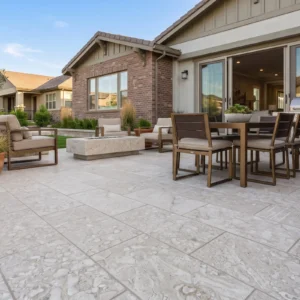
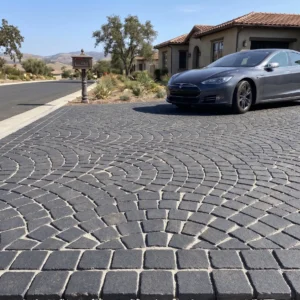
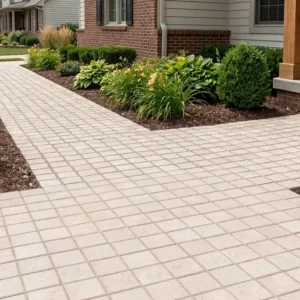
The structural performance of your driveway rock matters most, but the visual dimension is a legitimate specification consideration — particularly for residential projects where the driveway is a primary architectural feature. Natural stone offers a palette that no manufactured aggregate can replicate, and the color and texture choices you make will interact with your property’s architecture and planting design for decades.
Landscape design traditions vary considerably across different architectural contexts. A traditional colonial entry pairs naturally with warm buff limestone or tan-toned crusher run that echoes the earthy tones of brick and mortar. Modern minimalist properties tend to benefit from consistent grey crushed granite or blue-grey limestone with clean, angular particle profiles that reinforce geometric simplicity. Desert xeriscaping contexts — where the driveway often transitions directly into decomposed granite mulch areas — favor DG in matching tones that blur the boundary between hardscape and planting bed intentionally.
- Warm buff and tan limestone: Complements brick architecture, traditional colonial homes, and warm-toned timber cladding; coordinates naturally with ornamental grasses and native perennial plantings
- Grey crushed granite: Neutral tone works with contemporary architecture, concrete, and steel; pairs well with low-water plantings and ornamental boulder groupings in xeriscaping schemes
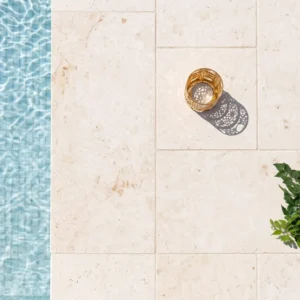
- White or cream limestone chips: High-reflectivity surface reduces solar heat absorption — particularly useful in hot, dry climates where surface temperature management matters; creates a bright, formal aesthetic suited to symmetrical entry designs
- Decomposed granite (gold/brown tones): The most visually seamless transition into naturalistic planting schemes, desert gardens, and informal curved driveway layouts
- Dark grey or charcoal crushed stone: Creates strong visual contrast with light-colored architecture; high contrast also makes driveway edges crisper against lawn or mulch beds
At Citadel Stone, we’ve found that color selection decisions are most effective when you view a physical sample against your existing architecture and existing planting under natural light — digital images consistently misrepresent undertones, particularly in limestone products where the grey-buff-cream range is subtle and light-dependent.
Surface Stability and Migration Prevention
The single most common complaint about loose driveway rock is migration — stone moving out of wheel tracks toward the edges or scattering onto adjacent lawn and planting areas. Migration isn’t primarily a product quality issue; it’s almost always a specification issue that you can prevent with the right aggregate selection and edge restraint system.
Angular, well-graded crushed stone migrates significantly less than rounded or poorly graded alternatives. The mechanical interlock between angular faces under vehicle loads creates a self-stabilizing matrix that resists lateral displacement. According to ASTM compressive strength standards for driveway paving stone, angular crushed aggregates under compaction load develop interparticle friction angles of 38–45 degrees, compared to 28–32 degrees for rounded gravels — that difference translates directly into migration resistance under wheel loads.
- Install steel or aluminum edge restraints on both sides of the driveway — buried 4–6 inches deep to resist frost heave — to physically contain the surface layer
- Use a surface aggregate in the ¾-inch to 1-inch range — too fine and wind erosion becomes a factor; too coarse and vehicle tires generate significant lateral stone displacement
- Compact the surface layer with a plate compactor in two passes — once in the direction of travel, once perpendicular — before the first vehicle use
- Avoid parking vehicles during the first 72 hours after installation while the aggregate matrix settles
- Re-dress the surface with a thin layer of matching ¾-inch stone every 3–5 years as migration losses accumulate
You can also specify stabilized decomposed granite using a polymer binder at a rate of approximately 15–20 lbs per cubic yard. This bonds the fine matrix particles together without eliminating permeability, creating a surface that behaves much like a compacted soil but sheds water freely. It’s particularly useful in high-rainfall environments where heavy rain events would otherwise erode standard loose DG surfaces within a single growing season.

Delivery Logistics and Site Preparation
Project planning for a driveway rock installation requires coordination between your site preparation timeline and your material delivery schedule. Receiving aggregate before your subgrade is prepared forces you to stage stone on an adjacent surface — which adds a second handling step and increases the risk of subgrade contamination at the staging area.
Citadel Stone ships driveway rock from warehouse inventory nationwide, which typically reduces lead times to one to two weeks for standard orders. For larger projects requiring multiple truck deliveries, confirm the delivery sequence in advance: base course stone should arrive and be placed before surface course material is ordered, ensuring your surface layer doesn’t sit exposed in a truck delivery staging area through weather events.
- Verify truck access before ordering — a standard delivery truck requires a minimum 12-foot clearance width and a 14-foot overhead clearance at any entry point
- Identify the drop point closest to the placement area — moving stone by wheelbarrow adds significant labor cost and time compared to a direct truck-to-spread sequence
- Confirm your subgrade has been proof-rolled and any soft spots have been excavated and replaced with compacted aggregate before the first truck arrives
- Schedule compaction equipment (plate compactor or vibratory roller) to arrive the same day as the base course delivery — don’t leave uncompacted base overnight if rain is forecast
- Inspect the delivered material against your specified gradation before the truck leaves the site — gradation errors are much easier to resolve before the material is spread
For projects using our loose stone and gravel selection, reviewing the available gradations against your layer-by-layer specification before placing your order ensures you receive the correct products for each layer of the system — base, intermediate, and surface course stones are separate specifications with different performance targets.
Maintenance and Long-Term Performance Expectations
A properly specified and installed driveway rock system doesn’t require intensive maintenance, but it does require periodic attention to sustain its structural and aesthetic performance. The maintenance tasks that matter most are surface re-dressing, edge restraint inspection, and drainage channel clearing.
Surface re-dressing replaces the fine particles lost to migration and abrasion over time. Plan for a light re-dress of ¾-inch surface stone at a rate of roughly 0.5–1 inch depth every three to five years. This restores the interlock matrix that develops ruts and low spots during the wear cycle between dressings.
- Re-grade the driveway surface annually — before the first freeze-thaw cycle in cold climates — using a box blade or drag to redistribute stone that has migrated to edges
- Inspect edge restraints each spring for frost heave displacement — re-secure any restraint sections that have lifted more than ¼ inch above the adjacent aggregate surface
- Clear drainage swales and shoulder channels after each significant rain event during the first year to establish stable drainage patterns before vegetation fills in channel edges
- Address soft spots immediately — a soft area that develops after a wet season typically indicates a subgrade drainage failure, not just a surface material issue
- Avoid using calcium chloride or rock salt for ice management on limestone-based surfaces — repeated salt exposure accelerates surface disaggregation of calcium carbonate particles
Realistic performance expectations for a well-specified gravel driveway: 15–25 years of functional service life before significant base reconditioning is required, assuming proper drainage maintenance and periodic surface re-dressing. Projects that skip the base course or use inadequate edge restraints typically begin showing failure symptoms within 5–8 years — most often at the driveway’s center section where wheel track loading is highest.
Choosing Driveway Rock: The Decisions That Define Long-Term Performance
Choosing driveway rock effectively comes down to treating the driveway as a drainage system first and a surface material second. The grade, gradation, and layering sequence you specify determine whether water moves through the system or accumulates within it — and that single design decision separates durable installations from ones that require constant patching. Your surface stone selection brings the visual dimension: color, texture, and particle size all contribute to how the driveway integrates with your property’s architecture and landscape design, whether that’s a formal entry framed by traditional plantings or a naturalistic approach blending with native groundcovers.
The specification decisions described in this guide — layer sequencing, gradation matching, compaction depth, edge restraint design, and surface material selection — are all interconnected. Optimizing one while neglecting another produces the same outcome as not specifying at all. As you finalize your project plan, it’s also worth exploring how stone type and color interact across different application contexts; for a related look at how blue limestone varieties perform in various hardscape uses, our article on blue limestone variety comparisons provides useful context for projects where stone character and long-term durability both factor into the decision. For projects ranging from rural lanes to suburban entries, Citadel Stone offers loose driveway rock selected for both structural performance and visual appeal.