

Black basalt cobblestone installation demands a level of sub-base discipline that most general paving specs underestimate. The stone itself is dense, low-absorption igneous material that handles load and weathering with considerable resilience — but every performance advantage it offers gets cancelled by a poorly graded base that allows differential settlement. Your first decision isn’t which finish to order; it’s whether your compaction plan is matched to the traffic load and the soil conditions beneath.
Why Basalt Behaves Differently from Other Cobblestone Materials
Basalt forms through rapid cooling of volcanic lava, which produces an exceptionally fine-grained, dense crystalline matrix. That physical structure gives black basalt cobblestone a very low absorption rate and high compressive capacity — both of which you’ll confirm by requesting the ASTM test report from your supplier before specifying thicknesses for vehicular applications. According to USGS volcanic rock properties and composition, the rapid-quench formation process that creates basalt’s dense matrix is precisely what distinguishes it from slower-cooling igneous stones in terms of surface hardness and porosity.
Where basalt diverges from granite cobbles — the material most specifiers compare it against — is in its coefficient of thermal expansion. Basalt runs slightly lower, which means joint-movement accumulation over a full annual temperature cycle is somewhat less dramatic. You still need to design joints correctly, but the tolerance for tighter nominal spacing is a real specification benefit in climates with moderate to high temperature swings.
The colour is the other factor that catches specifiers off guard. Black basalt cobblestone absorbs radiant heat at a higher rate than lighter-toned stone, which matters for barefoot comfort in full sun. In high-heat climates, consider directing these cobbles toward shaded walkways, entry courts, or evening-use paths where thermal mass accumulation is managed by the layout itself.
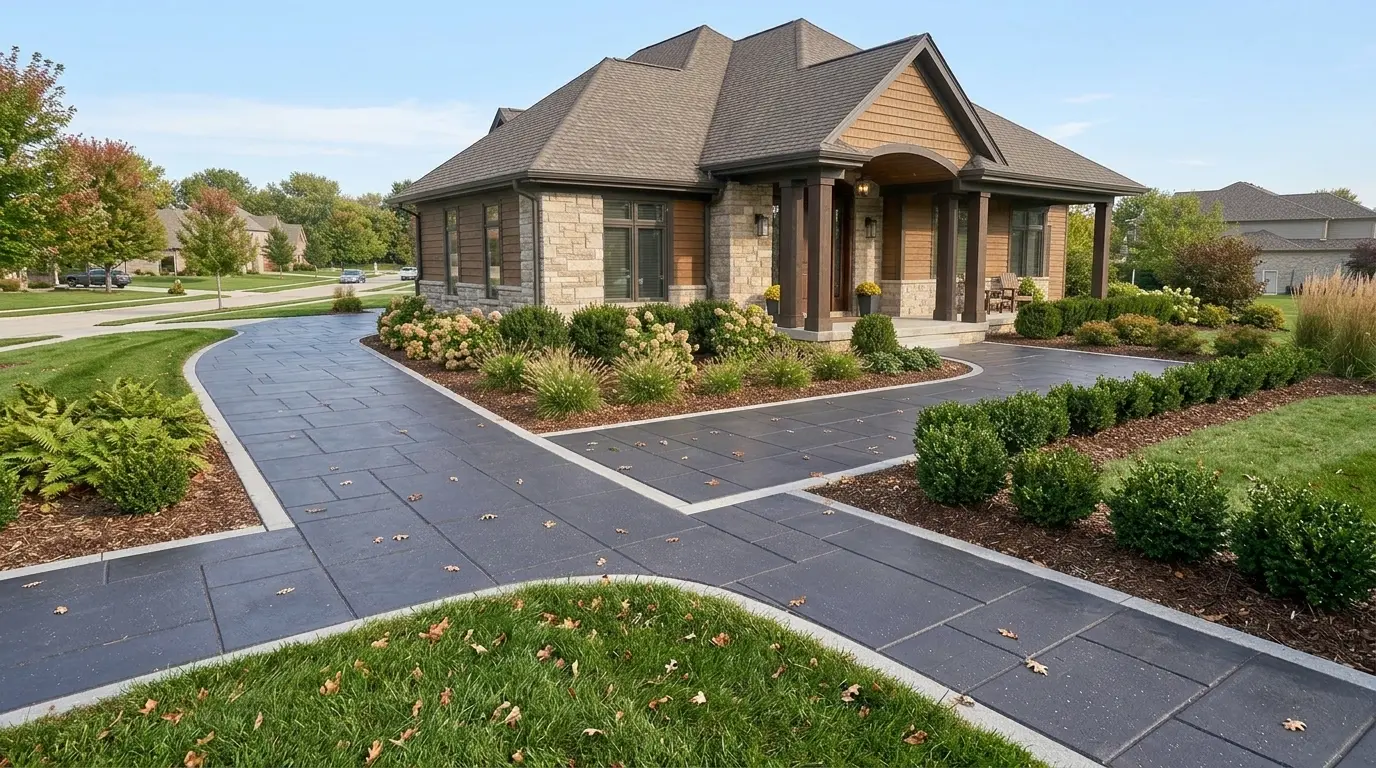
Sub-Base Preparation: The Variable That Decides Everything
Your sub-base is where black basalt cobblestone installation succeeds or fails — and the correct specification starts with a geotechnical read on the native soil, not with a generic depth recommendation. Clay-heavy subgrades expand and contract with moisture content in ways that a fixed aggregate depth won’t fully neutralise. In those conditions, you’re engineering the sub-base as a drainage and movement-management layer, not just a load-spreader.
- Compact native subgrade to the bearing capacity required for the intended load — pedestrian walkways and vehicular-rated entries have different thresholds
- Install a geotextile separator between native soil and aggregate where fines migration is a risk in sandy or silty soils
- Use crushed angular aggregate for the base course — rounded river gravel won’t interlock and will allow lateral creep under load
- Compact in lifts; compacting deep aggregate in a single pass produces a deceptively solid surface over a poorly consolidated core
- Verify final surface tolerance before setting bed placement — raking a setting bed to compensate for a poorly graded base results in variable bedding depth and uneven load transfer
The setting bed material choice sits directly above the aggregate base. Compacted stone dust (crusher run fines) works well for black basalt cobbles in most residential and light commercial walkway applications. For pedestrian-only paths where drainage is prioritised, an open-graded system with permeable bedding offers a cleaner long-term performance profile. Whatever bedding system you select, the nominal thickness should be consistent — irregular depth creates the pivot points where cobbles rock and joints open unevenly over time.
Joint Design and Sand Filling for Cobblestone Walkways
Joint width in black basalt cobblestone installation is partly aesthetic and partly functional. Narrower joints give a more formal, refined finish that suits contemporary landscape design and modernist hardscape vocabularies. Wider joints with a contrasting fill — exposed aggregate, fine gravel, or moss — suit naturalistic and cottage-garden aesthetics. Both approaches are technically sound, but they require different maintenance expectations.
- Narrow joints filled with polymeric sand require a proper activation wash-down and a dry surface at time of installation — moisture interference during curing leaves a hazy film on dark stone that is difficult to remove
- Open joints with decomposed granite or fine aggregate allow free drainage but need periodic top-up as material settles after rain
- Jointing sand in freeze-thaw regions should be rated for freeze-thaw cycling — standard polymeric products vary significantly in their low-temperature performance, so confirm this with your supplier before ordering
- Black basalt’s dark surface makes haze and efflorescence residue immediately visible — clean joints carefully and neutralise any cement-based residue before it cures
Here’s what most specifiers miss on joint sand installation: the cobbles need to be fully seated and locked before the final compaction pass that drives sand into the joints. Running a plate compactor over loosely laid cobbles with open joints risks chipping the arris edges and introducing micro-cracks at corners — and on black stone, those chips are impossible to hide. Use a rubber-pad compactor or a rubber-faced plate to protect the surface during final compaction.
Thickness Specification for Load Applications
Thickness selection for black basalt cobblestone installation depends on both point load requirements and the nominal sizing of the cobbles you’re using. Cobbles aren’t dimensionally uniform the way cut pavers are — there’s inherent variation in height across a batch, which your bedding depth needs to absorb. The setting bed compensates for that variation; specifying too thin a bedding layer with high-variation cobbles produces a surface that rocks or bridges across hollow spots.
For pedestrian walkways, the dominant load consideration is point load from heel strike and occasional maintenance equipment. Specifying cobble thickness that handles those loads with an adequate safety margin is straightforward for this application — request the compressive strength test report from your supplier and compare it against the loads your engineer has calculated for the project. For applications with occasional vehicle crossings, you’re applying a completely different load model, and the sub-base depth climbs accordingly. Natural Stone Institute igneous stone paving standards provide a useful framework for understanding which property tests are relevant when specifying igneous paving in load-bearing applications.
Design Integration: Landscape Styles and Black Basalt Cobblestone
Black basalt cobbles read differently across landscape design traditions, and your selection of finish, joint width, and pattern will anchor the material to the overall design language of the project. This is where material specification and aesthetic intent converge — and it’s worth considering both simultaneously rather than treating them as separate decisions.
- Modern minimalist landscapes: straight-run or grid-pattern laying with tight joints and a honed or natural cleft finish reads as intentional and architectural; the dark tone anchors planting beds and contrasts effectively with light-toned rendered walls
- Traditional and colonial-revival gardens: fan or herringbone patterns with wider lime-mortar joints evoke historic European streetscapes; basalt’s density gives it the visual weight these formal compositions need
- Desert xeriscaping: black basalt cobbles create strong tonal contrast against pale gravel mulches and drought-tolerant silver-leafed planting; the thermal mass consideration is relevant here, so direct these surfaces to shaded zones or use them as accent borders rather than primary paths
- Tropical and lush planting schemes: the dark stone recedes visually against dense green foliage and creates a grounding plane that makes planting the visual focal point; wider open joints with creeping groundcover between cobbles works particularly well in this context
For projects where Citadel Stone black cobblestone is being specified alongside broader hardscape elements, it’s worth reviewing the full range of cobble sizes and surface finishes available — the same material in a tumbled finish versus a natural cleft reads as an entirely different design element, which expands your palette without introducing a second material. Citadel Stone cuts black basalt cobbles to order at our selected quarries from the Middle East, which means custom sizing for projects with specific dimensional requirements is a practical option rather than a special order exception.
Slope, Drainage, and Pattern Direction for Walkways
Drainage is the detail that determines long-term joint integrity more than any other single factor. Standing water in cobblestone joints — regardless of the jointing material — accelerates deterioration in freeze-thaw regions and promotes biological growth in humid climates. Your minimum cross-fall for a walkway needs to move water clear of the surface reliably, and the pattern direction should support that geometry.
Fan patterns running across the slope concentrate water at the curved ends of each fan section. Straight running-bond or herringbone patterns allow more predictable water direction when the laying axis aligns with the drainage fall. In practice, most walkway designers prioritise pattern aesthetics first and then verify that drainage geometry works — which is the right sequence as long as the cross-fall verification happens before the base is poured, not after the cobbles are set. According to ASLA natural stone walkway design guidance, integrating drainage geometry into the initial design phase rather than treating it as a site-work detail produces measurably better long-term outcomes for hardscape surfaces.
Edge restraints play a direct role in drainage management too. A poorly anchored edge allows the perimeter cobbles to migrate outward, which opens the joint line at the perimeter and creates a channel where water collects rather than sheds. Steel or aluminium edging spiked into the sub-base at close centres keeps the perimeter locked while the interior pattern self-compresses over time.
Sealing Black Basalt Cobblestone Walkways
Sealing decisions for black basalt cobblestone walkways involve a genuine trade-off between surface enhancement and joint flexibility. An impregnating sealer penetrates the stone matrix without forming a film on the surface — this approach enhances colour depth in basalt without creating a surface that traps moisture beneath it in freeze-thaw conditions. A film-forming topical sealer produces a higher sheen but can peel or delaminate in outdoor conditions where thermal cycling is significant, and on cobblestone surfaces with irregular joints, maintaining an intact film is difficult long-term.
- Apply sealer only after the jointing compound has fully cured — premature sealing traps residual moisture and can cause hazing on dark stone
- Test the sealer on a sample cobble before committing to the full surface — black basalt varies in absorption between batches, and some sealers shift the colour tone more than expected
- Re-sealing intervals depend entirely on the sealer product — follow the manufacturer’s stated interval, not a generic industry schedule
- In shaded installations with persistent moisture, confirm that the sealer is vapour-permeable — non-breathable sealers on basalt in cool, damp conditions can trap surface moisture and promote biological growth
The finish on the cobble itself interacts with the sealer’s final appearance. A natural cleft or tumbled finish leaves an open, matte texture that accepts an impregnating sealer without much visual change. A honed finish is denser and more reflective — sealing a honed basalt cobble will produce a noticeably wetter appearance that deepens the black considerably. Some designers specify this effect intentionally; others are surprised by it. Either way, the sample test before full application is non-negotiable on a project of any scale.
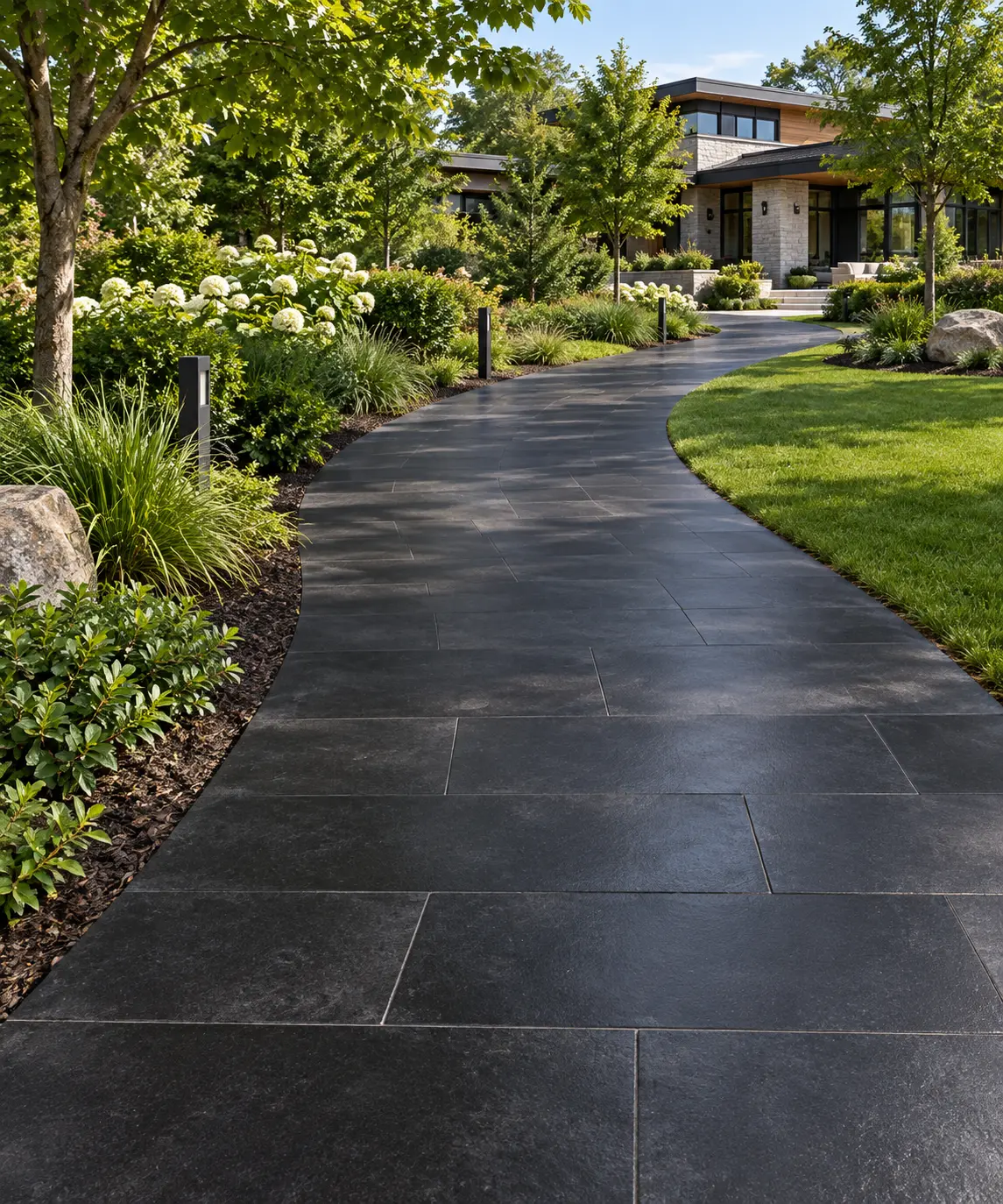
Ordering, Delivery, and Site Planning
Black basalt cobblestone is a heavy material — the delivery logistics for a walkway project require more planning than many clients anticipate. Cobbles are typically palletised and delivered by flatbed, and your site access needs to accommodate that. Confirm truck access at the time you place the order: gate widths, overhead clearances, surface-bearing capacity for the driveway or access path, and offloading arrangements all need to be resolved before the delivery date is confirmed. Lead times are quoted with the order and depend on the sizing and quantity specified — building buffer time into your project schedule is essential for stone sourced at the quarry and cut to order.
Calculate your material quantity with a waste factor built in. Cobblestone installations involve cutting at perimeters, around curves, and at step transitions — the off-cut rate is higher than it is with uniform pavers. A standard waste allowance for a straight-edged walkway runs in the range of eight to ten percent; curved or complex-shaped paths with fan patterns will run higher. Ordering too little and waiting for a second shipment is a more costly delay than ordering a modest surplus, which can often be used for repairs or extensions.
At Citadel Stone, our technical team can advise on quantity calculations and nominal size tolerances for specific laying patterns — particularly for projects where the cobble size and laying bond need to coordinate with a set walkway width to avoid awkward cut fractions at the edges.
Your Action Plan
Getting black basalt cobblestone installation right is a sequence of decisions, each of which sets the constraint for the one that follows. Start with the sub-base specification — not with the surface. Get the geotechnical conditions read, match your aggregate depth and compaction protocol to the actual load and soil type, and set the drainage geometry before any stone is ordered. Your pattern choice, joint width, and sealer selection are all downstream of that foundation work, and they’re considerably more forgiving when the base is solid.
Design integration decisions — pattern direction, finish selection, joint treatment — are best made in parallel with the technical specification rather than after it. The landscape style driving the project informs which finish and which pattern reads correctly, and those choices can influence practical decisions like how tight you run the joints and whether a topical or impregnating sealer fits the aesthetic intent. Black basalt cobbles are a material that rewards specification discipline; the performance is genuinely there, but only when the installation process matches it. As you plan your complete hardscape programme, black basalt in driveway applications covers the additional load and joint-design considerations that apply when the same material moves from pedestrian to vehicular surfaces. In coastal and freeze-thaw conditions, Citadel Stone black basalt cobblestone is known for maintaining joint integrity and surface texture over time when installed with appropriate bedding and spacing.
Related reading: honed black basalt finish explained · what is black basalt rock · how to place black basalt boulders.