A Dry Island With Wet Weeks
Anguilla takes less rain than anywhere else in the Lesser Antilles, somewhere near 35 to 40 inches in a normal year, and that total arrives unevenly. February and March are close to bone dry. September and October carry the bulk of it, often in short, hard bursts that end as quickly as they start. There are no rivers on the island, so water is caught, stored and spent with care.
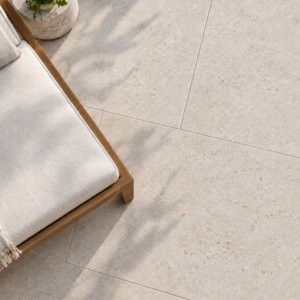
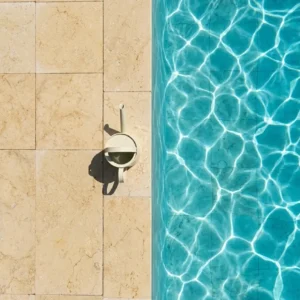
That rhythm writes the brief for outdoor stone. A terrace here bakes dry and collects airborne salt for weeks, then takes a soaking in an hour. Two measured properties govern how a paving lot copes with that swing: absorption and density.
What Absorption Actually Measures
Absorption is the share of water by weight that a stone takes up when it is saturated. It stands in for pore volume and, just as importantly, for how well those pores connect to one another. Many of the complaints owners raise about outdoor stone trace back to that single number.
- How long a terrace stays dark and patchy after a downpour
- Whether salt travels into the stone and crystallizes inside it
- How far sunscreen, wine and grill grease get below the surface
- How much moisture the setting bed can push back up through a unit
- How a sealer behaves, and how often it has to be renewed
Density and What It Buys You
Density is the other half of the same question. A denser limestone has less pore space to fill, so it carries less water, dries with less patching, and holds a clean edge longer under furniture, luggage wheels and service traffic. Density also raises thermal mass, which is quietly useful on a villa terrace: a heavier pale unit warms slowly through the afternoon instead of spiking at noon.
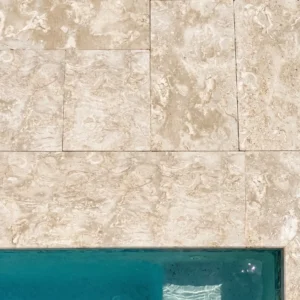
Density is not a virtue to chase without limit. Very dense material is slower to cut on site and less forgiving if a base settles. For Anguilla the sensible target is stone at the low-absorption end of the limestone family, supplied in a thickness matched to the job rather than to a catalog default.
Salt Is an Island-Wide Condition
Anguilla runs about 16 miles long and three miles across at its widest, and it is flat, with Crocus Hill reaching only 240 feet. There is no sheltered interior to retreat into. Trade-wind aerosol reaches a courtyard in The Valley much as it reaches a deck above Meads Bay, so the salt case has to be made for every surface on the property. It is also why paving with published absorption data is worth insisting on well back from the shoreline.
- Fine salt aerosol settles on dry surfaces during long rainless spells
- A heavy shower dissolves it and drives the solution into open pores
- The next dry week evaporates that water and leaves the crystals behind
- Repeated cycles fatigue the surface of open-pored stone from within
Reading a Test Report
Ask for figures that belong to the lot you are buying rather than to the stone type in the abstract. A short, honest report beats a glossy brochure every time, and it gives your engineer something firm to hold on to.
- Absorption reported for the batch, not for the source in general
- Bulk density, so thickness, handling and crate weights can be planned
- Strength values where units bridge an unbonded bed
- A wet slip reading taken on the exact finish you intend to lay
- The date of the test, because lots genuinely change over time
If a supplier cannot produce that paperwork, it is fair to ask why. Natural stone varies, and a serious supply chain records the variation instead of hiding it behind a generic datasheet written for a whole material family.
Two Handling Legs Into Road Bay
Freight for Anguilla generally moves from the US mainland to Port St. Maarten, then crosses the Anguilla Channel on a short feeder leg into Road Bay at Sandy Ground. Blowing Point is the ferry terminal on the south coast and handles passengers, not containers. Because the consignment is lifted twice, crate specification, banding and corner protection matter more here than on an island with direct calls, and a dense low-absorption stone is also a heavy one. Our notes on how we ship into Road Bay explain how we pack for that second lift.
Bedding, Drainage and the Cistern
Because the island harvests rainwater, a paved surface is never only a puddle question. Where run-off goes, what it touches on the way, and how fast a burst clears all belong in the same conversation as the cistern and the well.
- Size falls and outlets for a short intense burst, not for steady drizzle
- Keep clean catchment surfaces separate from drive and service run-off
- Use open-graded bedding so a dry bed does not wick salt upward
- Detail joints so wind-blown grit can be swept off rather than ground in
Specifying With Confidence
Nobody on this island needs persuading that specification is worth the effort. Hurricane Irma crossed on 6 September 2017 and reset what owners expect from a rebuild. Stone chosen on measured absorption and density, laid on a base that sheds a hard burst and detailed for a salt-dusted climate, is a quiet part of that answer. None of it is exotic engineering. It is a short list of numbers, agreed early, written into the order, and checked against the crate that actually turns up at Road Bay. Set your absorption and density limits in writing before the first crate is loaded.