The base layer underneath a crushed granite with pavers installation does more structural work than the surface material ever will — and that’s the detail most project planners underestimate before the first stone is set. Get the sub-base depth, compaction standard, and fines content right, and the pavers above stay level for years. Cut corners on the base, and you’ll be re-leveling pavers after the first wet season.
Why Crushed Granite Works as a Base Material
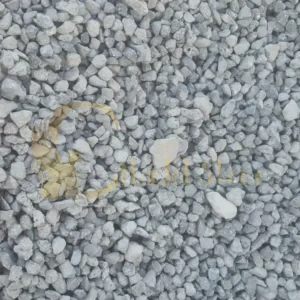
Crushed granite earns its place as a base aggregate because of how it compacts. Angular crushed particles interlock under roller or plate-compactor pressure in a way that rounded gravel simply can’t match. The interlocked structure resists lateral displacement even under repeated point loads — which is exactly what paver joints experience as foot traffic crosses unevenly settled edges.
The fines content matters just as much as the aggregate size. A well-graded crushed granite blend — sometimes called decomposed granite or crusher run, depending on the region and the mill — carries enough fine material to fill voids between larger particles and produce a near-solid compacted layer. Too much fines, though, and drainage suffers. Your material should drain freely even after heavy rain, so ask your supplier for a grading breakdown before you commit to a tonnage order.
- Angular particle shape promotes mechanical interlock under compaction
- Well-graded blends balance structural density with drainage performance
- Crusher-run and decomposed granite differ in fines content — confirm which grade suits your drainage requirement
- A properly compacted crushed-granite base resists settlement far better than a loosely poured gravel layer
Planning Your Crushed Granite Base Depth
Base depth is determined by three factors working together: the intended use of the surface, the native soil type beneath, and the paver thickness you’ve specified. For residential pedestrian paths and patios, a compacted crushed-granite base of 4 in (100 mm) sits under a 1¼ in (3 cm) paver in most stable soil conditions. Expand to 6 in (150 mm) on expansive clay or in regions where freeze-thaw cycling will test the base annually.
Clay soils deserve particular attention. When clay is wet, it expands; when dry, it contracts. That cyclic movement translates directly upward into your paver surface as differential settlement — the kind that creates rocking pavers and open joints. In clay-heavy ground, a geotextile separation fabric between the native soil and the crushed-granite base layer prevents the fines from migrating down and the clay from migrating up over time.
- 4 in (100 mm) compacted base for pedestrian patios and paths on stable soil
- 6 in (150 mm) on expansive clay or in freeze-thaw environments
- Geotextile fabric at the soil interface where clay content is high
- Paver thickness specification stays separate from base depth — they work together, not interchangeably
The Natural Stone Institute granite application overview outlines how granite’s density and structural characteristics interact with typical base preparations — useful background when you’re aligning material selection with your base design.
Compaction and Sub-Base Preparation
Compaction is where crushed granite with pavers setups succeed or fail at the base level. You can’t shortcut it. Place the crushed granite in lifts no deeper than 4 in (100 mm) each and compact each lift before adding the next. Running a plate compactor over a single 8 in (200 mm) layer looks efficient on the day but leaves the lower portion of the base undercompacted — and that’s where settlement originates, not at the surface.
Moisture content during compaction matters more than most DIY guides acknowledge. Crushed granite compacts most effectively at a moisture level just below saturation — the material clumps slightly when squeezed in your hand but doesn’t weep water. Bone-dry granite base compacts poorly because there’s no surface tension helping particles lock together; saturated material pumps under the compactor. If your delivery arrives dry in hot weather, a light water pass before compaction is worth the extra step.
- Compact in maximum 4 in (100 mm) lifts — never as a single deep layer
- Target near-optimum moisture content: clumps but doesn’t weep
- Use a plate compactor for smaller areas; a drum roller for runs longer than 30 ft (9 m)
- Make two compaction passes at right angles for uniform density across the surface
Choosing Your Granite Pavers for the Surface
Your surface paver choice interacts directly with the base specification, so the two decisions belong together rather than in sequence. A thicker paver at 1½ in (38 mm) distributes point loads over a broader footprint than a slimmer tile, which relaxes the compaction standard slightly on marginal soils. Conversely, very thin formats — anything under 1 in (25 mm) — demand an especially rigid, well-compacted base to prevent flexural cracking at unsupported edges.
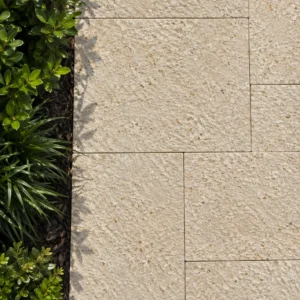
Finish selection also comes into this decision. For paths exposed to full sun most of the day, a honed or brushed finish reads well against the light-toned fines of a crushed-granite base, while a polished finish works only for dry indoor surfaces and should never be specified for an exterior path or patio. For outdoor pedestrian areas, a bush-hammered finish leaves an open, matte texture across the face; a brushed finish in a coarser grit produces a similar matte character with a slightly softer surface feel. Check a sample in your actual site conditions — the way finish reads next to crusher-run fines changes noticeably across lighting conditions.
Browse our granite paver range for format options, thicknesses, and finish descriptions that align with path, patio, and courtyard applications.
- Thicker pavers at 1½ in (38 mm) suit marginal base conditions better than thin formats
- Bush-hammered finish: open, matte texture — appropriate for exterior pedestrian paths
- Brushed 36 Grit: works well for patios and indoor-outdoor transitions
- Brushed 80 Grit: suitable for barefoot areas such as terraces where a finer matte texture is preferred
- Polished finish is for dry indoor surfaces only — never for exterior or wet environments
Laying the Setting Bed and Paver Placement
The setting bed — the thin layer directly under the pavers — is distinct from the structural base beneath it. For a crushed-granite with pavers setup on a pedestrian patio or path, a screeded bedding layer of coarse sand or limestone screenings at roughly 1 in (25 mm) depth allows final leveling adjustments as you lay each stone. The bedding layer is not a structural layer; its job is to receive the paver and fill the small irregularities in the compacted base surface.
Set each paver with a consistent joint width — typically ¼ in to ⅜ in (6–10 mm) — and use a rubber mallet and a spirit level to keep the surface plane consistent as you work across the installation. The most common field error at this stage is running too far ahead of your screeding, which lets the bedding layer dry out and lose its workability. Work in sections no wider than you can reach across comfortably, and lay pavers into freshly screeded sand only.
- Bedding layer: 1 in (25 mm) coarse sand or limestone screenings, screeded flat
- Joint width: ¼–⅜ in (6–10 mm) consistent throughout
- Use a rubber mallet to seat pavers — a hard-face hammer transfers shock that can chip cut edges
- Check the surface plane with a 4 ft (1.2 m) level as you go, not only at the end of a run
- Build in a drainage fall of approximately ¼ in per foot (2%) away from structures
Jointing and Locking the Paver Surface
Joint filling determines how stable the finished surface feels underfoot and how well it resists weed ingress over time. For a crushed granite with pavers installation on a pedestrian path or patio, kiln-dried jointing sand swept into the joints and then plate-compacted into place produces a stable, load-distributing fill. The compaction step is one that installers frequently skip, but it’s the step that locks the bedding layer and the joint fill together into a unified structure.
Polymeric sand is an alternative that binds with moisture and hardens to reduce joint washout, particularly on surfaces where hosing or heavy rain hits the joints directly. It costs more than standard jointing sand, and it requires the pavers to be clean and dry when applied — moisture trapped under the polymeric layer can cause it to cure unevenly and push up at the edges. Follow the manufacturer’s application instructions precisely on this one; the drying window is not a suggestion.
- Standard kiln-dried sand: sweep in, compact with plate compactor, top up, compact again
- Polymeric sand: follow manufacturer’s moisture and temperature requirements carefully
- Refill joints after the first wet season — initial settlement always opens gaps
- Edge restraints at the perimeter of the installation prevent the paver field from spreading laterally under traffic
The ASTM C615 granite dimension stone standard sets out the testing framework for granite quality in dimensional stone applications — when you’re specifying granite pavers, ask your supplier which ASTM standards their material has been tested against and request the relevant test reports.
UV Exposure and Long-Term Appearance of Granite
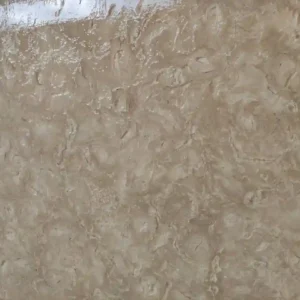
Granite surfaces in full, unshaded sun face a different weathering picture than those under a pergola or tree canopy. UV exposure doesn’t degrade granite structurally the way it affects polymer-based materials, but it does affect surface color over years of exposure — particularly in certain granite varieties where iron-bearing minerals at the surface oxidize slowly in sunlight and air, producing a subtle shift toward warmer, brownish tones. Tan brown granite, for example, carries a warm base palette that tends to mellow with prolonged sun exposure rather than shift dramatically, but the change is cumulative and worth factoring into your finish and sealer schedule from the outset.
A quality penetrating sealer applied to the surface slows UV-driven color shift by reducing the oxidation pathway at the stone’s open pore structure. The sealer schedule matters — a sealer that was applied once at installation and never re-applied won’t be doing much by year three in a hot, sunny climate. Most penetrating sealers for exterior granite require reapplication on the interval your sealer manufacturer states, typically somewhere in the range of two to five years depending on sun exposure and surface finish. A honed surface absorbs more sealer per application but may need the interval checked more frequently than a tighter, finer finish. Test a small area with a water drop: if the water beads, the sealer is still active; if it absorbs within a few seconds, it’s time to reseal.
- Iron-bearing minerals in some granites oxidize slowly under sustained UV — color shift is gradual, not sudden
- A penetrating sealer reduces the oxidation pathway and slows surface color change
- Reseal on the interval your sealer manufacturer specifies — not a single-application assumption
- The water-bead test is a reliable field check for active sealer coverage
- Coarser, more open finishes absorb sealer more readily but may need the seal checked more frequently
Ordering and Delivery Planning
Quantity calculation for a crushed granite with pavers project runs across two separate material streams: the base aggregate and the surface pavers. For the base aggregate, calculate the volume of the compacted base — length × width × depth in feet, then divide by 27 to convert cubic feet to cubic yards — and add 15% for compaction factor and waste. For the pavers, calculate the surface area in square feet, add 10% for cuts and breakage on a straightforward rectangular layout, and more for complex patterns or diagonal settings.
Delivery scheduling for natural stone cut to order needs more lead time than off-the-shelf concrete paver products. Citadel Stone cuts granite pavers to order at our selected quarries, so your order confirmation and lead time are quoted together — allow for that window in your project timeline and confirm site access when you place the order. Offloading arrangements for pallet quantities are confirmed before the delivery date; if your site has restricted access, note it at order time so the logistics can be planned accordingly.
- Base aggregate: calculate compacted volume, add 15% for compaction factor and waste
- Pavers: surface area plus 10% minimum for cuts and breakage on rectangular layouts
- Lead time for cut-to-order granite is quoted with the order — build it into your schedule
- Confirm site access and offloading arrangements before the delivery date
- Order pavers and base aggregate in the same planning phase to avoid timeline gaps between base readiness and paver arrival
Common Installation Errors to Avoid
Most crushed granite with pavers failures trace back to one of four consistent field errors — and none of them are exotic. The first is undercompaction of the base, usually because the installer tried to compact too deep a layer in one pass. The second is an insufficiently deep base for the soil type, which shows up as differential settlement within the first year. The third is laying pavers into a screeded bedding layer that’s been left open too long in hot, dry conditions — the surface dries and the pavers don’t bed properly, leaving hollow spots that crack under point load.
The fourth error is skipping edge restraints on the assumption that border pavers will hold the field in place. On a large paved area, the cumulative lateral pressure from foot traffic and thermal expansion pushes pavers outward at the perimeter over time, opening joints and allowing the entire surface to slowly migrate. Plastic or aluminum edge restraints pinned into the compacted base at the perimeter hold the paver field in position — a simple measure that prevents a frustrating rework.
- Undercompaction from single deep lifts: always compact in maximum 4 in (100 mm) layers
- Base too shallow for the soil: match base depth to soil type and climate, not just to minimum guidance
- Dried-out bedding layer: screed and lay in manageable sections, not too far ahead
- Missing edge restraints: pin restraints at the full perimeter before the first paver goes down
- Incorrect drainage fall: a flat or reverse-fall surface pools water at the paver joints and accelerates base saturation
The ASLA guidance on permeable paving surfaces covers broader design principles around drainage management and material selection for outdoor hardscape — a useful reference when you’re planning drainage integration for a large paved area.
Decision Points
A crushed granite with pavers installation rewards careful sequencing at the specification stage. The decisions that determine long-term performance — base depth, aggregate grade, compaction standard, paver thickness, finish selection, jointing method, sealer schedule — all interact, and changing one after the fact costs more than getting it right upfront. Your base specification should be driven by your native soil assessment and your climate, not by what the paver format calls for on its own. Get those two decisions aligned before you order material.
Granite pavers cut to the right format and finished for your specific application will hold their structure and character across decades of service life where the base beneath them is sound and the sealer schedule is maintained. For a related look at how granite performs in a demanding wet environment, granite pool deck design and specification explores format, layout, and finish choices for water-adjacent applications worth reviewing alongside your patio or path project.
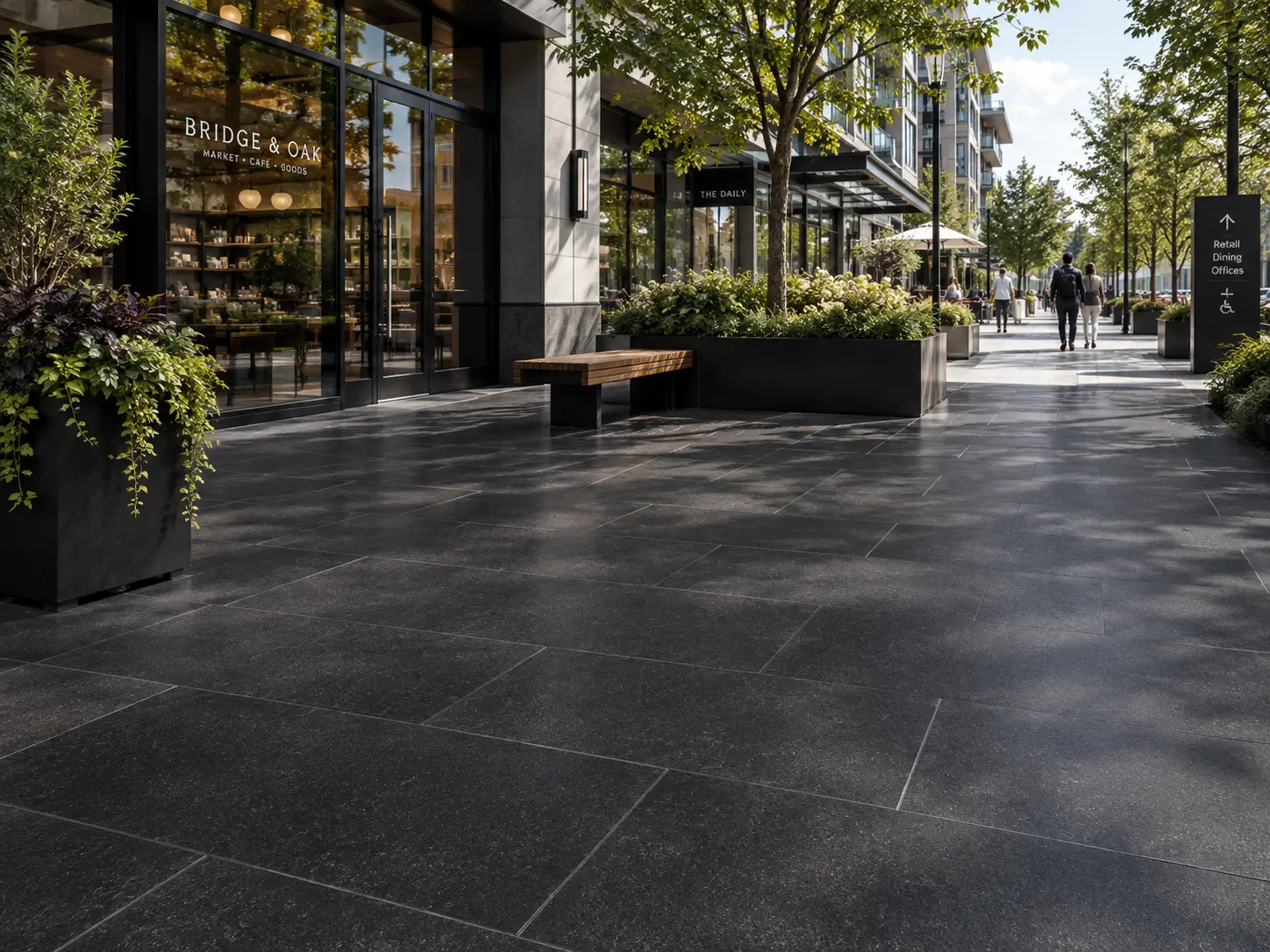
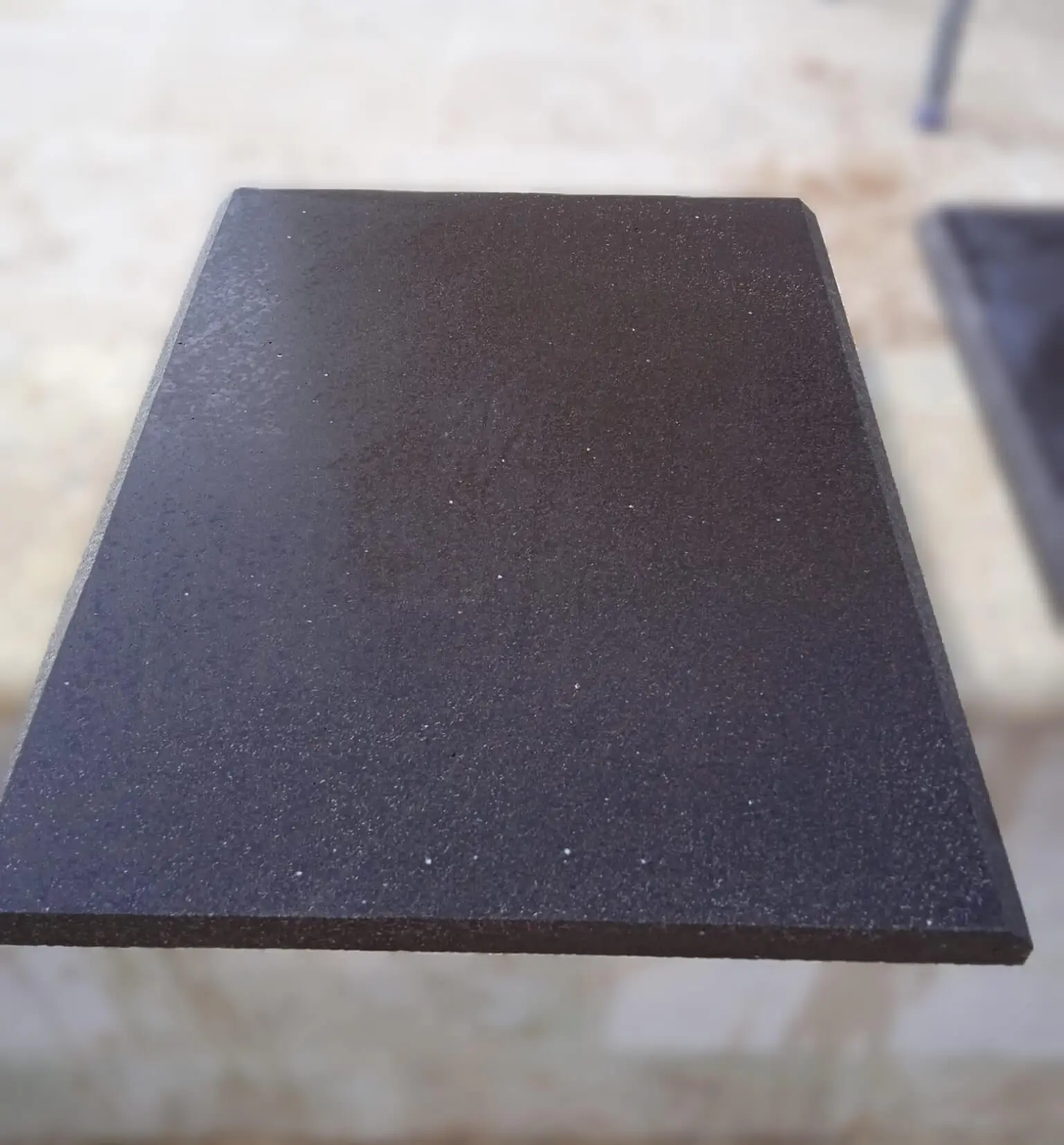
Granite pavers from Citadel Stone sit stable on a compacted crushed-granite base, selected for even drainage in heavy rainfall.
Related reading: granite paver color guide · reclaimed granite pavers · Flamed Granite Paver Finish: Texture, Grip and Best Uses.