

Basalt hexagon design ideas reward you most when you treat the tile’s geometry as a structural element, not just a visual one. The interlocking hex grid distributes point loads across more mortar contact points than a square or rectangular layout, which matters in rooms where floor deflection is a concern. Pair that structural advantage with basalt’s dense, fine-grained volcanic composition and you have a surface that holds its geometry through decades of use — provided the substrate underneath is prepared to the same standard the tile deserves.
Why Basalt Works in Hexagon Format
The hexagon shape is unforgiving to substrates that aren’t level. Because hex tiles share six sides with their neighbors, any lippage telegraphs across the field faster than it would in a brick or stack-bond pattern. You’ll want a flatness tolerance that keeps adjacent tile edges within the threshold your installation standard allows — check ANSI A108.02 for floor flatness tolerances before you set the first tile. Basalt, being denser than most sedimentary stones, shows lippage more starkly in raking light, so the preparation step isn’t optional.
The material’s uniform dark grey tone also amplifies grout joint visibility. Narrower joints emphasize the hex geometry; wider joints frame each tile individually and soften the overall pattern. Either approach is valid, but the decision changes how you read the room, so make it consciously before your tile setter begins.
Nine Basalt Hexagon Design Ideas for Modern Rooms
1. Full Floor Field in a Single Hex Size
A wall-to-wall field of one hex size in a honed 120 grit finish reads as intentional and calm — the pattern does the work without competing colors or mixed materials. This approach works especially well in open-plan kitchens and living areas where visual continuity matters. Keep the grout color within two shades of the basalt so the geometry registers as texture, not contrast.
2. Hex Accent Border on a Larger-Format Floor
Basalt hexagon tiles used as a border band around large-format basalt slabs create a transition that reads as designed rather than accidental. The border contains the slab field visually and gives the eye a resting point near walls and thresholds. Use matching stone so the two formats age to the same patina.
3. Shower Wall Panel in Honed Hex
A honed finish on a shower wall in hexagonal format introduces tactile interest without relying on gloss. The matte surface reads differently at different times of day as light changes, which makes a small wet room feel more considered. Your tile setter should back-butter each piece individually given the small format — coverage requirements for mosaic and small-format tile are stricter than for large format.
4. Feature Wall in Split Face Hex
A split face finish on hexagon tiles used as a feature wall behind a fireplace surround introduces strong shadow lines and depth. The irregular surface texture breaks up the geometric repetition in a way that polished or honed finishes cannot. Note that the fireplace or appliance manufacturer’s clearances and your local building code determine what may sit adjacent to the firebox — check those requirements before you specify tile layout and grout.
5. Outdoor Terrace in Brushed Hex
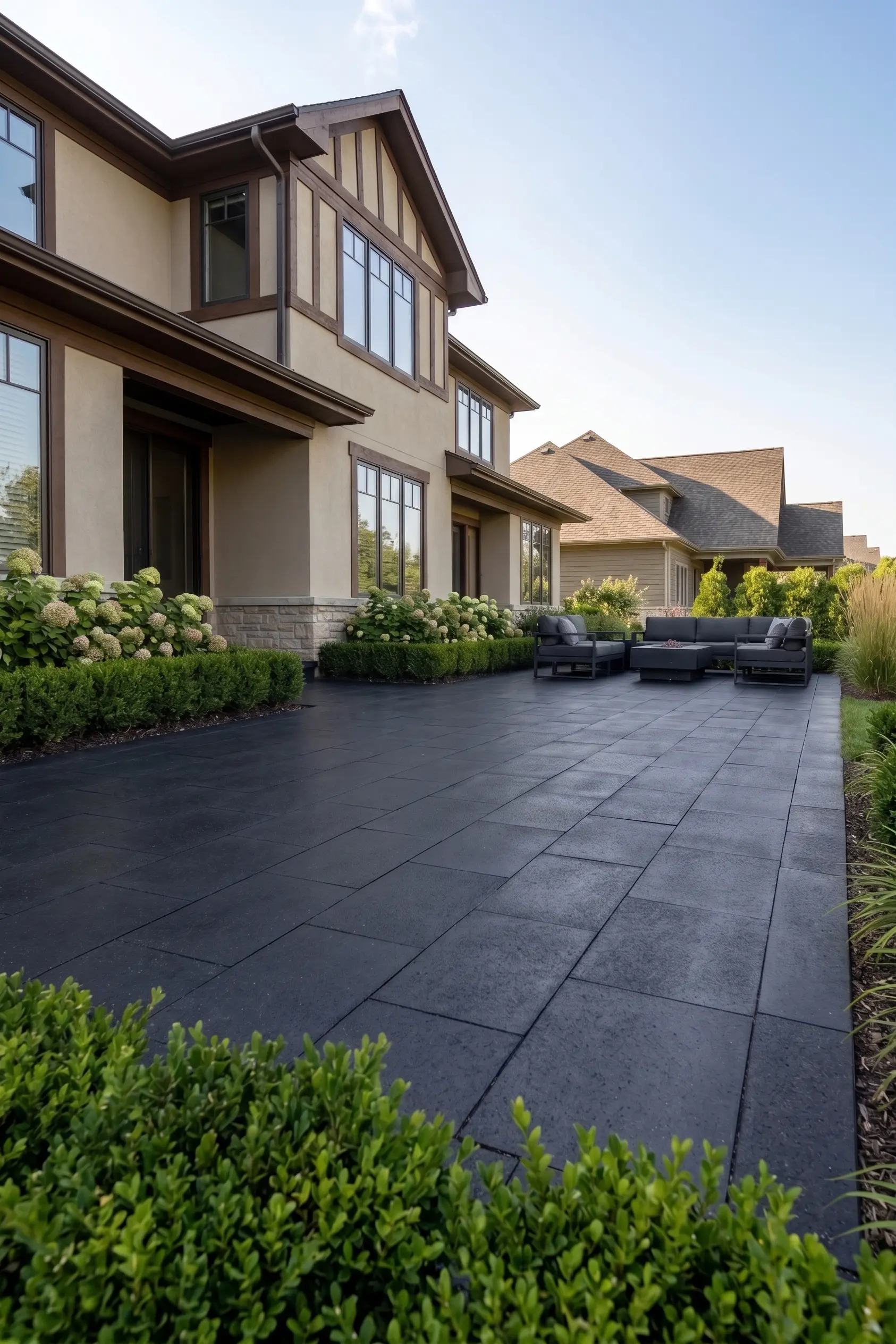
A brushed 36 grit finish on a covered terrace or pool house floor gives you an open, matte surface texture that suits outdoor barefoot use. The hexagonal format holds its edges cleanly in brushed form because basalt’s tight grain doesn’t crumble at cut edges the way some softer stones do. For uncovered pool decks and ramps, a bush-hammered finish is the specification to use.
6. Bathroom Floor in Double-Brushed Hex
A double-brushed 60 finish produces a surface texture that is finer than a standard brushed tile but retains a tactile quality that a polished finish loses. This is a well-suited specification for bathroom floors, covered terraces and spa areas. The double-brushed surface also takes sealer more evenly than a coarser brushed finish, which benefits maintenance.
7. Kitchen Backsplash in Mixed Hex Sizes
Mixing two hex sizes — a larger field tile with a smaller accent interspersed at regular intervals — creates pattern depth on a backsplash without introducing a second material. This works because basalt’s consistent coloring means size variation, not color variation, drives the pattern. A polished finish is appropriate here because this is a dry indoor vertical surface, and the reflective quality adds dimension in a wall application.
8. Entryway Medallion with Contrasting Grout
A medallion or inset panel of basalt hexagon tiles set in a contrasting light grout in an entryway floor creates a strong focal point. The hexagonal geometry reinforces the sense of a defined zone, which suits entry spaces where you want a transition between exterior and interior to feel deliberate. According to Natural Stone Institute ASTM tile stone specifications and standards, attention to substrate flatness and bond coat coverage is especially critical for small-format natural stone tiles, where any hollow spot risks cracking at a tile edge.
9. Exterior Pathway in Bush-Hammered Hex
For garden paths and exterior pedestrian areas, a bush-hammered finish on basalt hexagon tiles produces a surface texture with open relief that suits outdoor conditions. The bush-hammered texture also ages gracefully — rather than showing wear as a loss of surface quality, it mellows into a consistent patina that looks better with time, not worse.
Finish Selection by Application
The finish you choose shapes the design outcome more than the hex size does. Here’s a practical breakdown:
- Polished: dry indoor floors, walls, countertops, vanity tops and fireplace surrounds only — never for showers, wet floors or any outdoor surface
- Honed 120 grit: interior floors, bathrooms, wall cladding — a versatile indoor workhorse
- Double-Brushed 60: bathroom floors, interior floors, covered terraces and spa areas
- Brushed 36 grit: patios, pool surrounds and indoor-outdoor zones
- Brushed 80 grit: barefoot pool decks, terraces and interiors
- Bush-hammered: pool decks, ramps, wet areas and public paving
- Split face: feature walls, exterior cladding and fireplace surround panels
Explore our basalt hexagon palette to see which finishes are available in each hex size and confirm lead times with your order.
Sizing and Thickness for Your Application
Hex tile sizing affects layout geometry in a way that rectangular tile sizing does not. A small hex — say, a 2-inch point-to-point — reads as a surface texture from standing height, while a 6-inch or larger hex reads as individual tiles. The right size depends on the scale of the room, the desired visual density, and the substrate condition.
Thickness is the structural variable. Interior floor tile on a fully bonded substrate follows the tile manufacturer’s minimum — request the test report for the specific thickness you intend to specify. For material performance testing relevant to basalt tile in floor applications, ask your supplier for the test report on the specific size and finish you’re ordering.
For code-related questions about floor loading and substrate depth — particularly in multi-story construction or in seismic zones where floor assembly design is regulated — your structural engineer’s specification takes priority over any general guidance. Building departments in seismic regions often impose additional requirements on tile adhesive systems and substrate continuity that aren’t covered by tile standards alone.
Design Pairings That Work with Basalt Hex
Basalt’s even grey depth makes it one of the more accommodating stones in mixed-material interiors. The key is understanding what it does — it anchors. Lighter, warmer materials around it gain definition because the basalt holds the visual base of the room steady.
- Warm-toned timber: oak, walnut and teak all read as warmer against basalt’s cool grey, creating contrast without conflict
- White or off-white plaster: a rendered wall in a matte white finish lets the hex floor become the room’s texture without competing surfaces
- Brushed brass or bronze fixtures: the warm metal against cool stone is a pairing that has staying power in both residential and hospitality design
- Concrete countertops or panels: both materials share a mineral quality, so the pairing feels cohesive rather than eclectic
- Dark grout on a polished indoor field: emphasizes the geometry in a way that light grout softens
According to basalt volcanic rock formation and construction properties, the mineral uniformity of basalt — dominated by plagioclase feldspar and pyroxene — is what produces its consistent grey coloration and fine-grained surface, making it predictable to pair with other materials in a way that more variable stones are not.
Slip Resistance Considerations for Wet Areas
Slipperiness is finish-dependent, and basalt hexagon tiles span a wide range of surface textures depending on which finish you specify. The current standard for evaluating slip resistance in wet conditions is ANSI A326.3, measured wet — the finish is the primary variable. If a tested value exists for a specific tile in a specific finish, the test report is available on request. Never substitute a dry test result for a wet requirement.
For pool decks and wet steps, specify a bush-hammered finish. For other outdoor paths, a bush-hammered or brushed finish in a coarser grit both work — check a sample in your actual site conditions before committing to a full order. According to USGS basalt volcanic rock properties and composition, the dense, low-porosity nature of basalt means the finish surface — not the stone’s interior — is what determines the texture available to the foot.
Ordering, Planning and Delivery
Your project’s delivery schedule should account for the cut-to-order nature of natural stone tile. Citadel Stone cuts basalt hexagon tile to order from slabs at our selected quarries, so lead times are confirmed with the order rather than estimated from a generic schedule. Build your installation timeline around the confirmed lead time, not around a hoped-for arrival date.
Truck access at your site affects offloading arrangements. Confirm site access dimensions — particularly for deliveries to urban sites, tight driveways or projects with overhead restrictions — before the delivery date is confirmed. Offloading arrangements are finalized as part of delivery coordination, not assumed.
Order a calculated overage — 10% is a common starting point for a standard hex layout, and up to 15% for a diagonal or mixed-size field — to cover cuts at borders and any breakage during installation. Matching additional tile after the initial production run requires confirming the same finish specification and checking against the original batch, so getting the quantity right at the outset saves meaningful time.
Getting Your Basalt Hexagon Specification Right
The nine basalt hexagon design ideas above cover the range from spare, single-finish floor fields to mixed-size feature walls and layered indoor-outdoor transitions. Your decisions about finish, grout color, hex size and substrate preparation collectively determine how the installation performs and ages. The substrate is the variable most often underspecified — get that right and the tile will hold its geometry and its surface for as long as drainage works and sealing intervals are maintained. For detailed care and maintenance guidance after installation, basalt hexagon tile care and sealing covers the protocols worth following. Known for its even grey depth, basalt hexagon tile from Citadel Stone pairs with warm wood, sourced from our selected quarries in the Middle East.
Related reading: why basalt forms hexagons · how basalt columns form · basalt herringbone tile ideas.