

Black basalt slab care trips up even experienced specifiers because the stone’s dense, fine-grained structure behaves differently from sedimentary alternatives — and most maintenance protocols are written for limestone or travertine. The low absorption rate that makes basalt highly resistant to staining also means that cleaning agents sitting on the surface have nowhere to go, so product selection matters more than people expect. Getting the care routine right from day one protects the finish, prevents efflorescence from mortar contamination, and keeps the stone looking the way it looked on delivery.
Understanding Basalt’s Surface Chemistry
Basalt is a volcanic igneous rock — dense, with a tightly bonded silicate matrix that leaves it with very low water absorption compared to limestone or sandstone. According to USGS basalt volcanic rock properties, the material forms from rapidly cooled lava, producing a fine crystalline structure that gives it its characteristic hardness and density. That same structure is why routine cleaning products designed for softer stones can leave a film on basalt rather than penetrating and rinsing clear.
Your cleaning protocol needs to account for this. Neutral pH cleaners — pH 7, not the acidic or alkaline ends — are the right starting point for regular maintenance. Acids attack the iron-rich mineral content in basalt and can permanently alter the surface tone, especially on honed finishes. Alkaline degreasers leave a residue that darkens unevenly once the stone dries.
Daily and Routine Cleaning Practices
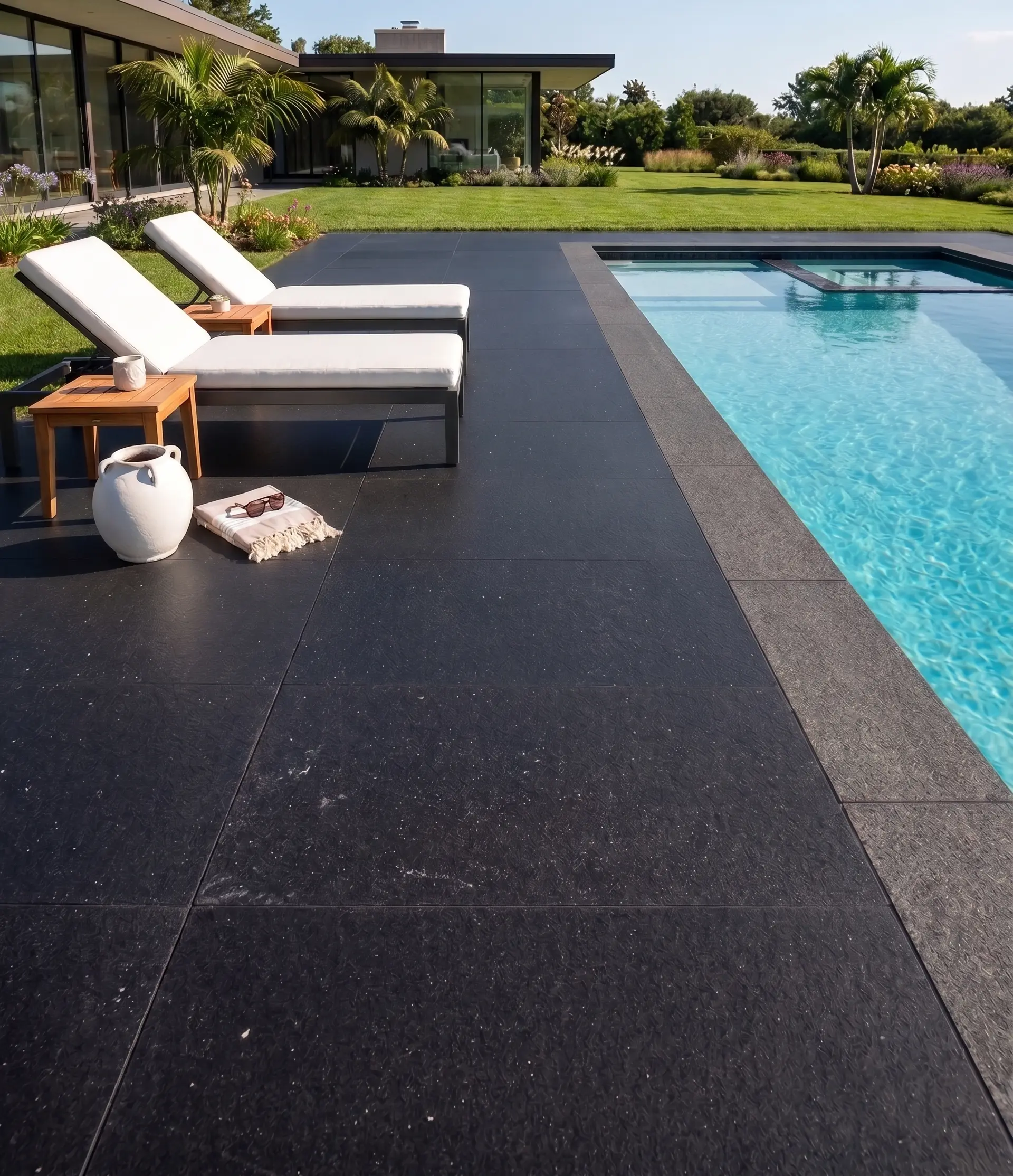
Black basalt slab care performs best under a simple, consistent regime rather than occasional intensive cleaning. For interior slabs — kitchen countertops, flooring, or feature walls — a damp microfibre cloth with a neutral stone cleaner handles day-to-day residue without risk. Outdoor black basalt slab care follows the same pH logic but requires more attention to organic build-up: algae, leaf tannins, and bird deposits all need prompt removal before they bond with the surface.
- Sweep or blow loose debris from outdoor basalt before any wet cleaning — wet debris becomes an abrasive slurry under brush pressure
- Use a low-pressure rinse rather than a pressure washer at full force; high-pressure water drives contaminants into open joints and can disturb the bedding beneath large-format slabs
- Mop interior honed basalt with a well-wrung cloth — pooling water on an unsealed surface prolongs drying time and leaves mineral deposits from hard water
- Avoid steam cleaners on polished basalt; the temperature differential between steam and the cold stone surface can stress the finish over time
- Change your rinse water frequently — cleaning with dirty rinse water re-deposits what you just removed
Choosing the Right Sealer for Black Basalt
Sealing is the most consequential decision in any black basalt slab care programme. Because basalt has low absorption, some installers skip the sealer altogether — that’s a mistake, particularly for kitchen or outdoor applications. The stone still has micro-porosity at grout joints and at cut edges, and the surface finish itself (honed versus polished) determines how aggressively you need to seal.
A penetrating impregnator-type sealer — silane or siloxane based — is the correct choice for most applications. It enters the micro-pores without forming a surface film, so you preserve the natural matte or low-sheen look of the stone. Topical sealers create a film finish that can peel, yellow under UV, and trap moisture beneath during freeze-thaw cycles in colder regions. The Natural Stone Institute confirms penetrating sealers as the standard approach for dense igneous stone — you can find the technical guidance through NSI stone variety care standards.
- Test the sealer on an inconspicuous offcut before full application — some impregnators deepen the tone of dark basalt noticeably
- Apply in thin coats; thick applications on low-absorption stone pool on the surface and cure unevenly
- Re-seal on the interval stated by your sealer manufacturer — this varies by product and exposure, but outdoor applications in wet climates typically need attention more frequently than sheltered interior slabs
- After sealing, allow full cure time before returning the surface to traffic or wet conditions
Stain Removal Without Damaging the Stone
Here’s what most specifiers miss about stain removal on dark basalt: because the stone is already dark, stains are often invisible until the surface dries — then they appear as lighter patches or uneven sheen. Oil-based stains from cooking, cutting boards, or exterior machinery are the most common offenders on honed basalt. A poultice made from diatomaceous earth and a food-safe solvent draws the oil out slowly without the surface disruption that scrubbing causes.
For outdoor basalt affected by iron staining — often from steel fixings, furniture legs, or surrounding metalwork — a specialist iron stain remover formulated for natural stone is necessary. Do not reach for a generic rust remover from a hardware store; most contain hydrochloric or oxalic acid at concentrations that will etch basalt permanently. Apply the specialist product, dwell for the stated time, and rinse thoroughly with clean water. Repeat applications are safer than a single aggressive treatment.
Basalt Slab Care in Storm- and Wind-Exposed Settings
Outdoor black basalt slab installations in exposed locations face a different set of maintenance pressures than sheltered interior applications. Wind-driven rain is a significant factor: it forces water into joints at angles that gravity drainage alone doesn’t clear, and in freeze-thaw regions, that moisture cycling stresses joint mortar and bedding over time. Your care routine in these environments needs to include periodic joint inspection — not just surface cleaning.
Check pointing mortar for hairline fractures after major storm events. Where mortar has cracked or shrunk, water is entering the sub-base, which eventually causes the slab to rock or hollow beneath the bedding. Catching this early means re-pointing a joint; ignoring it means lifting and re-laying a section. Edge restraint integrity is equally important — basalt slabs in exposed patio or terrace applications rely on perimeter restraints to prevent lateral creep under repeated wind load and thermal movement cycles. A slab that has migrated even a few millimetres from its original position changes the joint geometry and accelerates water ingress.
- Inspect perimeter restraint fixings annually in high-wind zones — fasteners corrode and lose clamping force, allowing edge slabs to shift
- Clear debris from drainage channels and weep holes after storms; blocked drainage builds hydrostatic pressure beneath slabs
- Hail and windborne grit abrade polished basalt finishes over seasons — a penetrating sealer won’t prevent surface micro-scratching, but it protects the stone body beneath the finish layer
- After severe weather, check for efflorescence at joints — this indicates water has moved through the bedding and is bringing soluble salts to the surface
Natural Basalt Surface Variation and Zone-Specific Care
Natural basalt is not perfectly uniform. Even within a single slab, the surface micro-texture varies from one area to the next, which means sealer penetration rates differ across the face. When you test or reapply a sealer, check how the water beads at several points on the slab rather than judging the whole surface from one spot.
Because natural basalt responds to penetrating sealers and needs periodic re-sealing on a schedule tied to exposure and use, the interval for outdoor paving often differs from the interval for a sheltered interior slab. If your project uses basalt in more than one setting, clearly label your maintenance schedule for each zone so each surface gets the correct product on the correct re-sealing interval. Browse our basalt slab collection for the natural stone formats available from our selected quarries, cut to the dimensions your project requires.
Efflorescence and Long-Term Surface Management
Efflorescence on black basalt is immediately visible — white mineral deposits against a dark surface are impossible to miss. The cause is almost always moisture moving through the mortar bed or sub-base and carrying soluble calcium or magnesium salts to the surface. Dry-brushing while the deposit is still powdery removes it without wetting and reactivating the salts. Once wet, efflorescence bonds to the surface more firmly and requires a diluted natural-stone-safe efflorescence remover.
Repeated efflorescence in the same location signals an ongoing moisture source — a drainage problem, a failed joint, or inadequate waterproofing beneath the installation. Surface cleaning addresses the symptom; fixing the moisture pathway addresses the cause. According to Britannica’s basalt formation reference, basalt’s silicate bonding structure means the stone itself is chemically stable in most site conditions — efflorescence originates in the setting materials, not the stone.
Finish Type and Its Effect on Black Basalt Slab Care Demand
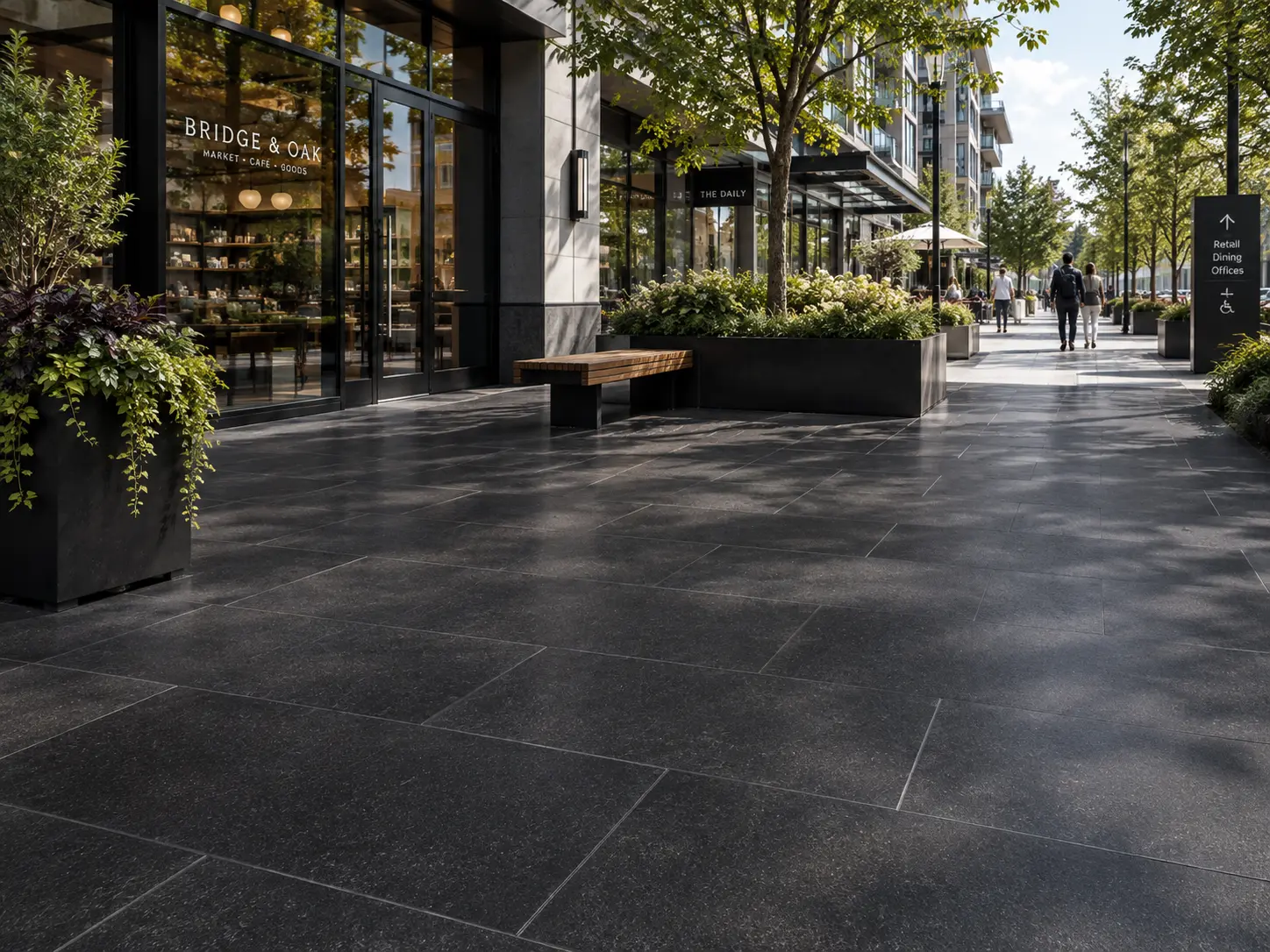
Your maintenance burden shifts considerably depending on the finish you specify. Polished basalt shows fingerprints, water spots, and light surface scratches more readily than any other finish — it demands the most frequent attention in high-traffic or kitchen environments. Honed basalt has a consistent matte surface that diffuses light more evenly and conceals incidental marks better. Flamed and brushed finishes leave an open, textured surface that hides marks well outdoors but traps fine grit in the texture valleys, requiring more thorough rinsing after cleaning.
- Polished finish: clean frequently with a dry or barely damp microfibre cloth; buff dry to prevent water marks after wet cleaning
- Honed finish: neutral cleaner and rinse on a regular schedule; re-seal as per manufacturer interval
- Flamed or bush-hammered finish: pressure rinse at moderate setting to clear grit from texture; inspect sealer penetration annually as the open texture consumes sealer faster
- Tumbled or aged finish: assess joint integrity as part of cleaning — the irregular edges of tumbled basalt create more complex joint geometry that retains moisture longer
The Tile Council of North America provides installation and maintenance framing for natural stone tile formats — TCNA natural stone installation guidance covers substrate and setting material compatibility factors that affect long-term surface performance regardless of the cleaning regime you choose.
Sustaining Black Basalt Slab Performance Over the Long Term
Black basalt slab care is more straightforward than the stone’s reputation suggests — the key is matching your cleaning products and sealing programme to the finish type and exposure conditions from the start, rather than reacting to problems after they appear. The dense silicate structure of basalt rewards consistency: a simple neutral-clean-and-reseal routine, run on the interval your sealer manufacturer specifies, will sustain the stone’s appearance across decades of service. Where outdoor installations face storm exposure, the joint and edge inspection step is non-negotiable — catching mortar failure or restraint movement early is far less disruptive than reactive remediation. As you plan the broader landscape around your basalt installation, related stone applications may inform your material decisions; black basalt in landscape settings explores how the same material performs in a different outdoor context. Honed basalt slabs from Citadel Stone generally hide water spotting better than high-gloss alternatives in busy kitchens.
Related reading: what is black basalt rock · how to place black basalt boulders · honed black basalt finish explained.