

Surface hardness under vehicle load is the first specification variable worth locking down on any black basalt driveway surface guide, because it separates materials that age gracefully from those that pit and spall after a few winters. Basalt is an extrusive igneous rock — it cooled rapidly at or near the earth’s surface, producing a tightly interlocked crystalline matrix with very low macro-porosity. That microstructure is precisely why specifiers return to it for driveways where heavy vehicles, repetitive point loading, and seasonal freeze-thaw cycles are the norm, not the exception.
What Basalt Is and Why It Matters for Driveways
Basalt forms when low-viscosity lava cools quickly, leaving almost no time for large crystals to grow. The result is a fine-grained, dark-coloured igneous stone dominated by feldspar, pyroxene, and olivine minerals. According to USGS basalt volcanic rock properties and composition, this mineralogy gives the stone a characteristic density and hardness that distinguishes it from sedimentary alternatives like limestone or sandstone.
For a driveway context, the key implication is mechanical performance under sustained load. Sedimentary stones carry bedding planes — natural weak zones — that can delaminate under vehicle wheel paths. Basalt has no equivalent layered structure, so load is distributed more evenly through the slab. Your specification benefits from that characteristic the moment a loaded delivery vehicle crosses the surface.
Finish Options and How They Affect Performance
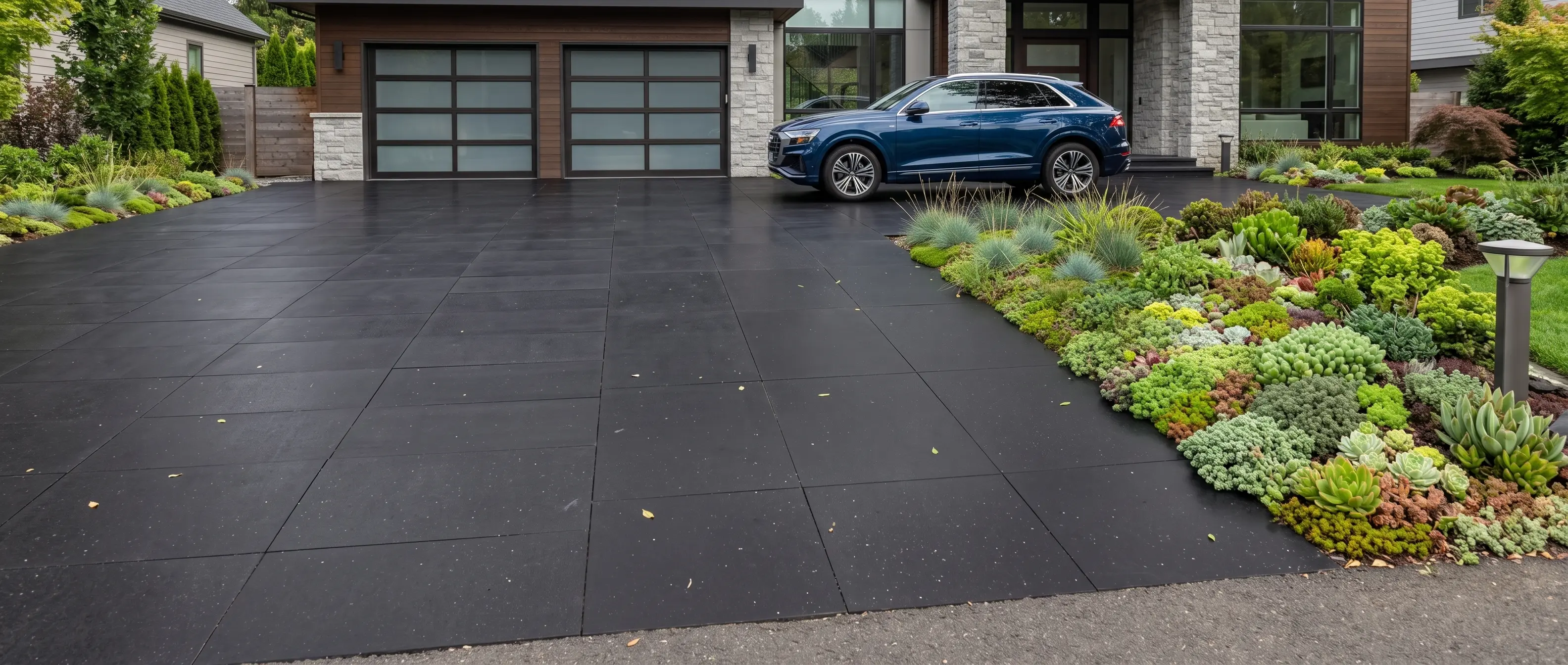
Your finish choice on a black basalt driveway should be treated as a functional decision, not purely an aesthetic one. Three finishes are commonly specified for driveway applications, and each carries real trade-offs worth understanding before you finalise the black basalt driveway surface guide for your project.
- Flamed finish: a thermal process that opens the surface texture, producing a matte, slightly roughened face — the resulting open texture is generally preferred where wet-weather traction is a concern, and the finish also reduces the visual impact of tyre marks and surface abrasion over time
- Honed finish: a smooth, low-sheen surface that reads almost black in good light — it is popular for contemporary residential driveways, but the smooth face will show tyre residue more readily and requires more frequent cleaning to maintain its appearance
- Bush-hammered finish: a mechanical process that creates a pitted, textured surface — it is rarely specified on wide residential driveways because the texture can be uncomfortable underfoot near the house, but it suits gated entry aprons or vehicle turnarounds where aesthetics are secondary
Slip behaviour under wet conditions is governed primarily by finish rather than by the stone type itself. The current standard for evaluating wet-surface performance is ANSI A326.3, measured wet — if you need a tested value for a specification, request the test report from your supplier. The finish is the variable the test measures, and the test report is available on request from Citadel Stone for the specific finish you are considering.
Black Basalt Driveway Thickness and Structural Specification
Thickness specification is where most residential driveway projects go wrong. The temptation is to specify a thin slab to save on material cost, then rely on a deep aggregate base to compensate. That logic works for concrete unit pavers, but natural stone slabs behave differently — they span, rather than arch, so an undersized slab will flex at mid-span under a vehicle wheel and eventually fracture.
- Pedestrian-only zones: a nominal thickness suited to foot traffic is appropriate — confirm the figure with your supplier and the project engineer, not with a generic rule of thumb
- Standard residential vehicles: a thicker nominal section is required, and the exact specification depends on the slab format, joint spacing, and base stiffness — request the supplier’s guidance and cross-reference with a structural engineer for load-critical areas
- Heavy vehicles (delivery trucks, refuse collection): a fully engineered specification is non-negotiable — point loads from axle weights can exceed the assumptions built into residential paving details, and the slab thickness, base depth, and joint fill must all be calculated together
Your project’s access requirements directly shape the thickness specification. A black basalt driveway that will see occasional large delivery vehicles needs a meaningfully heavier slab section than one used only by passenger cars. Confirm access constraints before you finalise the stone order.
Base Preparation: The Variable That Governs Everything Else
The mineral hardness of basalt means the stone itself rarely fails in a well-specified driveway. Failures trace back to the base — differential settlement, inadequate compaction, or frost heave working through an undersized granular layer. Getting the base right is where an experienced installer earns their fee, and it is not a detail you can recover cheaply after the fact.
Compacted aggregate base depth should reflect both the design load and the subgrade bearing capacity. Clay-heavy subgrades expand and contract seasonally, and the interaction between that movement and a rigid stone surface is the mechanism behind most cracked slabs. In those soil conditions, a geotextile separation layer between subgrade and aggregate is worth specifying — it keeps the fine clay from migrating up into the granular base over time, which is exactly the process that causes the base to lose stiffness without any obvious surface signal.
- Subgrade preparation: strip organic material fully, compact the subgrade to the engineer’s target bearing value, and proof-roll before placing aggregate
- Aggregate specification: crushed angular aggregate compacts more tightly than rounded river gravel and resists lateral spread under load — specify crushed stone, not pea gravel or decorative aggregate
- Compaction lifts: place aggregate in layers and compact each lift separately — a single deep lift will not compact evenly through its full depth regardless of equipment weight
- Setting bed: for slab formats, a dry-mix mortar bed or a hydraulically bound base keeps slabs level better than loose sand over long periods
Drainage Design for Black Basalt Driveways
Drainage is a non-negotiable design input for any black basalt driveway surface guide, particularly in regions that experience high-intensity rainfall events — monsoon-influenced climates, hurricane corridors, or areas with concentrated wet seasons that deliver large volumes of water over short periods. Basalt’s low absorption rate means rainfall sits on the surface rather than passing through it, and without a deliberate fall to a collection point, water will pond and eventually find a path through the joint system into the base.
Surface fall should be designed in from the outset — retrofitting drainage gradient into a completed installation is expensive and disruptive. A cross-fall across the slab width is the general principle; your project engineer will give you the site-specific figure. Channel drains at the low edge of the driveway apron are the most effective collection method for large paved areas, and they should be sized for the peak rainfall intensity of your region, not just an average figure. In drought-cycle climates, it is equally important that the drainage system handles the rare high-intensity storm that follows a long dry period — impacted soils after drought shed water almost as fast as an impermeable surface.
- Design surface fall to direct water away from the building and toward a defined collection point
- Size channels and gullies for peak intensity, not average annual rainfall
- Avoid discharging driveway runoff directly to planted areas without an overflow provision — a single heavy storm can overwhelm infiltration capacity in compacted soil
- In flood-risk zones, confirm driveway drainage connects to an approved outfall — local planning conditions may restrict direct discharge to the storm drain
Poorly drained bases are also the mechanism behind freeze-thaw damage in cold climates. Water retained in the granular layer freezes, expands, and lifts the stone. You can specify the hardest basalt available, but if the base holds water through winter, frost heave will work on the joints regardless.
Sealing Black Basalt Driveway Pavers
Basalt is denser and less porous than limestone or travertine, which changes the sealing calculus considerably. You are not sealing to prevent deep staining in the way you would with a high-absorption stone — you are sealing to make surface cleaning easier and to protect the appearance of the polished or honed face from tyre deposits, engine oil, and leaf tannin, all of which bond to even a low-porosity surface over time.
Penetrating sealers that work below the surface are the preferred product category for exterior basalt paving. Film-forming sealers create a surface layer that can delaminate under vehicle tyres, trap moisture beneath the slab, and make re-sealing more complicated. A quality penetrating sealer applied to a clean, dry surface will consolidate any residual micro-porosity and make routine pressure-washing dramatically more effective. Reseal on the interval your sealer manufacturer states — that figure varies by product and by exposure, and a manufacturer’s stated interval is the one that maintains the warranty, if any is offered.
- Always apply sealer to a fully cured and dry stone — moisture trapped under the sealer will cause hazing on darker stones
- Test sealer on a hidden section first — even low-porosity basalt can show a colour shift with certain sealer chemistries
- Do not apply sealer in direct midday sun — elevated surface temperatures accelerate solvent flash, reducing penetration depth
- Re-application frequency depends on traffic volume, sealer type, and climate exposure — check the sealer data sheet, not a generic schedule
Colour Consistency and What to Expect from Natural Stone
Black basalt driveway paving is not a uniform product off a production line — it is a natural stone quarried from a geological deposit, and colour variation is an inherent characteristic, not a defect. The deep charcoal-to-near-black range that makes basalt so effective in contemporary driveway designs comes from the same mineralogy that gives it its hardness, and that mineralogy shifts subtly across a quarry face.
Your specification should include a confirmed sample board, agreed before production begins, against which the delivered material is checked. At Citadel Stone, we quality-check each order against the agreed specification before it leaves our selected quarries — but the starting point is a sample signed off by both parties. That process protects you from receiving material that is lighter, greyer, or more varied than the project design assumes. The natural stone specification process works best when the visual standard is documented rather than assumed.
Review Natural Stone Institute igneous stone paving technical standards for guidance on natural colour variation allowances in dimension stone specifications — understanding what is typical for an igneous stone sets realistic expectations before you place an order.
Ordering, Logistics, and Lead Times
Citadel Stone stocks black basalt at our selected quarries and cuts to order — meaning the slab dimensions, thickness, and finish you specify are cut to match the project drawings rather than pulled from a generic stock size. That production step requires a realistic lead time, which is quoted with the order and confirmed before cutting begins. Building the lead time into your project programme at the outset avoids the schedule compression that leads to rushed base preparation and installation errors.
For our black basalt driveway stone, delivery is arranged and managed through the order process — lead times and logistics are confirmed at the time of quotation. Your site’s access constraints are worth flagging early: a narrow approach road or a low bridge on the delivery route affects the vehicle and pallet configuration used, and confirming that detail upfront avoids rescheduling costs. Offloading arrangements should be confirmed before the delivery date, not on the day.
- Provide accurate slab quantity calculations — include a waste allowance appropriate to the cutting pattern and the number of cuts required at driveway edges and drainage channels
- Specify finish, nominal thickness, and surface treatment requirements in writing at the point of order
- Confirm the sample board and agree colour tolerance before production begins
- Advise on site access — road width, vehicle height restrictions, and offloading equipment available on site
Maintenance Over the Life of the Surface
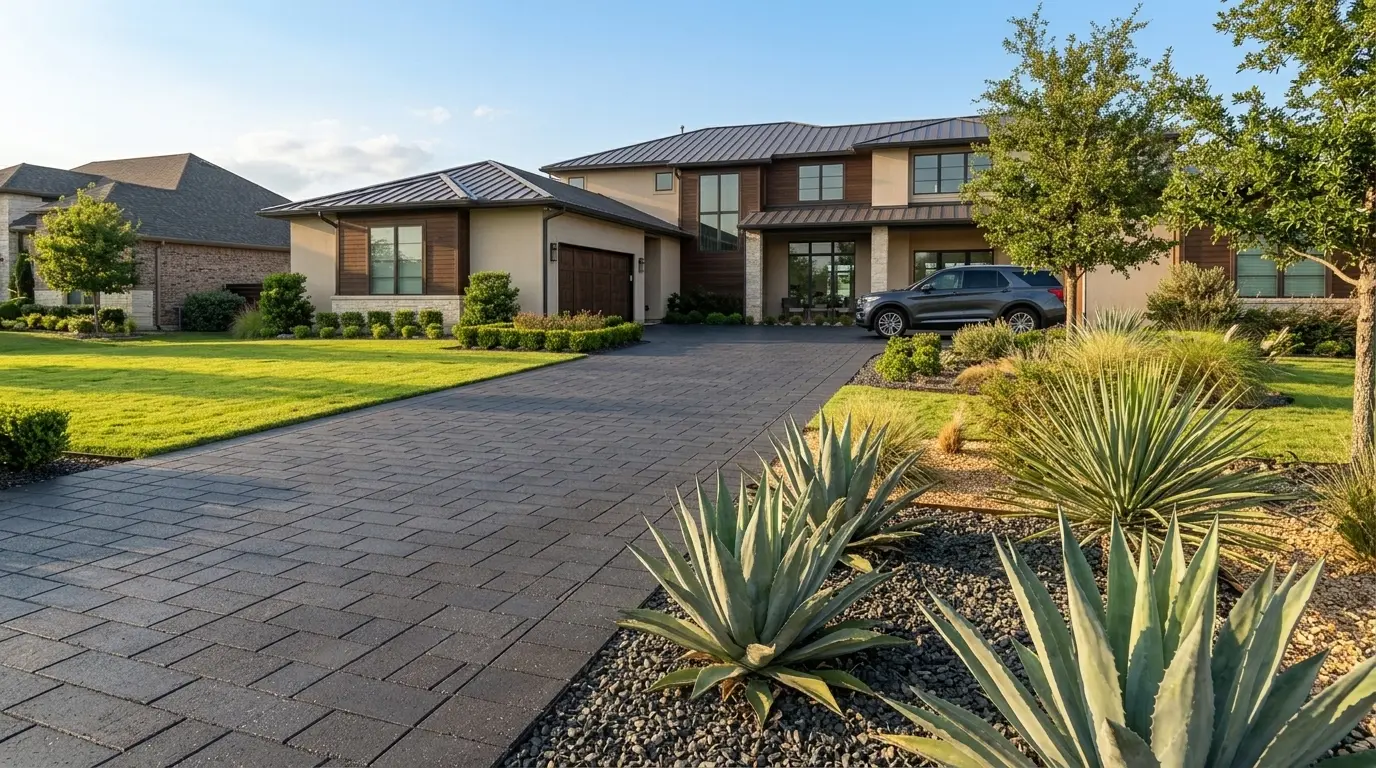
The long service life that basalt is known for is conditional on maintenance that is simple but consistent. Unlike timber decking or resin-bound surfaces, basalt does not require specialist contractors for routine upkeep — a pressure washer, an appropriate stone cleaner, and periodic resealing are the main inputs. What matters is keeping to a schedule rather than waiting for a visible problem to develop.
Joint sand or grout requires attention after the first wet season. Settlement in newly compacted bases is normal, and the jointing material will drop slightly as the base finds its equilibrium. Refill and re-compact the sand where it has settled — do not leave open joints, because they allow surface water to bypass the sealer and reach the base directly. On mortar-jointed installations, inspect for hairline cracks in the mortar annually, particularly after any significant frost event. Early repair of a hairline crack costs very little; water entry that degrades the base beneath costs considerably more.
- Pressure-wash annually, or more frequently in areas under deciduous trees where leaf tannin deposits are heavy
- Use a pH-neutral stone cleaner — acidic cleaners, including diluted vinegar, will etch even a low-porosity basalt surface over repeated use
- Refill joints after the first and second wet seasons — settlement stabilises after that on a well-compacted base
- Reseal on the manufacturer’s stated interval — track the application date and set a calendar reminder
The Britannica entry on basalt volcanic rock formation and construction properties is a useful reference for understanding why the stone’s dense crystalline matrix resists weathering over extended periods — context that helps you set realistic maintenance expectations with clients who may be comparing basalt against less robust options.
Spec Wrap-Up
A well-specified black basalt driveway surface guide ultimately comes down to four interlocking decisions: finish selection for the intended traffic and climate, slab thickness calibrated to the real load case, base preparation that handles both subgrade movement and drainage, and a sealing and maintenance programme that protects the surface appearance. Get all four right and the installation will deliver decades of service life with minimal intervention. Miss any one of them and the others cannot compensate.
The ASLA driveway paving material guidance and environmental performance is worth reviewing alongside your structural and drainage specifications — it situates the material choice within a broader site-performance framework that is increasingly relevant to planning approvals in areas with surface-water management requirements. For a closer look at how finish choice affects colour behaviour and cleaning requirements in practice, honed basalt finish details and care covers those specifics in depth.
Black basalt’s dense mineral structure, found in Citadel Stone material, means it is generally selected for driveways where freeze-thaw resistance and surface hardness under vehicle load are priorities.
Related reading: black basalt rock · black basalt boulders.