

Density and mineralogy separate honed granite vs basalt more decisively than most specification sheets acknowledge. Granite is a coarse-grained intrusive igneous rock — its interlocking feldspar, quartz, and mica crystals form slowly under pressure, producing a surface that honed finishing exposes as a smooth, low-sheen plane with subtle mineral variation. Basalt, by contrast, is a fine-grained extrusive volcanic rock that cools rapidly, yielding a nearly uniform, tight crystalline matrix. That structural difference drives real performance divergence across absorption, thermal behaviour, and long-term floor integrity — and it’s the starting point for every specification decision you’ll make between these two materials.
Mineral Structure and What Honing Reveals
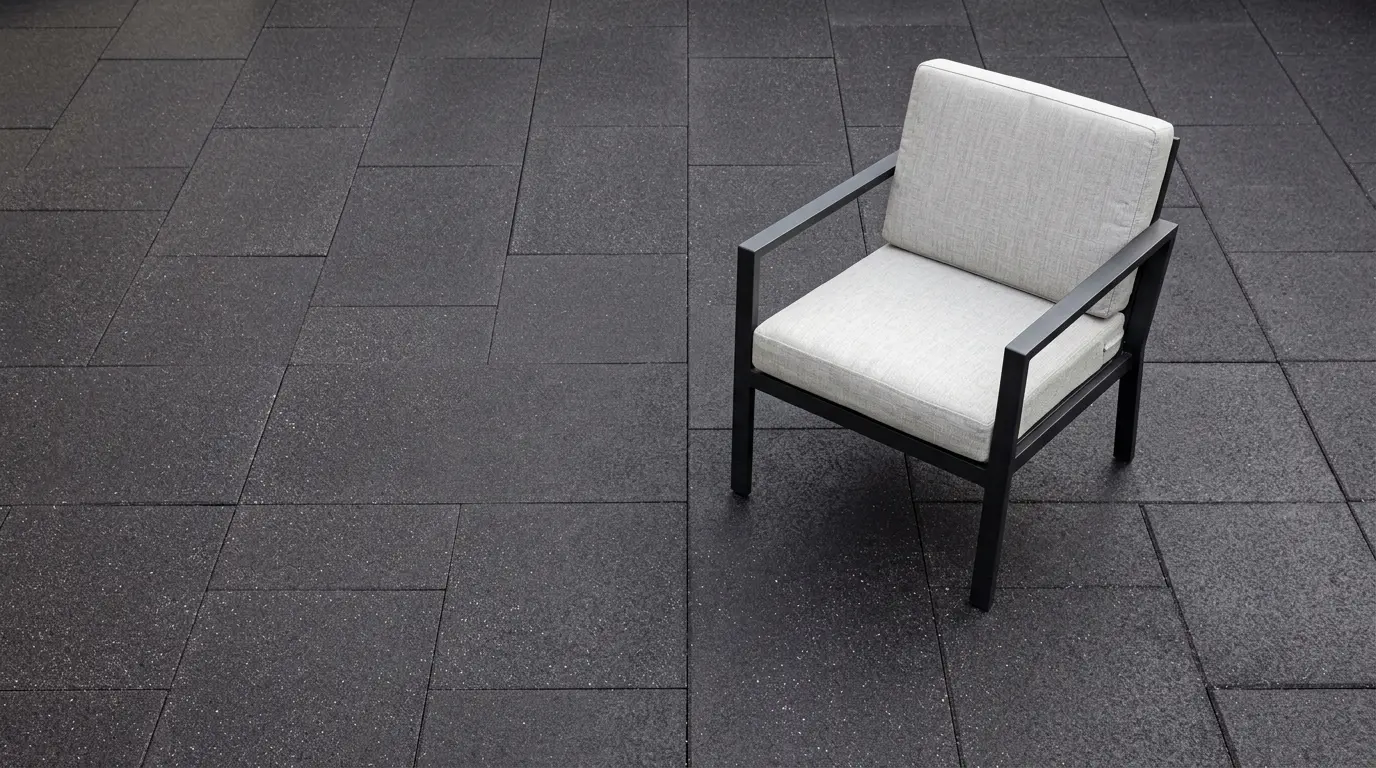
Honing removes the micro-peaks left by sawing without adding the reflective gloss of polishing. On honed granite, that process reveals a rich tonal landscape — flashes of quartz catching ambient light, feldspar in warm creams or cool greys, and biotite mica adding depth. You get visual complexity even at a muted sheen level. Basalt honed to the same finish reads as a near-uniform, blue-grey to charcoal surface with almost no visible grain variation. Neither is better in absolute terms, but the choice is rarely neutral for a project’s design intent.
The structural tightness of basalt’s matrix means honing produces an exceptionally consistent surface from tile to tile. Batch variation is minimal compared with honed granite, where quarry blocks from different sections of the same deposit can differ noticeably in tone and veining. For large commercial floor installations where visual uniformity matters as much as durability, that consistency carries real specification weight.
Hardness, Abrasion, and What High-Traffic Floors Actually Demand
Granite’s Mohs hardness typically sits in the six-to-seven range across its feldspar and quartz components, with quartz-rich varieties toward the harder end. Basalt generally tests in the five-to-six range — measurably softer than quartz-dominated granites. In a high-footfall floor context, that difference matters over years of abrasion from grit, sand, and hard-soled footwear. Per Natural Stone Institute granite durability and application specifications, granite’s quartz content is a primary driver of its long service life in commercial flooring, particularly in entryways and corridors where abrasive particles concentrate.
Basalt compensates with remarkable density. Its tight, low-porosity matrix resists moisture infiltration effectively and holds a honed surface well in environments where abrasion is moderate rather than intense. Think hotel lobbies, spa reception areas, and residential great rooms — spaces with meaningful foot traffic but not the industrial-grade abrasion of a transit concourse.
- Honed granite holds a surface longer under sustained abrasive foot traffic because of its quartz content
- Basalt’s density delivers strong performance in moderate-traffic commercial and residential floors
- Both materials require the same base preparation discipline — thickness specification should come from your project’s structural load calculation, not generic guidance
- Request the ASTM C615 test report from your supplier for granite; for basalt, request the applicable test documentation so your specification carries verified data rather than assumed values
Absorption, Moisture, and Floor Performance Over Time
Basalt’s low absorption rate is one of its most consistent field advantages. Its fine-grained volcanic matrix leaves minimal connected porosity, which means moisture from cleaning, spills, or humidity moves slowly into the stone. That makes basalt a strong candidate in honed granite vs basalt comparisons for environments with regular wet cleaning cycles or ground-floor applications where vapour transmission from the slab is a concern.
Honed granite varies more widely in absorption depending on its mineralogy and origin. Biotite-rich granites tend toward higher absorption than muscovite or quartz-dominant varieties. Your sealing interval — and the sealer type you specify — should be driven by the absorption data from the test report your supplier provides, not by generic stone-care assumptions. Request the test documentation and specify the sealer accordingly. According to ASTM C615 granite dimension stone quality standards, absorption testing is a defined part of granite’s dimensional stone specification framework and should appear on any compliant test report.
- Basalt generally requires less frequent sealing intervention on honed floors due to its lower inherent absorption
- Honed granite floors need sealer maintenance on the interval stated by the sealer manufacturer — request the test report to set the right interval
- Both materials benefit from penetrating sealers rather than surface coatings, which can alter the visual character of the honed finish
Thermal Behaviour on Indoor Floors
Dense stone stores and releases heat — relevant for radiant floor heating systems, which are increasingly common under natural stone in commercial and high-end residential installations. Basalt’s fine-grained density makes it an effective thermal conductor, and it bonds well with the adhesive beds used over in-floor heating systems when thickness and adhesive flexibility are specified correctly. Granite behaves similarly but its coarser grain structure means thermal conductivity varies more across tile batches.
The practical installation consideration: both materials move with temperature cycling, and your expansion joint layout must account for that movement. The thermal expansion coefficient for your specific stone should appear in the supplier’s test documentation. Spec joints from that coefficient applied to your panel dimensions — not from a printed rule of thumb that doesn’t account for your material’s actual behaviour. Failure to do this is one of the most consistent causes of field cracking at perimeter joints in honed stone floors.
Storm Events, Wind-Driven Rain, and Joint Integrity
For ground-level commercial floors in buildings exposed to storm-driven wind loads — particularly lobby entries, covered outdoor corridors, and transition zones between inside and outside — joint integrity under wind-driven rain deserves deliberate attention. Wind-driven rain forces moisture into joint lines at pressures well above what standing water produces. If your grouting mortar is porous or your joint profile is too shallow, that moisture migrates under the stone and works on the adhesive bed over repeated storm cycles.
Basalt’s low absorption gives it a practical edge here: even if moisture reaches the tile face during a storm event, less of it penetrates the stone body. Granite’s performance in the same scenario depends on its absorption characteristics and sealing condition. Either way, the installation detail that protects both materials is the same — deep-filled, correctly cured epoxy or polymer-modified grout joints, with sealant at perimeter and change-of-plane joints. Edge restraint at thresholds should be mechanically fixed rather than adhesive-only where wind-load exposure is documented in the project spec.
- Wind-driven rain tests joint depth and grout porosity — specify a polymer-modified grout rated for exterior-exposure conditions even on interior floors near entry points
- Perimeter sealant joints must remain continuous — inspect and regrout on the sealer manufacturer’s recommended cycle
- Both honed granite and basalt hold up well mechanically under impact from hail or windborne debris when thickness is correctly specified for the application
- Threshold edge restraints in storm-exposed transition zones should be mechanically fixed and checked after significant weather events
Getting the Basalt Specification Right
For floor applications where surface uniformity and low maintenance overhead are priorities, Honed Basalt is worth a close look alongside honed granite in your material schedule. The fine-grained matrix produces a honed surface with exceptional consistency across a large floor area — a quality that reads well in both contemporary commercial interiors and minimalist residential spaces.
The specification detail that most often gets skipped on basalt floor projects is the adhesive system. Basalt’s density means it’s heavier per square foot than many specifiers anticipate, and the adhesive bed must be rated for that load. Confirm the coverage rating with your tile adhesive supplier before ordering — back-buttering is generally required for full contact on large-format tiles. According to USGS basalt volcanic rock properties and composition, basalt’s high density is a direct product of its rapid volcanic cooling process, which closes porosity and compacts the mineral matrix — the same property that makes adhesive coverage rate so important to get right.
Side-by-Side: Where Each Material Wins in Honed Granite vs Basalt Floors
Understanding where honed granite vs basalt floors diverge in real project contexts helps you match material to application rather than defaulting to a single recommendation. The decision tree isn’t complicated once you know which performance variables actually matter for your floor.
- Heavy abrasive traffic — transit hubs, retail corridors, industrial lobbies: granite’s quartz hardness provides a longer service interval before refinishing is warranted
- Visual uniformity across large floor areas — hotel lobbies, spa environments, contemporary residential: basalt’s fine matrix delivers more consistent tile-to-tile appearance
- Radiant heat systems: both perform well; confirm thermal conductivity and adhesive flexibility specification with your heating system supplier
- Wet-area commercial floors: both require ANSI A326.3 finish evaluation measured wet — the finish, not the stone type, is the primary variable; request the test report from your supplier
- Cost sensitivity: honed granite in standard formats typically sits at a lower unit cost, but basalt’s lower maintenance overhead can offset the price premium over a decade of service life
Your project’s decision between these two materials should be driven by a combination of traffic category, design intent, and the maintenance programme the building owner is actually willing to sustain. Both deliver decades of service life in properly specified and installed floors — the failures in the field almost always trace back to base preparation shortcuts or adhesive system mismatches, not material deficiency.
Ordering, Lead Times, and Site Delivery Planning
Citadel Stone cuts both honed granite and basalt to order at our selected quarries, which means your specification — format, thickness, finish — is confirmed before production begins. That process eliminates the tolerance variation that comes from selecting pre-cut stock that wasn’t dimensioned for your project. Lead times are quoted with the order and should be built into your project programme before you finalise the installation schedule.
Your project’s vehicle access constraints are worth confirming early. Large-format stone arrives palletised and requires adequate clearance and a level offloading area. Offloading arrangements are confirmed before the delivery date, so raise any site access restrictions — overhead clearances, road width, or weight limits at the kerb — at the time of order. Getting this conversation done at specification stage rather than the week of delivery avoids the kind of last-minute scheduling pressure that leads to rushed offloading and damaged material.
Making the Right Call on Honed Granite vs Basalt
The honed granite vs basalt decision is ultimately a specification exercise, not a preference debate. Granite’s quartz-driven hardness gives it an edge in the highest-abrasion commercial floors; basalt’s fine-grained density and surface uniformity make it the stronger candidate where consistency and lower absorption overhead matter more than maximum scratch resistance. Both materials need correctly specified adhesive systems, properly cured grout joints, and a sealing programme that follows the sealer manufacturer’s interval — not a generic calendar. If your project spans finish types across different zones, the comparison of honed against other processed finishes is worth working through before you finalise the material schedule — how honed compares to other stone finishes covers that ground in detail. For high-traffic commercial floors, specifiers frequently turn to honed basalt supplied from our selected quarries in the Middle East for its reliable surface uniformity.