

The honed stone finish comparison most specifiers encounter in project documents rarely captures what actually separates these three surface treatments in practice. A honed finish sits in a middle ground that confuses even experienced designers — it shares the flatness of polishing but retains an open micro-texture that polished stone eliminates entirely. Understanding where that difference matters, and where it doesn’t, is what drives smarter material selection before samples arrive on site.
What Honed Actually Means at the Surface Level
Honing is an abrasive process, stopped before the stone develops a true reflective sheen. The surface is flat and smooth to the touch, but the crystalline or grain structure remains exposed rather than sealed under a compacted, mirror-polished layer. You’ll notice that honed limestone or honed basalt has a consistent matte appearance — the colour reads more deeply and evenly than a rough finish, but without the light-gathering quality that polishing creates.
What most specifiers don’t fully account for is that honing degree varies. A coarser hone leaves more surface relief and a slightly cooler, more industrial tone. A fine hone approaches a satin appearance. Both technically qualify as “honed,” so your specification should state the intended grit or finish standard rather than relying on the label alone. Request a physical sample from your supplier and assess it against your project lighting conditions before committing.
- Honed finishes expose the stone’s mineral structure without sealing it under a polished layer
- Colour depth increases compared to rough or flamed finishes, but reflectivity stays low
- The degree of honing varies by grit stage — specify clearly or request comparative samples
- Honed surfaces are more porous than polished equivalents of the same stone type — sealing becomes more important, not less
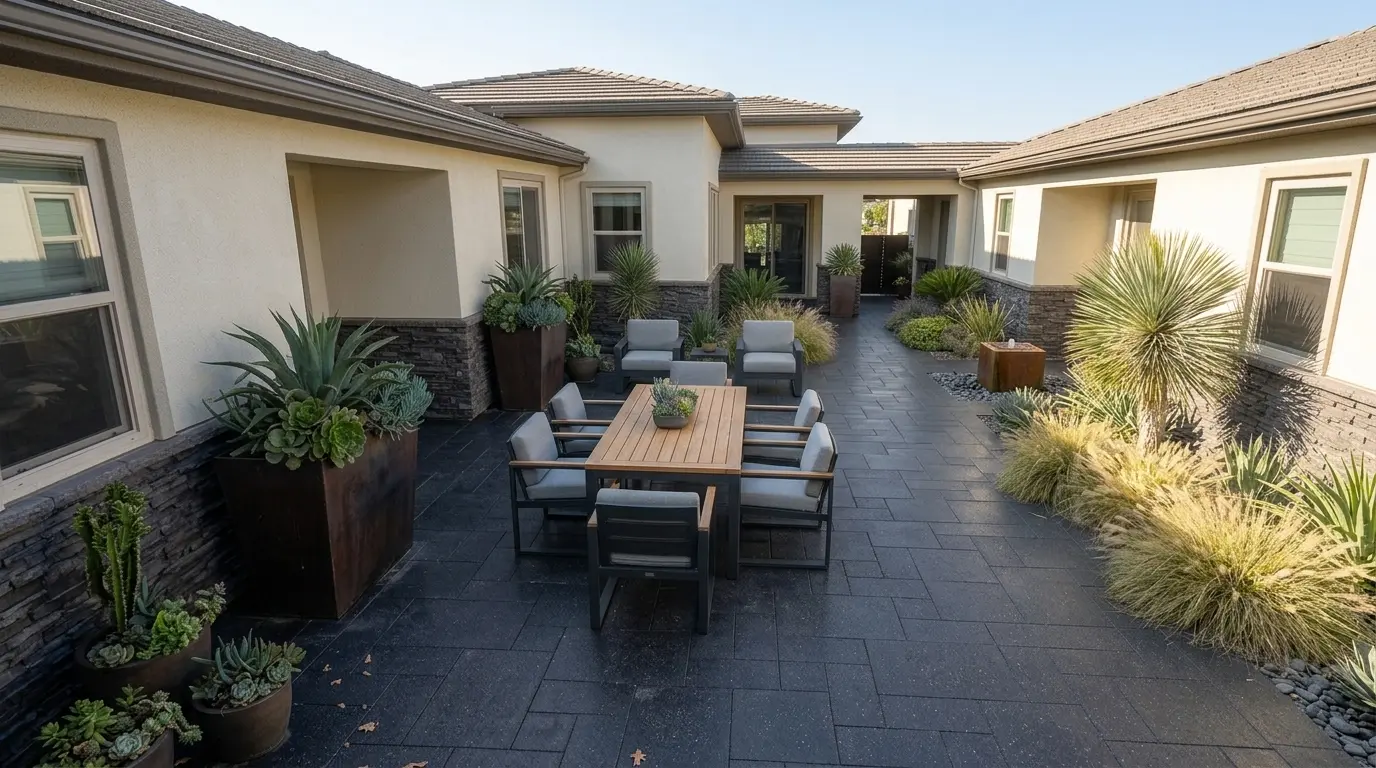
Polished vs Honed: The Real Differences That Affect Your Specification
The polished finish takes the abrasive process further, closing the surface pores under pressure and revealing the maximum reflectivity the stone’s mineralogy allows. Marble and granite polish exceptionally well because their interlocked crystal structures respond predictably. Basalt and limestone polish to a softer sheen — the result is still striking, but you won’t achieve the mirror depth that a dense igneous stone delivers.
For interior flooring, the polished vs honed distinction comes down to maintenance reality. Polished stone shows every footprint, watermark, and cleaning streak. High-traffic commercial corridors and domestic hallways develop visible wear paths as foot traffic gradually dulls the surface, which means periodic re-polishing is part of the long-term maintenance schedule. Honed surfaces age more gracefully in busy areas because the matte texture conceals incidental marks rather than amplifying them. According to Natural Stone Institute stone finish specifications, surface finish selection is one of the primary factors affecting long-term appearance retention and maintenance requirements for interior stone installations.
- Polished finishes maximise reflectivity but require regular maintenance to retain the sheen in foot-traffic areas
- Honed finishes age with less visible wear accumulation in high-use settings
- Dense stones like granite and basalt hold a polished finish better than porous limestone under comparable traffic levels
- For residential applications where maintenance schedules are informal, honed surfaces typically perform more predictably over time
- Neither finish eliminates the need for sealing on absorbent stone types — the interval varies by stone and sealer; follow the sealer manufacturer’s stated schedule
Flamed Finish: Where Texture Becomes the Specification
The flamed finish is produced by exposing the stone surface to an intense, direct flame, which causes mineral crystals near the surface to fracture and spall. The result is a coarse, open texture that reads visually as a roughened, lighter-toned surface compared to the same stone in a honed or polished state. Granite responds dramatically to flaming — the feldspar and quartz crystals burst at different rates, creating a varied, natural texture. Basalt flames to a more uniform open surface given its denser, finer-grained structure.
Specifiers reach for flamed finishes in outdoor settings where texture is the primary design driver. The open surface produced by flaming creates a more complex visual tone and a distinctive tactile quality underfoot. For sun-exposed terraces, this aesthetic is often exactly right — the lighter tonal shift that flaming produces also means the surface reflects more solar radiation than a dark honed equivalent, which matters in climates with intense summer sun. Your project should consider how finish selection interacts with surface temperature at midday, especially for stone specified in full-sun exposures.
UV Exposure, Colour Stability, and Finish Selection for Sun-Exposed Projects
The honed stone finish comparison gets more nuanced when your installation will face direct UV exposure year-round. Prolonged UV light doesn’t chemically alter most natural stone minerals the way it degrades synthetic materials, but it does interact with the sealer you’ve applied over the stone — and that interaction varies depending on whether your surface is honed, polished, or flamed.
Solvent-based sealers applied to honed surfaces in strong sun can yellow or haze over a single summer if the product isn’t rated for UV exposure. Some silicone-based penetrating sealers perform far better under sustained UV loading because they don’t form a surface film that oxidises visibly. The open micro-texture of a honed finish absorbs penetrating sealers efficiently, which is an advantage in high-UV settings — you’re sealing into the stone rather than relying on a surface coating that the sun degrades from the outside in. Always confirm with your sealer manufacturer that the product is rated for direct UV exposure before committing to a sun-facing installation.
- Honed surfaces accept penetrating sealers more efficiently than polished surfaces — an advantage in outdoor UV-exposed settings
- Film-forming sealers on any finish type can yellow or cloud under sustained UV — select UV-stable penetrating products for exterior use
- Flamed surfaces, with their open texture, require sealer products formulated for highly porous or textured substrates
- Resealing schedules in strong-sun climates should follow the sealer manufacturer’s guidance, erring toward the shorter end of the stated range
- Colour tone can shift slightly on honed stone in exterior settings as surface oxidation affects the mineral edges — this is most visible on iron-bearing stones like certain basalts and sandstones
For a benchmark material with notable UV stability and consistent tone retention outdoors, USGS basalt composition data confirms that basalt’s dense mineralogy and low iron-oxide surface concentration make it among the more stable volcanic stones for exterior finish retention under sustained sun exposure. Specifying a honed finish on basalt for a sun-facing terrace or courtyard gives you the matte tone of an outdoor finish with better long-term colour consistency than many sedimentary alternatives.
Honed Stone Finish Comparison by Material Type
Not every stone hones identically, and the differences matter when you’re selecting materials for a specific look. Dense, fine-grained stones like basalt produce a tight, consistent honed surface with minimal variation across a floor field — this uniformity is why basalt honed tiles are a preferred choice for large-format interior flooring and modern minimalist schemes. For projects specifying a continuous matte floor across a significant area, Honed Basalt delivers the surface consistency that makes large-field installations read as cohesive rather than patchy.
Limestone hones to a warmer, more varied surface. The fossil inclusions and natural colour variation in limestone become more visible under a honed finish than under polishing, which some designers find appealing and others find inconsistent. If uniform colour across a field is the priority, limestone requires careful batch-matching and sample review before order commitment. Travertine presents a different consideration — its natural void structure means a honed stone finish leaves open pores that can accumulate soil in high-traffic areas, which is why many specifiers request a filled-and-honed travertine for interior use.
- Basalt hones to a tight, uniform surface — suited to large-format interior fields where consistency matters
- Limestone shows natural variation more prominently under a honed finish — assess samples under your project lighting
- Marble hones well but reveals veining strongly — this is usually desirable, but worth confirming with samples before specification
- Travertine in honed finish typically requires filling to prevent void accumulation in active-use areas
- Granite hones to a less dramatic effect than polishing — the material’s best visual qualities emerge more in polished or bush-hammered finishes
Choosing the Right Finish for Your Application
Your finish decision should follow your application logic rather than trend preference. Interior floors in residential settings see moderate foot traffic and a controlled maintenance environment — either polished or honed works, and the choice comes down to aesthetics and how much time the homeowner will invest in upkeep. Commercial interiors with heavy foot traffic are where honed surfaces demonstrate a real practical advantage: the surface retains its specification appearance longer without professional intervention.
Outdoor applications are different again. A flamed finish on a terrace or driveway gives you a textured surface that stands up to weather cycling and reads naturally in a garden or landscape setting. A honed finish outdoors reads more architectural — it’s specified on exterior cladding, feature walls, and contemporary pool surrounds where the smooth matte surface is part of the design language. Polished stone outdoors is a specialist choice, primarily for covered areas or climates where freeze-thaw cycling is not a concern — sustained water ingress into a polished surface’s micro-fractures can accelerate surface breakdown in cold-climate installations.
- Heavy-traffic interior floors: honed finish preferred for appearance retention
- Formal residential interiors: polished finish where maintenance is manageable and visual impact is the priority
- Exterior terraces, pool surrounds, and feature walls: honed or flamed depending on texture preference and design language
- Driveways: flamed or bush-hammered for texture in high-load settings; honed for low-traffic feature drives
- Polished finish outdoors: appropriate only in covered or sheltered locations in temperate climates
Sealing and Maintenance Across All Three Finish Types
Sealing requirements differ meaningfully between honed, polished, and flamed surfaces, and getting this wrong at the specification stage creates maintenance headaches later. A honed surface is the most porous of the three — the open micro-texture accepts liquids readily, which means staining risk is higher than on a polished equivalent. Penetrating sealers on honed stone should be applied before grouting or use and refreshed on the interval the sealer manufacturer specifies for the stone’s absorption rate. You can assess a stone’s approximate absorption class by requesting the relevant ASTM test report from your supplier rather than relying on finish assumptions alone.
Polished surfaces have lower absorption because the polishing process compresses and partially closes surface pores, but they still require sealing — particularly marble and limestone, which are calcium carbonate-based and vulnerable to acid etching regardless of surface finish. The etch mark from a spilled acidic liquid is more visible on a polished surface than on a honed one, which is an honest reason to specify honed limestone or honed marble in kitchen applications where etching is a genuine risk. According to the Tile Council of North America installation standards, sealer selection must account for both the stone’s absorption class and the finish type to achieve effective, long-lasting protection.
- Honed stone: highest sealing priority — penetrating sealer required before use, refreshed per manufacturer schedule
- Polished stone: sealing still required on calcium carbonate stones; schedule the same but etch risk is the additional consideration
- Flamed stone: highly porous texture requires sealers formulated for open, textured surfaces — standard penetrating sealers may not achieve adequate coverage
- Kitchen and dining applications: honed calcium carbonate stones (limestone, marble) are more forgiving than polished when acid etching occurs
Ordering, Batch Consistency, and Project Planning
The honed stone finish comparison doesn’t end at specification — it continues through supply and delivery planning. Batch consistency is the practical challenge that catches projects out, particularly on large interior floors where visual uniformity across a field is the design objective. Honed basalt and honed limestone are both susceptible to tonal variation between production batches if the stone is sourced from different quarry faces or processed at different times. Citadel Stone cuts to order at our selected quarries, which allows the full project quantity to be processed from a consistent production run — a meaningful advantage for large or phased-delivery projects.
Delivery scheduling for natural stone should account for site access constraints. Your project’s access geometry affects how palletised stone can be offloaded — whether that’s direct to the installation area or to a staging zone on site. Offloading arrangements are confirmed before the delivery date, and lead times are quoted with the order. Factor this into your programme, particularly for commercial projects where delays in material arrival have downstream effects on other trades.
- Order the full project quantity in a single production run wherever possible to minimise batch tonal variation
- Request physical samples from the actual production batch, not from a generic sample board, before approving for delivery
- Confirm site access dimensions and offloading zone requirements before scheduling delivery
- Lead times for cut-to-order stone are quoted at order placement — build this into your programme from the outset
- For phased projects, store matching batch quantities on site or arrange quarry-side hold of the balance until your installation programme requires it
Final Considerations
The finish decision shapes every downstream specification — sealing frequency, maintenance regime, long-term appearance, and how the stone reads in your project’s specific lighting conditions. A thorough honed stone finish comparison isn’t just about aesthetics; it’s about matching surface behaviour to the demands of the application and the realities of ongoing care. Polished surfaces reward controlled environments and attentive maintenance. Honed surfaces perform predictably across a broader range of settings with lower ongoing intervention. Flamed finishes serve outdoor and high-texture applications where a more natural, worked surface is the intent. The choice isn’t arbitrary — it follows from honest assessment of how the stone will be used, who will maintain it, and what the design is actually asking the surface to do. For projects where natural stone formation informs material understanding, the geological background covered in how basalt forms at the geological level provides useful context for specifiers working with igneous stone finishes. Designers specifying matte interiors often find that Citadel Stone honed basalt, drawn from selected quarries in the Middle East, delivers consistent grain tone across large floor fields.