What pH Actually Means for Your Travertine Surface
A pH neutral cleaner for travertine isn’t just a marketing claim — it’s a chemistry requirement that determines whether your stone surfaces survive routine maintenance or deteriorate from the inside out. Travertine is composed predominantly of calcium carbonate, and that mineral structure reacts immediately and measurably to both acidic and alkaline exposure. The damage isn’t always visible after one application, but repeated use of the wrong cleaner strips the crystalline matrix at the surface, accelerating porosity and leaving the stone vulnerable to staining and structural micro-fracturing.
Understanding the pH scale in practical terms helps here. A reading of 7.0 is neutral — pure water territory. Cleaners below 6.5 carry enough acidity to etch polished or honed travertine finishes within minutes of contact. Cleaners above 8.5 on the alkaline side aren’t corrosive in the same way, but they leave saponification residues in travertine’s characteristic voids and pores that attract soil, dull the surface, and complicate future sealing adhesion.
What to Look For on the Label Before You Buy
Reading a stone cleaner label requires some translation. Manufacturers don’t always advertise pH values prominently, so you need to know which ingredients and certifications actually confirm safe chemistry for travertine.
- Look for a stated pH range of 6.5–8.0 on the product data sheet or safety data sheet — this is the safe operating window for calcium carbonate stone
- Confirm the cleaner is specifically labeled for natural stone or calcareous stone, not just “all-purpose stone” which sometimes includes acidic formulations for siliceous materials
- Avoid any cleaner listing vinegar, citric acid, lactic acid, phosphoric acid, or ammonia in the ingredients — all of these etch travertine, regardless of dilution
- Check for “pH balanced” plus a numeric value — “balanced” alone without a number is insufficient, as some formulas are balanced for ceramic tile, not natural stone
- Certifications from the Natural Stone Institute or similar trade bodies indicate the formula has been tested against stone-specific chemistry requirements
- A rinseless or low-residue formula is preferable for travertine’s open-pore structure — surfactant buildup in the voids accelerates re-soiling faster than most installers expect
The natural stone tile installation standards developed by the Tile Council of North America emphasize that cleaning product compatibility with the specific stone type is as important as grouting or setting methodology — a detail that gets overlooked during the specification phase on many projects.
Stone Cleaner for Travertine: Matching the Formula to the Finish
Your travertine’s finish type changes which formulas perform best. A honed travertine floor and a tumbled travertine patio don’t respond identically to the same cleaner, even when the pH is identical.
Polished travertine has a recrystallized surface layer created through mechanical grinding and buffing. That layer is thinner and more chemically reactive than the raw stone beneath. For polished surfaces, a pH neutral cleaner for travertine that skews toward the lower end of the safe range — closer to 6.8–7.2 — preserves the surface integrity of that polished layer without introducing residual alkalinity that interferes with the topical sealers commonly applied over polished finishes.
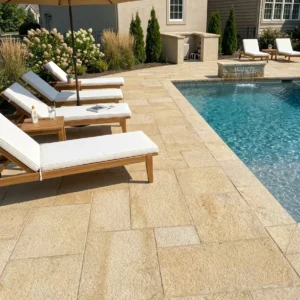
Honed and brushed finishes are more forgiving, but they expose more of the stone’s actual pore structure. Here the risk shifts to surfactant entrapment rather than etching. A low-foaming, pH-balanced formula rinsed thoroughly is the right call. For tumbled travertine used outdoors as a natural stone paver — particularly in applications like pool surrounds or patio fields — you need a formula that can lift organic growth residue without any acid component, since the rough, textured surface holds biological material in ways polished stone does not.
How Temperature Cycling Affects Your Cleaning Program
This is where the connection between climate and cleaner chemistry gets practical. In regions experiencing significant day-to-night temperature swings — particularly where nighttime lows push below freezing while daytime surfaces reach well above ambient air temperature — travertine’s natural porosity becomes a vulnerability that your cleaning routine either manages or worsens.
Travertine absorbs water into its void structure during cleaning. According to ASTM C1527 travertine dimension stone specifications, water absorption rates in travertine can range considerably depending on void fill treatment and surface finish. In freeze-thaw regions, any moisture retained in those voids after cleaning is subject to volumetric expansion of approximately 9% when it transitions to ice — a force the calcium carbonate matrix cannot accommodate repeatedly without micro-fracturing at the void edges.
- Clean travertine pavers during daytime temperatures above 45°F — this allows surface moisture to fully evaporate before overnight temperature drops
- Avoid saturating the surface during cleaning; a dilute, low-volume application followed by thorough rinsing reduces moisture retention in the voids
- In freeze-thaw climates, a pH neutral cleaner for travertine with a fast-dry or quick-rinse formulation reduces the window during which absorbed moisture can freeze inside the stone
- Timing your cleaning program around seasonal temperature swings — scheduling deep cleaning in late spring and early fall rather than mid-winter — protects the stone’s structural integrity over the long term
- After cleaning and before the first hard freeze of the season, verify that any penetrating sealer is intact, since a compromised sealer allows dramatically more moisture ingress than a well-maintained one
The thermal cycling consideration doesn’t stop at cleaning timing — it also affects grout and joint mortar. Joints that have contracted from overnight cold retain cleaning residue differently than they do at midday temperatures. A pH-neutral formula with minimal residue chemistry is particularly important in climates with wide temperature ranges, because residue trapped in contracted joints during cold periods can crystallize and cause joint spalling over multiple cycles.
Natural Stone Cleaner for Travertine: Getting Dilution Right
Most professional-grade stone cleaners are concentrated formulas — and the dilution ratio matters more than many users realize. A natural stone cleaner for travertine that’s pH neutral at the recommended 1:10 dilution may shift meaningfully in pH if applied at 1:3 concentration. That shift can be enough to initiate surface etching on polished travertine, even from a formula marketed as stone-safe.
The practical rule: always mix to the manufacturer’s stated dilution before testing pH if you have a concern. A simple aquarium-grade pH strip costs almost nothing and gives you real-time confirmation of the solution you’re about to apply. This is particularly useful when working with a new batch from a different warehouse lot — small formulation variations between production runs can affect pH by 0.3–0.5 points, which is within the safe range but worth confirming.
For ongoing maintenance cleaning of travertine pavers, a dilution on the lighter side of the recommended range is almost always preferable. Routine maintenance removes dust, foot traffic soil, and light biological film — not grease from a commercial kitchen floor. The instinct to use a stronger solution to “clean better” is counterproductive with travertine; the stone’s porous structure picks up and holds surfactant residue that then attracts more soil faster than a lighter, well-rinsed application would.
pH-Neutral Stone Cleaner for Travertine: Building a Maintenance Schedule
Routine maintenance with a properly balanced formula prevents the compounding damage that makes restorations necessary. The frequency depends on the installation environment and traffic level, but some general benchmarks apply across most applications.
- Interior travertine floors in residential settings typically need pH-balanced cleaning every 1–2 weeks for high-traffic areas like kitchens and entries, and monthly for lower-traffic rooms
- Exterior travertine pavers in exposed conditions benefit from a thorough cleaning 3–4 times per year, timed to remove seasonal organic accumulation before it bonds to the surface
- Pool deck travertine requires more frequent attention — weekly light cleaning during swim season — because bather load, sunscreen residue, and pool chemistry all deposit on the surface and interact with the stone’s calcium carbonate base
- After any event that deposits acidic material — mulch migration, fertilizer runoff, bird waste, leaf tannins — clean the affected area promptly rather than allowing the residue to dwell
- Document your cleaning product and dilution for each area so that any surface change can be traced to a specific application rather than requiring a full diagnostic investigation
For specific product guidance matched to travertine type and application, our stone cleaner recommendations cover the formulas we’ve tested and found reliable across a range of travertine finishes and installation environments.
What to Avoid Entirely on Travertine Surfaces
The list of products that damage travertine is longer than most people expect. Some are obvious — bleach, vinegar, lemon-based cleaners — but others appear on shelves marketed broadly as stone-safe despite containing chemistry that attacks calcium carbonate.
- Any cleaner containing hydrochloric acid or muriatic acid — these are used to strip mineral deposits from tile but will dissolve travertine’s surface immediately
- Grout haze removers and tile cleaners formulated for porcelain or ceramic — these are often acidic enough to etch travertine even after brief contact
- Hydrogen peroxide-based cleaners above 3% concentration — while sometimes recommended for stone, higher concentrations can oxidize iron content in travertine and cause rust-colored bleed staining
- Steam cleaners without pH-controlled solution — steam itself doesn’t harm travertine, but it drives any residual cleaning chemistry deep into the pores before the stone has had time to be rinsed
- Oil-based soaps — they clean effectively on the surface but leave a soap film in the travertine voids that builds cumulatively and eventually seals the pore structure against the penetrating sealer applied later
- Ammonia-based glass cleaners used on polished travertine surfaces — a common substitution that causes progressive dulling visible after 6–8 weeks of regular use
Travertine Pavers and Product Selection for Outdoor Applications
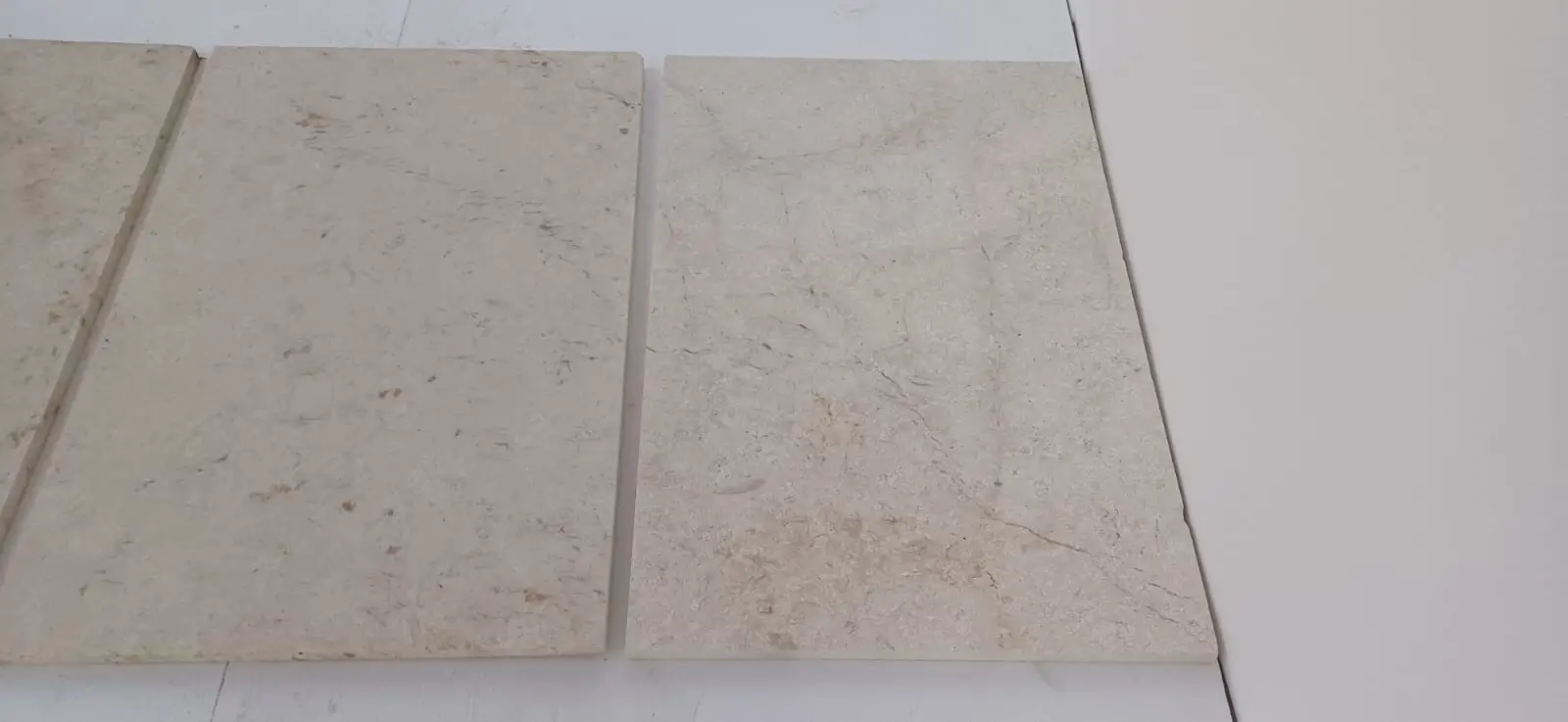
Outdoor travertine pavers face a different set of contamination challenges than interior floors. Soil tracking, organic material, mineral salt migration from the sub-base, and UV-accelerated biological growth all appear in outdoor settings and require cleaning strategies that interior-focused products aren’t necessarily designed to address.
The Natural Stone Institute’s travertine properties documentation highlights that travertine’s open-pore cellular structure, while visually distinctive, requires specific maintenance attention in outdoor settings where biological growth can colonize the voids. A ph neutral cleaner for travertine used outdoors needs sufficient surfactant action to lift biological film without the acid that would otherwise be the standard approach for algae and moss removal on hard surfaces.
For travertine pavers used around pools, the chemistry interaction extends beyond cleaning products. Pool water — whether chlorinated or saltwater — deposits on the surrounding paver field and affects the stone’s surface chemistry over time. A cleaning formula that’s pH neutral relative to the stone but mildly alkaline enough to counteract pool acid deposits is actually appropriate in this context. The practical target for pool deck travertine cleaning solutions is 7.2–7.8 — slightly alkaline but well within the safe range for calcium carbonate. Citadel Stone’s technical team regularly advises on this distinction when clients are setting up maintenance programs for travertine paver installations sourced from our warehouses, since pool environments create chemistry conditions that standard interior cleaning protocols don’t account for.
Sealing and Why a Clean Surface Is Non-Negotiable
Every penetrating sealer application requires a chemically clean, residue-free travertine surface — and that means the cleaning step before sealing is arguably the most consequential cleaning your stone will ever receive. Residue left in the pores from prior cleaning products prevents penetrating sealers from migrating fully into the stone matrix, creating an uneven protection profile where some areas are sealed and others remain open.
The failure mode looks like this: sealer is applied to what appears to be a clean surface, and six months later certain areas stain easily while others repel water normally. The explanation in the majority of cases is surfactant or soap residue in the pores that blocked sealer penetration during application. Testing your cleaned surface with a water drop test before applying sealer — if water beads, the surface isn’t clean enough for sealer, or existing sealer is still present — prevents this outcome.
For the pre-seal cleaning step, use a dedicated stone cleaner and degreaser that’s still pH-balanced but formulated specifically to strip surfactant residue from the prior maintenance cleaning program. This isn’t the same as your regular maintenance formula. It’s a single-use deep clean that prepares the travertine surface for maximum sealer penetration, and it should be rinsed thoroughly and allowed to dry completely — typically 24–48 hours in moderate conditions — before sealer is applied.
Final Considerations for pH-Neutral Travertine Cleaning
Choosing the right pH neutral cleaner for travertine doesn’t require a chemistry degree, but it does require reading past the marketing language on the label and confirming actual pH values and ingredient lists before the product touches your stone. The consequences of a wrong choice compound over time — a single application of the wrong cleaner rarely causes visible damage, but a year of routine cleaning with an incompatible formula produces etching, porosity increase, and sealing failures that are expensive to reverse.
Your maintenance program should align with the finish type, the installation environment, and the seasonal temperature patterns your stone experiences. In climates with meaningful freeze-thaw cycling, timing and rinsing discipline add another layer of importance to an already chemistry-dependent process. For travertine pavers in outdoor settings especially, connecting your cleaning schedule to seasonal transitions — rather than arbitrary intervals — protects both the stone surface and the joint system that holds the installation together through thermal stress cycles.
As you refine your maintenance approach, understanding the broader cleaning picture for this material is essential. cleaning travertine safely and effectively covers the full process in detail, from routine care through restoration-grade interventions. When clients contact Citadel Stone about surface dulling, the cause is most often a general-purpose cleaner used in place of a properly balanced stone-safe formula.
Related reading: What Type of Stone Is Travertine, Really? · Travertine Stone Colors: How to Choose the Right Shade.