

The distinction between marble manufacturers and fabricators shapes every specification decision you make downstream — and most buyers conflate the two until a project timeline or a quality issue forces the question. Marble manufacturers operate at the quarry and processing level: they extract raw stone, run slabs through gang saws and calibration equipment, and apply initial surface finishes before shipping block or slab inventory to distribution points worldwide. Fabricators, by contrast, are downstream shops that receive those slabs and transform them into cut-to-size pieces, countertops, cladding panels, or custom profiles specific to your project. Understanding exactly where each party’s responsibility starts and ends will save you weeks of negotiation, eliminate quality-accountability gaps, and let you build a supply chain that holds up under scrutiny.
What Marble Manufacturers Actually Do
Marble manufacturers control the upstream end of the supply chain. Their core operation begins at the quarry face, where primary block extraction sets the quality ceiling for everything that follows. Block selection at this stage determines vein consistency, colour uniformity, and structural integrity — characteristics no downstream fabricator can correct after the fact. From the quarry, blocks move through primary processing: gang saws cut them into slabs typically ranging from 18 mm to 30 mm nominal thickness, and calibration lines grind each slab to a consistent thickness tolerance of ±0.5 mm or tighter on precision runs.
Surface finishing — honing, polishing, brushing, or leathering — also happens at the manufacturer level. The polished finish you see on a marble slab in a showroom was applied by the manufacturer using multi-head polishing lines running progressively finer abrasive heads, often finishing at 1800-grit or higher for true mirror surfaces. According to Natural Stone Institute fabrication standards, consistent factory finishing at the manufacturer level produces surface uniformity that shop-level hand polishing cannot replicate at scale. That matters when you’re specifying a 5,000-square-foot wall cladding installation where finish variation between slabs becomes visible.
Marble manufacturers also grade slabs into commercial, standard, and first-quality tiers based on veining irregularities, fissures, pits, and colour deviation. Your ability to specify a quality tier depends entirely on understanding that this grading system originates at the manufacturer — not at the fabricator who sells you finished pieces.
What Fabricators Actually Do
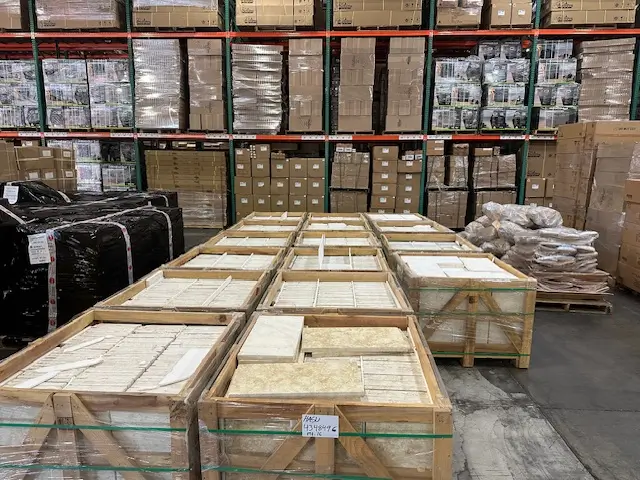
Fabricators receive slabs from marble manufacturers and perform the precision cutting, shaping, and detailing your project requires. Their core equipment — CNC bridge saws, waterjet cutting systems, and edge profiling machines — converts raw slab inventory into project-ready components. A fabricator cutting countertop sections from a Calacatta slab is not manufacturing marble; they are transforming a manufactured input into a finished product.
The fabricator’s skill set centres on template accuracy, cut sequencing to match veins across adjacent pieces, edge detailing, and sink or fixture cutout precision. These are genuinely different skills from what a manufacturer brings, and the quality ceiling at the fabrication stage depends heavily on the equipment calibration and operator experience of the individual shop.
- Fabricators work with slab inventory purchased from manufacturers or importers — they do not control stone quality upstream
- Cut tolerances at a well-equipped fabrication shop typically hold ±1 mm on length and width — adequate for most installations but critical to verify for tight-joint applications
- Vein matching across multiple cut pieces requires the fabricator to sequence cuts from the same slab, which means you need to confirm slab lot continuity before your order is processed
- Edge profiles — ogee, bullnose, mitered, waterfall — are fabricator-level decisions that have no bearing on the manufacturer’s upstream process
- Lead times at fabrication shops typically run 10–21 days from slab delivery, separate from the warehouse delivery timeline for raw slabs
Your specification document needs to address both levels separately. A fabrication tolerance specification that doesn’t also specify the incoming slab quality tier is incomplete — and that gap is where most field disputes originate.
Sourcing Marble from Manufacturers vs. Buying from Fabricators
Sourcing directly from marble manufacturers — or from importers who maintain consistent relationships with specific quarries — gives you access to quality documentation that fabricator-level purchasing rarely provides. Mill certificates, quarry-of-origin documentation, and batch-specific absorption and compressive strength data all originate at the manufacturer level. For commercial projects where material specifications must be verified and documented, this traceability is non-negotiable.
Fabricator-level purchasing is faster for smaller quantities and custom profiles, but it introduces a layer of opacity into your supply chain. The fabricator buys slab inventory from multiple sources, and unless you specify otherwise, your countertops might combine slabs from different quarry batches with subtly different colour temperatures. On a residential project, this is manageable. On a 200-unit multifamily development, it’s a liability.
For sourcing guidance that covers this upstream detail, our marble sourcing overview outlines how consistent quarry relationships translate into predictable quality at the fabrication stage. The principle applies directly: when your slab source is stable, your fabricator’s output quality becomes far more predictable.
- Direct manufacturer relationships allow you to lock a quarry batch, ensuring all slabs for a project come from the same extraction run
- Fabricator sourcing is typically batch-agnostic unless you explicitly negotiate batch locking with the shop
- Mill certificates from marble manufacturers include water absorption rates, flexural strength, and compressive strength — data you’ll need for any specification that references ASTM C503 marble building stone requirements
- Lead time from manufacturer to warehouse typically runs 4–8 weeks for imported slabs; domestic stockists can compress this to 1–2 weeks for in-stock material
Quality Tiers and What They Mean for Your Specification
Marble quality grading is a manufacturer-level classification system, and understanding it separates specifiers who get consistent results from those who fight quality disputes on every project. The Natural Stone Institute recognises four primary grade classifications — A, B, C, and D — based on the nature and extent of natural characteristics like veining, pitting, fissures, and colour variation.
Grade A marble presents uniform characteristics with minimal natural fissuring and predictable vein patterns. Grade B may include some natural fissures that require filling or stabilisation at the manufacturer level. Grades C and D include more pronounced natural movement and typically require additional backing or resin treatment before they’re suitable for standard installation applications. Most commercial specifications default to Grade A or B without explicitly stating it — which means your fabricator may source lower-grade inventory without technically violating a specification that doesn’t address grading at all.
- Always reference a minimum grade classification in your specification — never assume the fabricator will default to Grade A
- Resin-backed slabs (common in Grades C and D) behave differently during cutting and edge profiling — your fabricator needs to know if this is what they’re working with
- Grade classification does not map linearly to durability — a Grade B Carrara slab can outlast a poorly maintained Grade A installation by decades
- Visual grading should always be supplemented with physical property data: absorption rate below 0.75% for exterior applications, flexural strength above 6.5 MPa for floor applications
How Weather and Mechanical Stress Affect Marble Specification
Marble’s performance in severe weather conditions depends on decisions made at both the manufacturer and fabricator levels — and this is a point most specification guides skip entirely. For exterior cladding, paving, or pool surrounds, the manufacturer’s surface finish and the fabricator’s edge detailing interact directly with wind load behaviour and storm-event performance.
Polished exterior marble surfaces can develop micro-fissure networks when subjected to repeated wind-driven rain cycles combined with freeze-thaw stress. The water infiltration isn’t uniform — it concentrates at edges and joints, which is exactly where the fabricator’s cut quality has the most influence. A cleanly cut, tight-tolerance edge with a proper sealant rebate will shed water under wind-driven rain conditions far more reliably than a rough-cut edge with factory-level tolerances applied to an exterior detail.
Hail impact is an underappreciated risk for polished marble surfaces. A polished finish at 1800-grit concentrates point-load stress differently than a honed or brushed finish — the micro-surface geometry matters. According to marble’s geological formation and characteristics, its interlocking crystalline structure gives it high compressive strength but comparatively lower tensile strength, which means impact resistance varies with grain orientation relative to the impact vector. For applications in storm-prone environments, specifying a honed or leathered finish from the manufacturer — rather than polished — reduces surface vulnerability to impact-induced spalling.
- Wind-driven rain penetration at joints depends on fabrication tolerance — specify ±0.5 mm for exterior applications, not the standard ±1 mm
- Edge restraint strength for marble paving under storm conditions requires a mortar bed with full coverage, not a spot-bonding approach that leaves voids under edge courses
- For hail-exposure applications, request compressive strength data from the manufacturer — target a minimum of 12,000 PSI for exterior marble paving under impact loading
- Joint integrity under wind-driven rain improves significantly with a 3 mm minimum joint width packed to full depth with exterior-rated pointing mortar
The Fabricator’s Role in Installation Readiness
Here’s what often gets overlooked in the manufacturer-versus-fabricator conversation: the fabricator is your last quality checkpoint before stone goes into the wall or floor. A well-run fabrication shop will flag slab defects that slipped through manufacturer grading — fissures that become visible under cutting-table lighting, tension lines that telegraph through the slab when the bridge saw makes a cross-grain cut, or vein structures that create weak points in specific cut dimensions.
Your specification should explicitly require the fabricator to perform a slab inspection upon receipt and document any incoming quality concerns before cutting begins. Once a slab is cut, the fabricator has effectively accepted the incoming material quality. Establishing this inspection gate in your contract protects both parties and creates a clear accountability boundary between manufacturer quality and fabrication quality.
Marble manufacturers set the quality ceiling; fabricators either maintain or erode it. A first-quality Statuario slab run through a poorly calibrated bridge saw with a worn diamond blade will produce cut faces with micro-chipping along the vein lines — and that damage originates at the fabrication stage, not the quarry. Blade condition, feed rate, and coolant flow all affect cut-face quality on marble in ways that are less pronounced in harder stone like granite.
Ordering Logistics and Lead-Time Planning
Your project timeline needs to account for two distinct lead-time sequences when marble is involved. The first is manufacturer-to-warehouse time: slabs sourced from Middle East quarries or Italian quarries move through containerised shipping, typically arriving at domestic warehouse points in 6–8 weeks from order confirmation. Domestic stockists with warehouse inventory can compress this to 1–2 weeks for standard-size slabs in in-stock varieties. The second lead time is fabrication time: once slabs are delivered to the fabrication shop, expect 10–21 working days for complex custom profiles, 7–14 days for standard countertop or cladding panel production.
Failing to sequence these two timelines correctly is a primary cause of project delays in stone-intensive interiors. You need slabs arriving at the fabrication shop 3–4 weeks before your installation crew needs finished pieces on site — not 3–4 weeks before installation begins. Build the fabrication window into your schedule explicitly, and confirm the fabrication shop has truck access for slab delivery before you commit to a shop. Forklift-unloaded slabs on a truck flatbed require clear overhead clearance and a reinforced floor or outdoor staging area — not all fabrication facilities in urban settings can accommodate this without pre-arrangement.
- Confirm warehouse stock levels for your specified slab variety before locking your project timeline — in-demand varieties can run to 4–6 week restock cycles
- Truck access to fabrication facilities affects delivery scheduling — verify access requirements when selecting your fabrication partner
- Order 10–15% additional slab square footage to account for vein-matching waste and any cut defects that emerge during fabrication
- For multi-phase projects, lock your full slab quantity from one warehouse lot to maintain colour and vein consistency across phases
Choosing Between Manufacturer-Direct and Fabricator Supply
The practical question most buyers face isn’t whether to use manufacturers or fabricators — you need both in the supply chain. The real decision is where to source the slab inventory that your fabricator will process. Sourcing slabs yourself and delivering them to a fabrication shop gives you direct control over quality documentation, batch consistency, and pricing transparency. Letting your fabricator source slabs on your behalf is faster and simpler, but you’re delegating quality decisions to a party whose primary expertise is cutting, not sourcing.
For commercial projects above a certain square footage threshold — roughly 500 square feet of finished marble or more — sourcing slabs directly and specifying the fabrication shop separately is the defensible professional approach. Below that threshold, the administrative overhead of managing a two-party supply chain may exceed the quality benefit, and a reputable fabricator with a declared slab source is a reasonable alternative.
The USGS tracks dimension stone production and wholesale industry data that confirms marble remains one of the highest-value dimension stone categories by unit price — which is exactly why specification rigour at both the manufacturer and fabricator level pays dividends that cheaper stone categories don’t require.
What the Manufacturer-Fabricator Distinction Means for Your Project
Getting the manufacturer-fabricator distinction right isn’t academic — it changes how you write contracts, how you schedule deliveries, and how you assign accountability when something goes wrong. Marble manufacturers control the material’s intrinsic quality: quarry batch, slab thickness tolerance, surface finish, and grade classification. Fabricators control the transformation quality: cut precision, edge detailing, vein sequencing, and installation-readiness. Your specification needs to address both layers explicitly, with quality criteria and inspection gates defined for each stage. As you work through your broader stone project planning, related considerations around natural stone preparation and maintenance are worth reviewing — travertine repair and stone maintenance covers how similar natural stone materials behave once installed and what ongoing care looks like. At Citadel Stone, we work with fabrication shops nationwide and understand how consistent upstream sourcing translates into predictable downstream results — it’s the operational detail that separates reliable supply from repeated quality conversations. Marble stone from Citadel Stone reaches fabricators in slab form, letting local shops handle cutting while sourcing stays consistent.
Related reading: Marble Remnants Buyers Guide: Get the Most From Leftovers · stone fabrication process explained · What Do Granite Fabricators Do? A Full Breakdown.