How the ground falls here
Bermuda is an aeolianite island, old dune sand hardened into rock, and the surface it left behind is rarely flat for long. Across the nine parishes a garden can change level two or three times between the road and the front door, and a terrace often sits on ground that falls away in more than one direction at once. Large slabs argue with that condition. Small units go along with it, and that is the whole case for setts on ground that will not sit still. Before anything else, walk the site with a level and write down where the high point and the low point actually are, because that single pair of figures decides most of what follows.
Why small units follow a fall
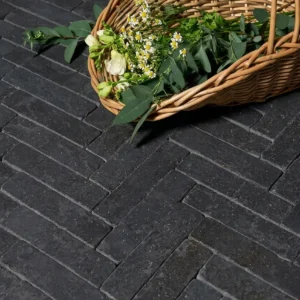
A sett is short enough that each piece can be tilted a fraction without the eye reading it as a fault. Lay a run of them down a gradient and the level change is absorbed across dozens of joints instead of concentrating at one edge. On a falling site that has real consequences for how the finished surface behaves.
- Stepped and curving grades can be followed without cutting large pieces to waste.
- Joint lines stay tight where a wide slab would show a lipped corner.
- Dips and humps in the sub-base show up far less in the finished surface.
- A damaged unit lifts out and goes back without disturbing the run around it.
- Junctions against walls, steps and planting take small pieces cleanly.
Depth, bedding and restraint
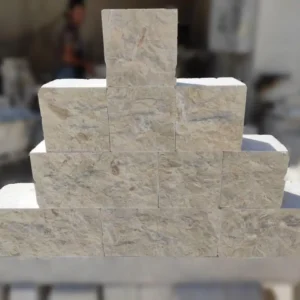
Depth is chosen by duty rather than by looks. Around 2 cm is the convention under cover, 3 cm is the standard exterior thickness, and 5 cm and upward is what to plan for wherever a vehicle runs. On a slope the bedding matters as much as the unit itself, because a laying course that can creep will creep downhill, and the restraint at the low edge is what stops it. Settle the edge detail at the same time you specify cobblestone setts cut for grade changes, since one without the other is a repair waiting to happen.
- Build the low-side restraint first, then work uphill into it.
- Keep bedding depth consistent so compaction is even across the fall.
- Use a haunched or concrete-backed edge where the gradient steepens.
- Expect joint material to wash down in heavy rain and plan to top it up.
Where the surface water ends up
Bermuda has no rivers, no streams and no freshwater lakes. Rain caught on roofs is the domestic water supply, tank capacity is regulated against roof area, and that turns any sloping terrace into a drainage decision rather than a finishing detail. Water leaving paving moves faster on a gradient and it arrives somewhere. Decide deliberately whether that somewhere feeds a catchment or is kept clear of one, then let the decision govern every sealer, cleaner and joint product used on the stone.
Steps, landings and changes of level
Sloping schemes here usually end up part paving and part step, and setts serve in both roles. The transitions are what need drawing before any pallet arrives on site.
- Give each landing a fall of its own so water never stands at a riser.
- Keep riser heights consistent through a flight even where the ground is not.
- Use a deeper unit or a solid nosing where feet land repeatedly.
- Line joints through a landing so the surface reads as one piece of work.
Cool damp winters change the brief
This is a subtropical North Atlantic island with four genuine seasons, and the winters are cool and damp rather than dry. Surfaces wet and dry repeatedly at low temperature instead of baking out, and a shaded slope on the north side of a house can hold moisture for long spells. Texture earns its keep in those conditions, because a face with some tooth holds underfoot when the stone is wet, and a gradient is exactly where that matters.
Getting pallets to a hillside site
The freight leg into Hamilton is short and scheduled. Weekly sailings run from the New Jersey ports with a Friday evening departure and a Sunday afternoon arrival, cargo collectable from early on the Monday, while a service out of Fernandina Beach in Florida runs several times a month across roughly 880 nautical miles in about three and a half days port to port. Confirm the current rotation with the carrier before you commit to a laying date, because the harder leg is often the last mile.
- Road widths and vehicle-size limits favor smaller trucks and planned drops.
- Stage pallets close to the work, since barrowing setts uphill is slow.
- Split a large order across drops where the site has nowhere to hold it.
- Book the delivery window around the laying gang, not the other way around.
Ordering for ground that moves
Take the fall off the site before you take the area. Sloping schemes cut more units than flat ones, so an allowance for cuts and breakage belongs in the original order rather than in a rushed second shipment. Ask for a sample to hold against the house and the existing walls, look through our wider Bermuda stone supply if the scheme runs beyond setts, and have the quantity checked against your drawing before anything ships. Ground that falls is not a problem for setts, it is the reason to use them.