Grip Is a Surface Question First
Two slabs cut from the same block can behave completely differently underfoot depending on how the face was worked. That is the practical starting point for any wet area. The stone type sets absorption, density and tone; the finish sets what happens when a wet foot lands on it at an angle. Both matter, but only one of them can still be changed after the material is chosen.
On Bonaire there is a third variable that gets less attention: what sits on top of the surface. Sunscreen, salt residue and fine wind-blown dust all come between a foot and the texture, and a finish that grips beautifully when clean can be disappointing when it is not.
The Faces Worth Considering
Each finish is a different depth and pattern of surface relief, and the choice balances grip against cleanability and how the floor looks under strong sun. Working through the texture grades we cut alongside the layout drawing is more useful than picking a finish from a name on a list.
- Honed: smooth and easy to clean, best kept away from wet barefoot routes.
- Brushed: a gentle relief that keeps a refined look while adding bite.
- Tumbled: broken edges and a softened face that hides dust and marks.
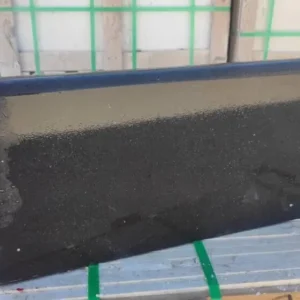
- Bush-hammered: deep, even texture for the wettest and steepest ground.
- Sandblasted: an open, uniform face that reads matte under bright light.
Fresh Water, Salt Water and Sunscreen
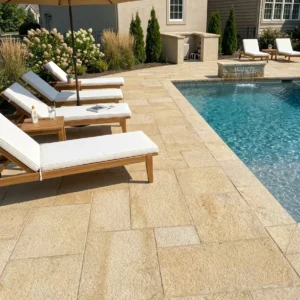
A pool deck here rarely deals with one liquid at a time. Pool water comes out on feet and towels, sea air deposits salt on the same surface, and low rainfall means neither is rinsed away by weather with any regularity. Sunscreen and body oils are the third layer, and the one that changes grip the most, because they fill shallow texture and leave a film across it.
The design answers are straightforward: deeper texture where bare feet turn or step, an outdoor shower placed so people rinse before crossing the deck, and a cleaning routine that lifts oils rather than spreading them around.
Coping, Thresholds and the Edge
Grip failures cluster where the surface changes. Coping units, the first step out of the water, thresholds into the house, and any transition between finishes are the points where a foot is loaded sideways or has to pause.
- Give coping the deepest texture on the deck, not the most refined finish.
- Keep step nosings consistent in height and clear of standing water.
- Avoid a change of finish exactly where a foot changes direction.
- Detail thresholds so water is stopped before it reaches an interior floor.
Format matters here as well. Smaller units mean more joints and more edges within a single footstep, which adds grip in exactly the places where one large slab offers none.
Where the Water Goes Afterward
Falls, joints and drainage are part of the grip specification, because water that lingers on a surface undoes whatever texture was chosen. In a semi-arid climate it is easy to under-detail drainage, and then a November downpour finds every flat spot at once.
There is a second reason to get it right. Bonaire National Marine Park covers all the water around Bonaire and Klein Bonaire from the high-water mark down to sixty meters, managed by STINAPA Bonaire, and four Ramsar wetland sites were each given a 500-meter buffer zone in 2021. Silt and construction runoff leaving a coastal site do not stay on that site.
Trade-Wind Grit on a Wet Floor
The northeast trade wind runs through the year at an average close to 15 mph, and it carries fine material onto every horizontal surface. On a dry deck that grit is a nuisance. On a wet deck it behaves like a lubricant across a smooth face, and like extra bite on a textured one, which is one more argument for relief you can feel.
- Expect deposits to build up on the leeward side of walls and planters.
- Sweep before rinsing so grit is not ground into the face.
- Choose a texture deep enough that dust does not fill it flat.
- Keep planting beds edged so soil does not wash across the deck.
Cleaning Without Wrecking the Texture
The fastest way to lose grip is an aggressive cleaning habit. Acidic products etch limestone and dull the worked face that was paid for. A pressure washer held close enough to strip an oil mark will also open the surface and shorten its life. The routine that works is duller than the alternatives, and it protects the specification you bought.
- Rinse with fresh water where a supply allows, especially after salt spray.
- Use a pH-neutral cleaner formulated for natural stone.
- Deal with sunscreen and oil marks while they are still fresh.
- Keep any pressure washer at a distance and on a moderate setting.
The units and depths in limestone paving cut for Bonaire poolsides are held with that routine in mind, because a finish performs only as long as it survives its own maintenance.
Stand On It Wet
No published slip figure replaces the test you can run yourself in five minutes. Wet a hand sample, tilt it, put a bare foot on it and push sideways. Do it again with a smear of sunscreen across the surface, because that is the real condition on a deck in the middle of the afternoon. If the sample still feels secure under both, the finish is doing its job.
The finish that feels safe wet and greasy is the one to specify.