What humidity actually does to a floor here
Bonaire is dry by Caribbean standards, but dry air and dry rooms are not the same thing. Sea breeze carries moisture and salt inland all day, a rinse-off shower may run more than once a day, and a covered terrace can stay damp long after the sun has moved off it. The question is never really whether a floor gets wet. It is how the surface behaves in the minutes immediately after it does, and whether the water leaves cleanly. Finish is the part of the specification that answers that, and it is also the part most often decided last, from a photograph, when it should have been decided first, from the room list.
The finishes in plain terms
Finish names get used loosely, so it helps to describe what each one physically does to the face of the stone rather than repeating the label.
- Honed: ground flat with pores still open, quiet underfoot and easy to wipe down.
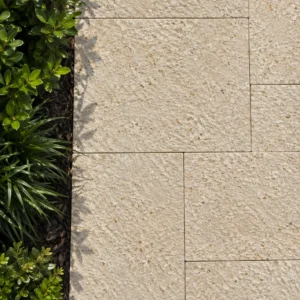
- Brushed: abrasive brushes open a soft texture that keeps some bite when wet.
- Bush-hammered: a percussive face with real depth, suited to places where water sits.
- Sandblasted: a fine even roughness that lowers glare without a strong texture.
- Tumbled: eased edges and a worn face, forgiving on small units and steps.
Where grip is actually needed
Texture is not needed everywhere in equal measure, and over-specifying it makes a floor harder to keep clean. Map the wet zones first, then apply the face that suits each one, and accept that the list is usually shorter than people expect. If you want to see how each surface is produced before choosing, read how a surface is dressed and match it back to the zones below.
- Shower floors and the first stride taken out of them.
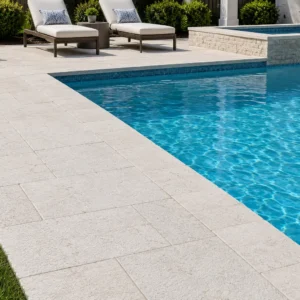
- Pool surrounds and the steps between deck levels.
- The route from an outdoor rinse point back into the house.
- Covered terraces that stay damp in permanent shade.
- Any sloped run where water moves across the surface rather than standing.
Absorption is the number worth asking for
Texture governs grip; absorption governs everything else. A dense, low-absorption unit takes up less water, dries faster and gives salt fewer places to sit, which matters more here than it would in a wetter, cooler climate. For rooms that meet standing water every day, specify limestone tile graded for wet traffic and keep the more open-pored options for dry interiors where they are comfortable to live with. Ask for the figures in writing rather than accepting an adjective, and compare them across the shortlist rather than reading one in isolation. Absorption also drives the maintenance routine, so the number decides how much work the household is signing up for long after the installer has gone.
Salt, not frost, is the decay mechanism
The process to design against on Bonaire is salt crystallization rather than freeze-thaw. Salt aerosol arrives on a permanent north-east wind averaging roughly 7 m/s, about 15 mph, and annual rainfall of only 350 to 450 mm means surfaces are seldom washed down by weather alone. Salt that is not rinsed away dries, recrystallizes and works at the surface from within, which is why absorption and rinsing matter more here than any frost rating ever will.
- Prefer low-absorption units in splash zones and on windward frontage.
- Rinse salt off with fresh water instead of waiting for rain to arrive.
- Avoid trapping salt in wide, soft joints on exposed external surfaces.
- Hold porous material back from the wettest and most exposed positions.
Drainage, runoff and the marine park
Bonaire National Marine Park covers all the water around Bonaire and Klein Bonaire from the high-water mark down to 60 m depth, managed by STINAPA Bonaire. The boundary beginning at the high-water mark is the detail that matters on site: a shoreline terrace is working at the park edge, not somewhere near it. Four Ramsar wetland sites, Washington Slagbaai, Klein Bonaire, Lac Baai and Pekelmeer, were each extended with a 500-meter buffer zone in 2021. Permeable jointing and positive sediment control therefore belong on the drawing rather than in a method statement written afterward.
Testing a finish before you commit
A finish decision is one of the few specification choices you can test properly for the price of postage, and a sample board seen in a dry showroom tells you almost nothing about how a face performs under water. Four simple checks settle it.
- Wet the sample and stand on it barefoot, not in shoes.
- Tilt it slightly, since almost every wet area has a fall built into it.
- Leave it out overnight to see how salt film shows on the face.
- Wipe it with the cleaner your household actually uses.
How we work through a finish schedule
Send us the room list with the wet zones marked and we will propose a face for each, rather than one texture applied across the whole floor. Where a room needs both comfort and grip, the answer is often a change of finish in the same stone, which keeps the tone continuous and the detailing simple. We will also flag any position where absorption, not texture, is the deciding factor, because those are the places where a finish change alone will not solve the problem. Samples are sent before commitment, and they are worth wetting on site rather than assessing dry across a table. Quotes are written in US dollars, and freight into Kralendijk runs on a published weekly sailing from Florida. The right finish is the one that still feels safe when the floor is wet and nobody is paying attention.