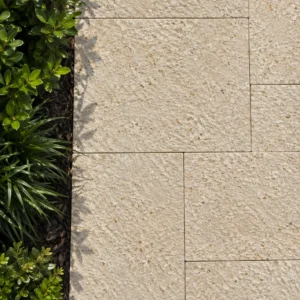
Two Different Products in One Build-Up
It helps to separate two things that often get merged in a specification. Crushed aggregate, graded sand, fill and boulders are one product family. Dimension-sawn paving in calibrated thicknesses is another. Curacao produces the first in quantity and does not produce the second, so the two are not competitors on a price list; they are consecutive layers in the same build-up. A well-run job buys both, from different sources, on different schedules.
What the Island’s Mining Sector Produces
Mining Company Curacao has been operating since 1874, when phosphate was found in the Tafelberg near Santa Barbara in the southeast of the island. Its published list is graded material rather than cut units.
- Base coarse at 0 to 50 mm for sub-base work
- Presieved Sand at 0 to 3.5 mm and Barmac sand at 0 to 4.5 mm
- Aggregates in graded bands from 3 to 5 mm up to 25 to 50 mm
- Processed limestone powders, including water filter and feed grades
- Selected boulders up to 3.5 metric tons for marine defense
Where the Imported Unit Sits in the Stack
The imported course is the wearing surface laid over locally quarried ground. That single sentence resolves most of the arguments that surface at tender stage, because it assigns each supplier a layer rather than a share of the same layer. It also sets the tolerances: base and bedding are placed to a level, while a calibrated paving unit is chosen for a repeatable thickness so the finished surface reads flat. Set the interface levels early and both trades can work to them. Our wider supply position for the island is set out in the Curacao stone hub.
Read the Building in Front of You First
Coral stone and quarry stone finished with lime plaster, with brick detailing, is the island’s traditional wall material, and it deserves to be treated as Curacao’s own fabric rather than as a backdrop for something imported. What that means for your paving choice depends entirely on the property. The wall behind a terrace may be plastered masonry, block, render or timber; the roof above it may be tiled or flat. Establish what the building actually carries before fixing tone, unit size and texture, instead of choosing from a sample board and reconciling afterward.
- Record the wall finish and its tone in daylight, not from a photograph
- Note any exposed masonry, brick detail or plaster line the paving will meet
- Check what the thresholds and steps are made from, since they set the joint lines
- Establish whether the property carries a heritage listing before anything is specified
A Drainage Tradition Worth Borrowing
Older houses here used high gabled roofs with red tiles that collected rainwater and channeled it into stone reservoirs. That instinct is worth carrying into a hardscape design on an island where the rain arrives in short, heavy bursts and the ground is baked for most of the year. Falls, joint material and discharge points deserve as much attention as the stone itself, and they are far cheaper to get right at drawing stage than after the first heavy October. Ground that has stayed dry for months does not absorb a downpour politely, so the surface has to move water somewhere deliberate.
Permits and Sequence
- No construction works may be carried out without a building permit under the Bouw- en Woningverordening Curacao
- Applications run through Ruimtelijke Ordening en Planning, the planning department formerly known as DROV
- Its counter sits at Plasa Horacio Hoyer 19 in Scharloo, Willemstad, open in the morning from 07:45 to 11:45
- The statutory decision period is as soon as possible and no later than a month, with six to eight weeks a practical expectation
- The Historic Area of Willemstad, Inner City and Harbour was inscribed in 1997 and covers Punda, Otrobanda, Pietermaai and Scharloo
Hardscape Inside the World Heritage Area
Work in those four districts is not a retail purchase. It runs past the Monuments Office, which sits within the Department of Urban Planning, Development and Housing and is responsible for the historic townscape, as well as the ordinary planning route. Stichting Monumentenzorg Curacao separately manages over 120 monuments, from town houses and forts to plantation houses. The inscribed area holds 743 listed monuments and most of its fabric dates from 1650 to 1900, so allow real time in the program for consultation before anything is ordered.
Splitting the Supply Chain Sensibly
Willemstad takes ocean freight directly, with no transshipment required, and the port operates as a transshipment hub in its own right. The container terminal runs two gantry cranes at 24-hour service with a maximum depth of 12.2 m, and the 91,000 square meter Harbor Free Zone sits next to it for staging before duty is triggered.
- Buy base course, bedding sand and aggregate locally, close to the date they are needed
- Ship the wearing course as one consolidated order with the finish already fixed
- Carry an overage on imported units, because a mid-job top-up is a shipping event
- Agree who owns the interface levels between local base and imported surface
- Stage material where it will not sit in blown salt before it is laid
Once the units land, sawn limestone paving for Willemstad projects should reach site with its finish and thickness already agreed. Buy the base locally, import the surface, and write the interface into the drawings before either order goes out.