What the older fabric on Aruba actually is
Traditional building on Aruba used caliche, the crusty calcium material taken from the hills in the south-east, along with dry-laid coral rock walls fitted without mortar so precisely that many of them are still standing. That wall-building is described as a lost art. The cunucu house belongs to the same register: small, thick-walled, built against heat and wind rather than for display.
Notice what is not on that list. There is no historic paved-street tradition here to match. The island’s recorded old stonework is walls rather than paved ground, and no paved-street tradition is documented alongside it. Stone paving on a site like that is a new element being introduced, not the repair of something lost. Saying so plainly makes the specification easier, because you stop trying to match a precedent that never existed and start asking a simpler question: what will sit well next to what is already there?
Reading the wall before choosing the sett
If there is an old coral rock wall or a caliche section on the site, it sets the terms. Spend an hour with it before choosing anything.
- Look at the color range in full daylight and again late in the afternoon, because dry-laid walls carry more variation than a photograph suggests.
- Note the unit size in the wall itself, since the paving should not out-scale the masonry above it.
- Check whether the face is rough, weathered or partly rendered, as that sets how much texture the paving can carry.
- See where the wall meets the ground now, and decide whether new paving runs to it, stops short of it, or turns away.
- Judge samples against the wall in daylight rather than against a screen, since stone chosen on a monitor is stone chosen wrong.
Scale and joint: keeping the paving quiet
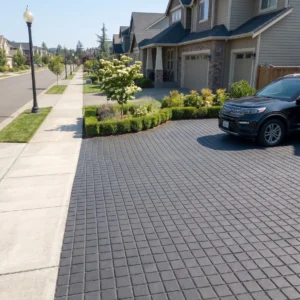
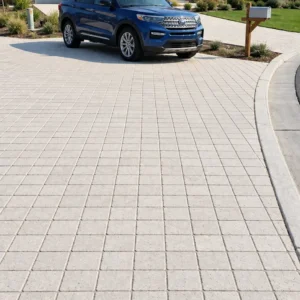
The instinct on a heritage-adjacent site is to reach for something dramatic. The better instinct is restraint. A paving field made of small units with a consistent joint reads as background; large-format slabs read as an event, and next to a hand-fitted wall an event is the wrong note.
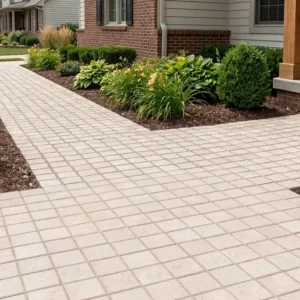
Keep the coursing simple and let the wall stay the interesting object. A modest sett in a plain bond, with a joint that is neither hairline nor gaping, will sit under an old wall for years without arguing with it. That is why quieter sett choices near old walls tend to work better on these sites than a statement floor does: they carry traffic and they stay in the background, which is the whole job.
The setting helps too. This is dry, open country of divi-divi trees bent permanently by the trade wind, cactus and pale ground, and a paving field that stays close to those tones sinks into the landscape rather than sitting on top of it. Strong contrast announces new work; a quieter tone reads as though the ground was always finished that way.
Face texture and glare on a bright, dry island
Aruba is bright, dry and dusty, and that changes what a finish does. A high-sheen face throws glare in this light and shows every salt bloom and dust film between washes. A textured face scatters the light and carries the film less visibly.
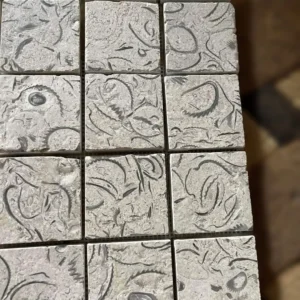
- Tumbled and bush-hammered faces read as settled rather than new, which suits older company.
- Brushed and honed faces sit between the two and take a routine wash easily.
- Sawn faces look crisp but read as modern, so use them where that is genuinely the intention.
- Leave gloss finishes for interiors, because the light outdoors here is unforgiving and blown dust makes it worse.
Comparing low-glare face textures in stone against a piece of the actual wall is the only reliable way to settle it, and that takes a small hand sample rather than a delivery.
Working near a wall you must not disturb
A dry-laid wall holds itself up by friction and fit. It has no mortar to forgive disturbance, so the risk during paving works is mechanical rather than aesthetic.
- Keep excavation and compaction plant back from the wall base, and hand-work the last stretch.
- Do not lean formwork, stacked pallets or stone crates against a dry-laid face.
- Grade new paving so runoff is carried away from the wall foot instead of ponding against it.
- Leave a soft margin or a narrow gravel strip if the wall base is uneven, rather than forcing setts hard against it.
- Photograph the wall before work starts, so any pre-existing movement is on record.
Consent, caution and who to ask
If a building or a wall on the site carries any protected status, the consent route is a question for the relevant Aruban authority and it should be settled before the drawings harden rather than after quantities are ordered. That is worth confirming even when the work is only at ground level, since ground treatment around a protected structure can fall inside the same conversation. Ask early, get the answer in writing, and specify to it. No supplier can answer a consent question on your behalf, and no quantity should be committed until that answer exists on paper.
New work in old company
Working beside historic fabric is less about imitation than about manners. There is no lost paving tradition here to recover, which frees you to choose a surface that simply behaves well: modest in scale, quiet in finish, stable underfoot and easy to wash. Let the old wall keep the attention, and let the paving do its job without asking for any.