Two stones, one island, different jobs
A single Aruba site can easily justify both materials, and the argument about which stone is better tends to dissolve the moment somebody walks the plot with a plan in hand. A beachfront terrace, a shaded courtyard, a turning apron and a bin store behind a kitchen are four different problems, and they take different answers. The variables that decide are simple enough to hold in your head: how much sun the area gets, how much salt and dust the wind delivers there, what rolls or drags across it, and whether anybody crosses it barefoot. Answer those four questions for each area on the plan and the material selection more or less writes itself, which is a far better process than picking one stone in a showroom and then asking it to do every job on the property.
Where limestone earns its place
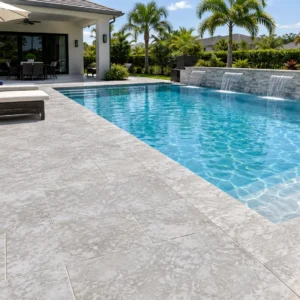
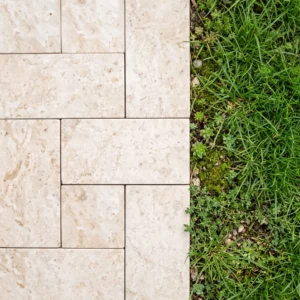
Pale limestone is the natural choice wherever comfort and light matter. It reflects more of the sun’s energy than dark stone, so it runs cooler underfoot in the same position; it sits well against render, timber and white-painted walls; and it takes the textured faces that work best around water. Specified with tight absorption and enough thickness for the traffic, it handles the island’s salt film and blown grit with a straightforward maintenance routine.
- Terraces and roof decks where people walk without shoes
- Pool surrounds and coping, in a deep-textured face
- Interior floors and covered thresholds, honed and large-format
- Approach paths and steps that need to read light against planting
Where basalt earns its place
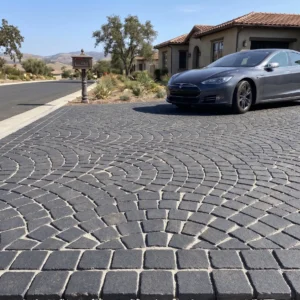
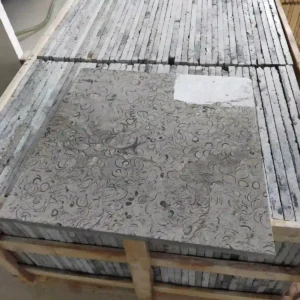
Basalt is a dense volcanic stone with a naturally tight structure and a dark, even tone. That density is the point: it takes concentrated loads, holds an edge under turning wheels, and shows tire marks and service traffic far less than a pale surface. It is the material to reach for where a site works hard and appearance has to survive being used rather than admired.
- Entrance drives and the turning circle in front of a garage
- Delivery aprons and any surface a vehicle stands on
- Service yards, plant enclosures and bin areas
- Borders and step risers where a darker line is wanted
Because the tone is even, basalt also copes better with the patchwork look that repairs and later phases can leave behind on a pale field.
Zone by zone across a site
Walking a typical villa or small resort plot, the split tends to fall out like this:
- Beach-facing terrace: pale limestone, textured face, tight absorption
- Pool surround and coping: limestone in a deep-textured finish
- Entrance drive and turning apron: basalt in a heavier depth
- Service yard and bin area: basalt, where marks and spills are routine
- Interior floors: honed limestone in larger formats
The heat trade-off you cannot ignore
Dark stone absorbs more solar energy, and on an island with this much sun that is felt immediately by bare feet. Basalt therefore belongs where shoes are worn and vehicles run, not on the route between a pool and a lounger. Where a dark surface is wanted visually in a barefoot area, keep it to bands, borders or shaded sections rather than the open field, and let where limestone belongs on Aruba set what covers the areas people actually walk on. The reverse trade-off is just as real: a pale drive shows tire marks, oil and the dust that the wind lays down between washes, so the material that is kind to feet is not the one that flatters a working surface.
Depth and format follow the traffic
Exposure decides the material; load decides the depth and the unit size. Smaller units distribute movement better under wheels, larger formats read calmer underfoot, and thickness has to answer to what crosses the surface rather than to what the drawing looks like on a screen.
- Foot traffic on terraces and around pools: standard exterior thickness
- Occasional vehicles: increased depth and a bound bedding detail
- Daily service vehicles: the heaviest depth, in smaller units
- Covered interiors: thinner units, larger faces, fewer joints
Mixing both without it looking accidental
A two-material site reads as designed when the change happens at a line that means something: a step, a threshold, a planting bed, the point where shoes go on. Repeat the darker stone somewhere else, even as a narrow border or a step riser, so it looks intentional rather than left over from a delivery. Keeping the joint width and laying direction consistent across both materials does more for the result than matching tones ever could, and basalt paving for Aruba service yards can carry the same joint discipline as the terrace it adjoins.
Costing the two into one order
Both stones land the same way. Cargo comes into Barcadera, Aruba’s cargo port since it officially opened on 12 April 2016, with Oranjestad now handling cruise and passenger traffic. Duty is assessed on the CIF value in a band running roughly 2 to 22 percent by product, and turnover tax has been collected at the border since 1 August 2023 at a combined 7 percent, so have your broker confirm the current lines. Ordering both materials together consolidates packing and paperwork, and because there is no storm season to work around, deliveries can be staged across the year to match the build. One island, two stones, and a plan that puts each one where it does its best work.