Two things arrive on your floor every day
Aruba’s maintenance problem is not the one that generic Caribbean advice is written for. There is no storm season to recover from and no long wet months to dry out. Instead the trade winds deliver two things to every exposed surface, every day of the year: airborne salt, and fine abrasive dust off an arid landscape of cactus and divi-divi trees.
Neither is dramatic. Both are relentless. A cleaning routine built for a rainy island will miss them completely, and a floor that is otherwise well specified will look tired years earlier than it should.
Grit is the wear agent, not the salt
Salt is a cosmetic and chemical nuisance. Grit is what actually wears stone. Fine wind-blown particles sit on the surface, get trodden in, and behave like a very mild abrasive under every footfall. Over years that is what flattens texture and dulls a face, and it is why the sequence of cleaning matters more than the product used.
- Remove dry grit first, always, before water or detergent touches the floor.
- Sweeping a gritty floor with a stiff brush grinds it into the surface.
- Mopping over grit turns the mop into an abrasive pad.
- Entrance matting cuts the amount of grit that reaches interior stone.
A routine that actually fits the island
Good maintenance here is frequent and gentle rather than occasional and aggressive. The aim is to keep salt from drying into a film and to stop grit accumulating enough to do work underfoot.
- Blow or soft-sweep exposed terraces on a short, regular cycle.
- Rinse wind-facing stone with fresh water to lift dried salt.
- Wash with a pH-neutral cleaner made for natural stone, then rinse clean.
- Deal with spills on the day rather than at the next scheduled clean.
- Inspect joints annually, since failed joints let water travel sideways.
None of this needs a contractor. It needs somebody with a hose and a soft broom working to a rhythm rather than to a crisis. A floor rinsed little and often will hold its face far longer than one left alone for months and then attacked with something strong.
What never to put on limestone
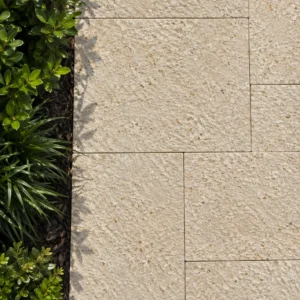
Limestone is a calcareous stone and reacts to acid. That single fact rules out a long shelf of ordinary household products, and acid damage is entirely avoidable once that one rule is understood. Vinegar, lemon-based cleaners, descalers, patio acids and many bathroom products will etch the face, leaving dull marks that no amount of further cleaning will lift. Bleach and strong alkaline degreasers bring their own problems. If a label does not name natural stone, assume it is not for your floor. Choosing dense tile that survives daily grit helps, but no stone is immune to acid.
Sealing: what it does and what it does not
An impregnating sealer soaks into the top of the stone and reduces how readily liquids are absorbed, buying time to wipe a spill before it stains. That is the whole promise. It is not a coating, it does not make stone waterproof, it does not stop acid etching, and it does not remove the need to clean. Understood that way it is a useful and inexpensive piece of insurance. Understood as armor it leads to disappointment, and to complaints about a product that was working exactly as intended.
- A sealer slows absorption; it does not block water.
- It offers no protection whatever against acid etching.
- It is not a coating and leaves no surface film.
- Cleaning is still required on exactly the same schedule.
Reapplication, and why exposure zones differ
Sealer life is not a single number across a property. A sheltered interior floor and a wind-facing terrace on the same house will not need the same treatment on the same schedule. Test rather than guess: drop water on the surface in each zone and watch whether it beads, sits, or darkens the stone as it soaks in. When it soaks in readily, that zone is due. Keep a note of what product went where, because mixing systems at reapplication rarely ends well.
Salt film on exterior stone
Exterior stone near the coast collects a salt film that dries pale on the surface and gathers in any texture. Fresh water lifts it easily; time and pressure do not. Rinsing is a maintenance habit rather than a repair, and it is far cheaper than the alternative of periodically deep-cleaning a floor that has let salt build up in its face.
- Rinse with fresh water rather than reaching for a stronger product.
- Work when the surface is cool so water is not drying as it lands.
- Pay attention to the windward side of the property first.
- Watch the joints as closely as the tile faces.
Budgeting supply and maintenance together
Maintenance cost belongs in the same conversation as supply cost. Freight, duty and landed pricing are laid out in the Aruba supply and duty overview. Turnover tax has been charged at the border since 1 August 2023, made up of BBO, BAVP and BAZV components that together come to 7 percent, with import duty varying by classification on top; confirm the current figures for your tariff line with your customs broker before budgeting.
Sweep the grit off first, rinse the salt away often, and an Aruban stone floor keeps its face.