What Older Fabric Here Is Made Of
It is worth being plain at the start. What the older fabric on a given site is made of varies from address to address, and we will not tell you what any particular setting was historically surfaced in, because that is not ours to assert. The custodian body and the professionals who file permits here are the right people to ask, and the answer will be specific to the site rather than general to the island.
That is not a limitation, it simply changes the brief. On a sensitive site the job is not to invent a historic reference, but to choose a surface that sits quietly against whatever fabric is already there.
The Monument List and Its Custodians
Sint Maarten maintains a list of designated monuments. Fort Amsterdam, Fort Willem and Belvedere Plantation are among the recognized sites. The Sint Maarten National Heritage Foundation and Museum acts as the custodian body for the island’s heritage record.
If your site is on or beside a designated monument, that status shapes what you may do to the ground as much as what you may do to the building. Treat it as a design input at concept stage.
The Island’s Own Stone as Heritage
There is a piece of local geology worth knowing. The Point Blanc formation is a layered rock dated at roughly 15 million years, and a sample of it is held in the Sint Maarten Museum. The island’s bedrock is volcanic: andesite tuff and tuff breccia from the Eocene, intruded by hypabyssal basalt and quartz diorite, with limestone and marl laid down later over the eroded volcanics. Point Blanche, where the cargo port sits, is characterized by hard layered limestone.
That rock is part of the island’s identity, not a product line to be measured against. Local material makes the aggregate and the concrete; imported stone is the wearing surface above it.
Paving That Defers Rather Than Competes
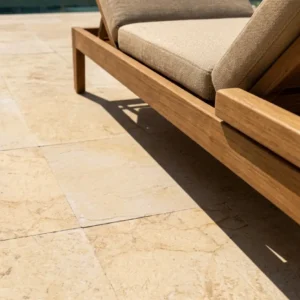
On a sensitive site the paving should be the quietest element in the view. That argues for a narrow tonal range, a modest unit, a finish without shine, and a laying pattern that does not draw the eye. It is also the argument for sett formats that suit older fabric rather than large format slabs.
- Keep the tonal range narrow within one field, and let variation happen slowly across it.
- Avoid high-gloss faces, since a matte or lightly textured face ages without a visible turning point.
- Match the joint tone to the stone rather than contrasting with it.
- Let the paving pattern follow the building line instead of a geometry of its own.
- Detail thresholds so the new surface meets old render and worn steps without a raw edge.
Front Street, the Boardwalk and the Rebuild
Philipsburg is the capital, and Front Street and the Boardwalk along Great Bay Beach were rebuilt after Hurricane Irma made landfall on 6 September 2017. Reports at the time put the destruction at around 70% of the Dutch side’s infrastructure. That is recent, and for the people you work with it is memory rather than history.
The public realm there carries a load no residential specification anticipates. Cruise arrivals passed a million passengers by 2018, and that foot traffic crosses the same surfaces season after season. Anything specified for that context is a commercial wear specification.
Permits and the Objection Window
Work that alters the ground is permitted separately from work on the building itself. The Ministry of VROMI issues civil works permits covering terrestrial, coastal and marine terrain alteration, including excavation and demolition, and those are prerequisites for the building permit.
- The building permit is the bouwvergunning, granted by the government through VROMI’s Department of Permits.
- The National Building Ordinance sets the rules for building activity, ministerial approval and preparatory civil works.
- Approved permits are published biweekly in the National Gazette.
- A six-week objection window follows publication, and a sensitive site is exactly where objections arrive.
Finish, Tone and Joint Choices
Finish does more work than color here, because it governs how the surface handles light. A polished face reflects; a textured face scatters. Beside a pale rendered wall under strong sun, that difference decides whether the paving recedes or glares.
- Textured faces hold slip resistance when wet and disguise the fine grit that blows in off the coast.
- Tumbled edges read as settled rather than newly installed from the first day.
- A sawn face with a light texture suits interior thresholds where a heavy texture would catch.
- Keep one finish across a courtyard and vary the unit size instead, if you want relief.
- Test the finish wet as well as dry before committing the whole area.
Samples First on a Sensitive Site
Nothing about a heritage-adjacent specification should be settled from a screen. Get a physical piece on site, hold it against the render and the timber in the actual light, and look at it more than once.
- View the sample against the actual wall, never against a drawing or a screen.
- Wet it, since tone and reflectance both change and that is the condition after rain.
- Look in the morning and again late in the day, because the light is very different.
- Keep the sample on file so a later phase can be matched to it.
Freight from the United States lands directly at Point Blanche, and because Customs Sint Maarten describes itself as mainly a law enforcement agency rather than an import duty collecting organization, the landed figure is freight, handling and local margin rather than freight plus a tariff. If you would like sourcing and delivery coordinated, here is how we supply the Dutch side. Send us photographs of the surrounding fabric and we will propose a surface that stays in the background.